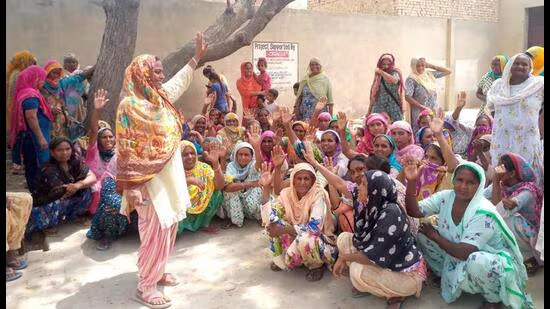
In March of this year, Enhancing Financial Inclusion and Advancement (EFInA) convened its International Women’s Month gathering under the theme, ‘Gather, Gain & Grow.’ It was a much-needed conversation focused on bridging the divide between women’s savings associations, financial regulatory agencies, development organisations, and financial service providers. This conversation highlighted an understated fact: women’s savings associations are among the most trusted and resilient sources of informal financial inclusion at different stages of a woman’s financial journey, especially for women in rural and underserved communities in Nigeria.
In Nigeria, we have the Esusu, Adashe, and Ajo models. These models have also become the defunct financial inclusion systems in regions deeply affected by conflict and the climate crisis, as formal financial providers struggle to find the business case to serve that demographic when their priorities are anchored on profitability and sustainability. According to Nigeria’s A2F (2023) survey, informal financial service providers continue to play an important role in expanding overall financial inclusion, particularly in rural agricultural areas, among women, and in the Southeastern part of Nigeria. It goes further to state that women are also more likely to rely only on informal providers compared to men. The result is a persistent gender gap in formal financial inclusion.