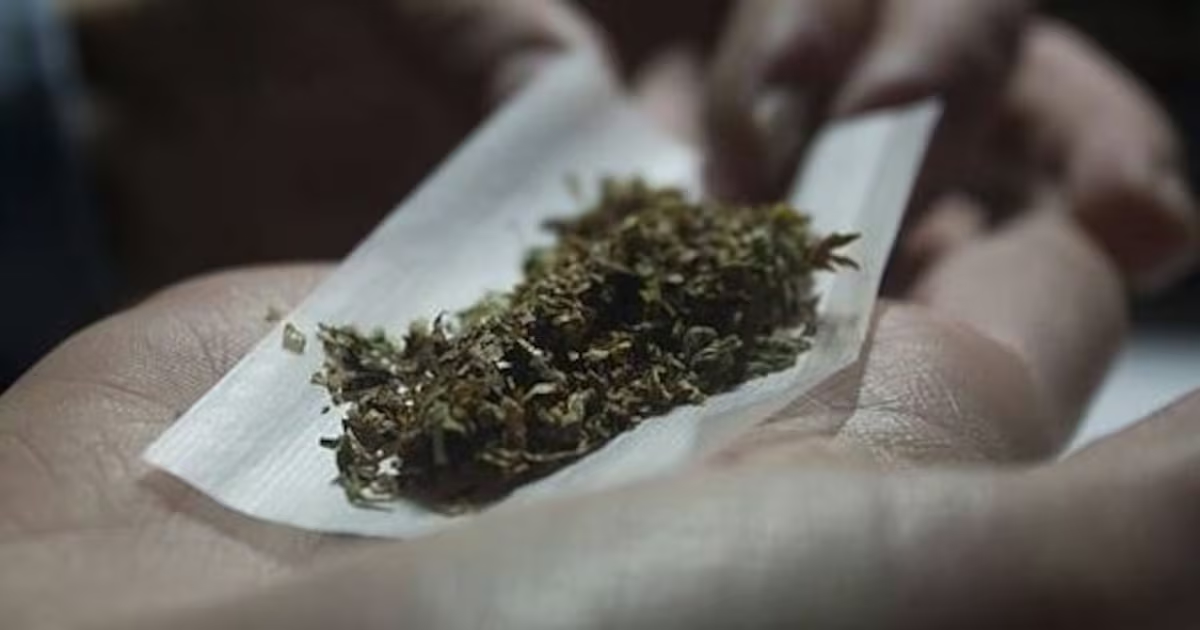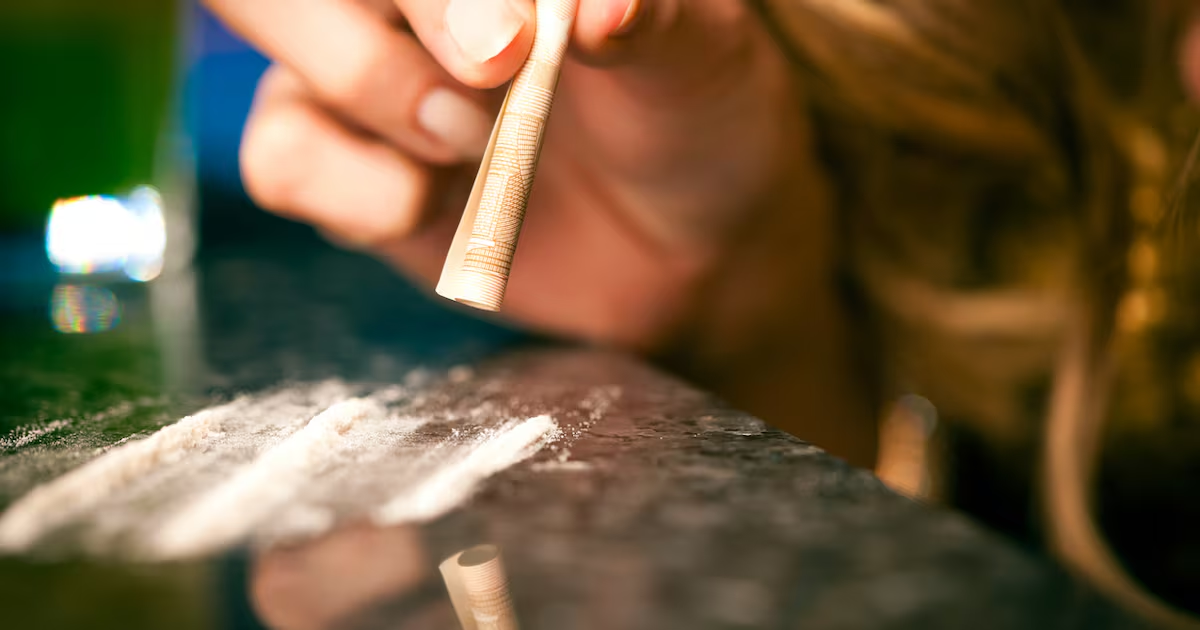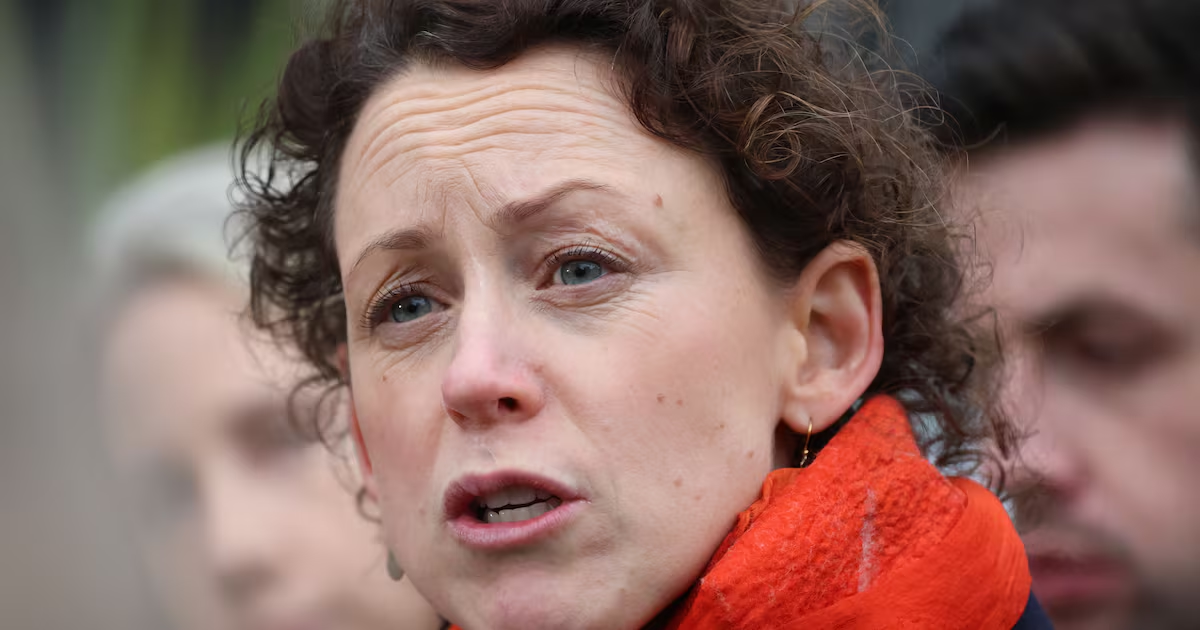
Could Ireland be poised to decriminalise the possession of all drugs for personal use?That question is now over to the Government after a cross-party Oireachtas committee recommended that it does so. As Órla Ryan, Ellen O’Riordan and Marie O’Halloran report, the Joint Committee on Drug Use has published its final report, which included 161 recommendations aimed at moving Ireland towards a health-led, rather than criminal, approach to drug possession.With decriminalisation, drugs would remain illegal but a person found in possession of them for personal use would not receive a criminal sanction.The committee was established to respond to 36 recommendations made by the Citizens’ Assembly on Drugs Use in 2024. The assembly – comprised of 99 citizens and chaired by Paul Reid, former HSE chief executive – also recommended the State ‘s give a comprehensively health-led policy response to drug use.Speaking at the presentation of the assembly’s report, Reid said the State had a “once-in-a-generation opportunity” to help people affected by addiction.Should the committee’s recommendations be acted upon by the Government, it would not be the first time the process of holding a Citizens’ Assembly followed by Oireachtas Committee scrutiny has brought about a significant change in policy. This was the path – along with a subsequent referendum – that ultimately saw the repeal of the Eighth Amendment on abortion. Social Democrats TD Gary Gannon, chair of the Joint Committee on Drugs Use, said the decriminalisation of drugs for personal use was “not a softening of the State’s resolve on drugs; it is a more honest and more effective use of it”.Gannon said criminalising people for their own drug use “has not reduced harm” and “a different approach is both possible and overdue”.Fianna Fáil Senator Mary Fitzpatrick, the committee vice-chair, said the nature of drug use in Ireland “has changed completely” in the last 20 years.“Where once it was often associated with heroin use in disadvantaged and marginalised communities, today we are dealing with widespread poly-substance use. Cocaine, cannabis, prescription drugs and new substances are now present in every county – in villages, towns and cities alike.”Indeed as our Health Correspondent Shauna Bowers reports elsewhere today, a leading charity in the drugs sector has said a growing number of Irish people are developing a drug addiction after using substances to ease social anxiety or nervousness.On Wednesday, Labour Party MEP Aodhán Ó Ríordáin – a former junior minister with responsibility for drugs – was optimistic about the chances of the committee’s report being acted upon. “We’ve been here before, there have been reports before, but this feels different,” he said. “It feels like a moment, and it feels that finally the war on drugs, which is effectively a war on people, has ended, and we’re going to have a much more human-focused and health-focused approach to the issue of addiction.“Today we had representatives from all political movements uniting on this issue, and I think now it’s time for Government to seize this moment and finally decriminalise the drug user.” So how has the Government responded to the committee’s report?With caution, so far.Speaking about the report in the Dáil on Wednesday, Taoiseach Micheál Martin said the State had “moved to a health-led approach in terms of drug addiction”. The approach “hasn’t been a criminal response in the main”, he said, but “very serious consideration” will be given to the report.Minister for Justice Jim O’Callaghan said he believed Ireland should be “very careful” about making legal changes that could increase the incidence of drug taking.He said he would consider the report but also noted how Canada’s British Columbia province recently ended its decriminalisation of drugs for personal use and said there was “widespread recognition” that legalisation of drugs in parts of the US had “simply increased” the incidence of drug taking.“We need to have a consistent message for young people; drugs damage and destroy people’s lives,” he said.It could be some time before we learn whether the committee’s recommendations are to be acted upon. The ‘heat dome’ lands on our headsOur lead story today is on the punishing heatwave that has swept across Europe, during which temperatures have climbed to unprecedented highs. Ireland is bracing for the hottest day of 2026, possibly smashing a 150-year record.The weather has been “exceptional”, said meteorologist and emeritus professor at Maynooth University John Sweeney.He said there was no question the scorching weather was a direct consequence of climate change and said normal heatwaves were being “topped up by climate change. We had extreme events before but these events are climate on steroids, in a sense.”Alan O’Reilly of Carlow Weather said there were two weather stations that would be watched closely: the appropriately named Newportfurnace in Co Mayo; and Athenry in Co Galway.“It is going to be hotter in the midlands and the west as the edge of the heat dome moves over Ireland and Newportfurnace is the one many people will be looking at. That is the one to keep an eye on,” he said.In her political sketch Miriam Lord writes that “the Dáil chamber is a heat dome at the best of times”.She says “Leinster House is an old building. Rather like the TDs housed in it, there is no such thing as temperature control” and “The place is boiling”.Best ReadsElsewhere on the front page Ellen Coyne outlines how the head of a prestigious Irish-American scholarship has accused the Government of engaging in a “baseless whispering campaign” designed to scupper its chances of raising private funds.Government TDs are seeking extra scrutiny of legislation removing the three-day waiting period for abortion services due to fears of a backlash from voters over it being “railroaded” through the Dáil. Jack Horgan-Jones reports.Coyne has a story about how Minister for Finance Simon Harris has enlisted the help of social media influencers and online money coaches to explain his upcoming savings and investment plan to the public.On Wednesday’s Inside Politics podcast Political Editor Pat Leahy talks to Jack Horgan-Jones and Jack Power about Ireland taking over the presidency of the EU Council next week. It can be found here. PlaybookTánaiste and Minister for Finance Simon Harris will take parliamentary questions in the Dáil from 8.47am. Next up is Minister for Housing James Browne at 10.23am.Leaders’ Questions is at noon.Government Business at 1.52pm is a second-stage debate on legislation related to strategic gas reserve.There is an opportunity for TDs to ask topical questions at 5.26pm.Proposed legislation from the Labour Party on child sexual abuse proceedings against unincorporated bodies or persons will be debated at 6.26pm.The Offences Against the State Act – the legislation that underpins the non-jury Special Criminal Court, which handles terrorism and gang cases – is up for renewal and is due to be debated in the Seanad at 11.30am. Legislation for setting up a domestic violence judgments register will be considered by Senators from 12.45pm.The Committee on Higher Education will be examining sexual violence and harassment policies and procedures in higher education institutions from 9.30am.The Dáil’s Public Accounts Committee will hear from the board of Beaumont Hospital on the hospital’s 2024 financial statements from 10.30am.Committee-stage consideration of the Government’s Occupied Territories Bill aimed at banning the import of goods from illegal Israeli settlements on Palestinian land will continue at the Committee on Foreign Affairs from 3.30pm.The full Dáil, Seanad and committee schedules can be found here.
Is decriminalisation of drug possession on the way?
A ‘once-in-a-generation opportunity’ to help people with addiction; and ‘climate on steroids’
1,216 words~6 min read