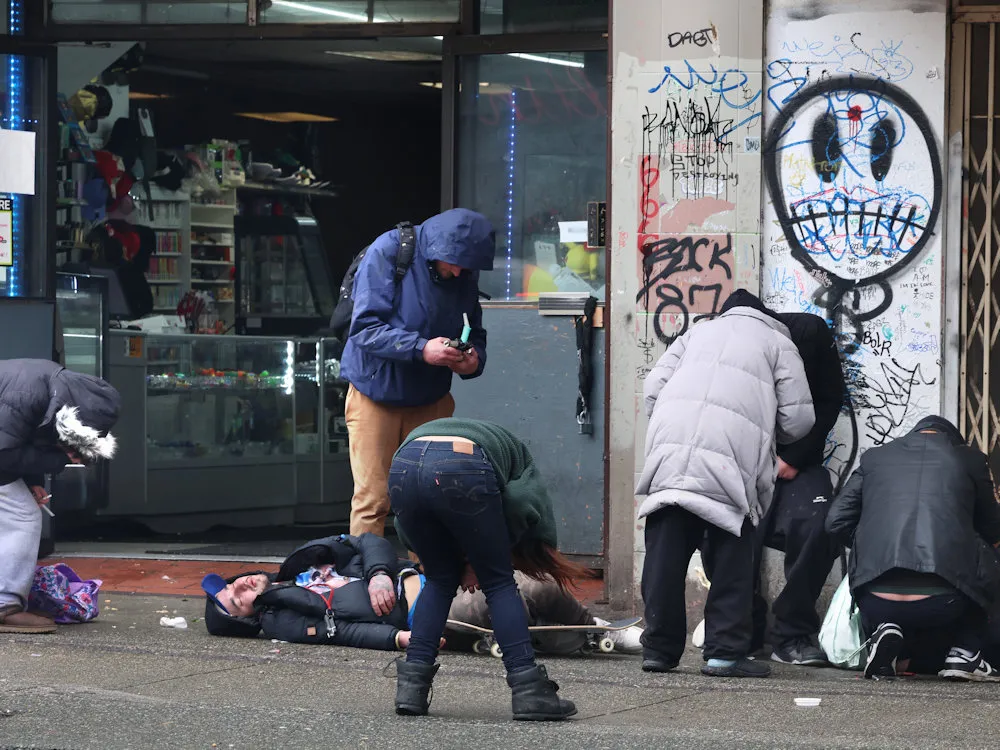
Skip to Content Subscribe Our Offers My Account Manage My Subscriptions FAQ Newsletters Canada Canadian True Crime Canadian Politics Health World Israel & Middle East Financial Post NP Comment Longreads Puzzmo Diversions Comics NP News Quiz New York Times Crossword Horoscopes Life Eating & Drinking Style Sponsored Play for Ontario Travel Travel Canada Travel USA Travel International Cruises Travel Essentials Culture Books Celebrity Movies Music Theatre Television Business Essentials Advice Lives Told Tails Told Shopping Buy Canadian Home Living Outdoor Living Kitchen & Dining Tech Style & Beauty Personal Care Entertainment & Hobbies Gift Guide Travel Guide Amazon Prime Day Deals Savings National Post Store More Sports Hockey Baseball Basketball Football Soccer Golf Tennis Driving Vehicle Research Reviews News Gear Guide Obituaries Place an Obituary Place an In Memoriam Classifieds Place an Ad Celebrations Working Business Ads Archives Healthing Epaper Manage Print Subscription Profile Settings My Subscriptions Saved Articles My Offers Newsletters Customer Service FAQ Newsletters Canada World Financial Post NP Comment Longreads Puzzmo Diversions Life Shopping Epaper Manage Print Subscription HomeNP CommentFIRST READING: Recriminalizing drugs might have something to do with B.C.'s falling overdose rateThe introduction of decriminalization, on the other hand, directly precipitated one of the world's worst spikes in overdose deaths You can save this article by registering for free here. Or sign-in if you have an account.Street drug use in the 200 block of E. Hastings St in the Downtown Eastside as the city prepares for the 2026 World Cup, in Vancouver, B.C., March 13, 2026. Photo by NICK PROCAYLO/PNGFirst Reading is a Canadian politics newsletter curated by the National Post’s own Tristin Hopper. To get an early version sent directly to your inbox, sign up here.Enjoy the latest local, national and international news.Exclusive articles by Conrad Black, Barbara Kay and others. Plus, special edition NP Platformed and First Reading newsletters and virtual events.Unlimited online access to National Post.National Post ePaper, an electronic replica of the print edition to view on any device, share and comment on.Daily puzzles including the New York Times Crossword.Support local journalism.Enjoy the latest local, national and international news.Exclusive articles by Conrad Black, Barbara Kay and others. Plus, special edition NP Platformed and First Reading newsletters and virtual events.Unlimited online access to National Post.National Post ePaper, an electronic replica of the print edition to view on any device, share and comment on.Daily puzzles including the New York Times Crossword.Support local journalism.Create an account or sign in to continue with your reading experience.Access articles from across Canada with one account.Share your thoughts and join the conversation in the comments.Enjoy additional articles per month.Get email updates from your favourite authors.Create an account or sign in to continue with your reading experience.Access articles from across Canada with one accountShare your thoughts and join the conversation in the commentsEnjoy additional articles per monthGet email updates from your favourite authorsSign In or Create an AccountorWhen B.C. Provincial Health Officer Bonnie Henry was asked last week why the province’s overdose deaths were suddenly in steep decline, she answered that “multiple factors” were responsible.Fewer teens were doing drugs. There was greater public awareness of what a drug overdose looked like. And there was “expanded access to health and social supports,” according to a report in the Times Colonist. Henry also cited the availability of the anti-overdose medication Naloxone, despite the fact that it has been distributed free since 2017.This newsletter from NP Comment tackles the topics you care about. (Subscriber-exclusive edition on Fridays)By signing up you consent to receive the above newsletter from Postmedia Network Inc.We encountered an issue signing you up. Please try againThe one factor Henry didn’t seem to mention was how the falloff in drug deaths had tracked pretty closely with the end of a program she had enthusiastically supported, and whose cancellation she had publicly mourned.That would be drug decriminalization, an experimental three-year policy whose introduction just happened to correspond with a surge in fatal overdoses unmatched in Canadian history. And whose end just happened to correspond with a sharp decrease in drug deaths.According to critics who opposed decriminalization the entire time, the numbers show that there was an obvious cost in lives to be paid for Canada’s three-year experiment in letting meth, fentanyl and other illicit drugs run rampant.“I fought hard along with others to end the NDP’s drug decriminalization & ‘safe supply’ experiments and to move towards recovery because it’s the right thing to do,” B.C. Conservative MLA Elenore Sturko wrote in a statement earlier this month.“Now, overdose deaths have dropped by a third in B.C. over the past year, a period that coincides with the NDP ending those very drug experiments,” wrote Sturko.I fought hard along with others to end the NDP's drug decriminalization & "safe supply" experiments and to move towards recovery because it’s the right thing to do.They accused us of increasing stigma. They said we were spreading misinformation.Now, overdose deaths have… pic.twitter.com/xmR2SjP6hA— Elenore Sturko (@elenoresturko) June 16, 2026Beginning on Jan. 31, 2023, drug users in B.C. no longer faced arrest or criminal consequences if they were carrying less than 2.5 grams of heroin, fentanyl, meth or any of the other illicit drugs covered by the Controlled Drugs and Substances Act.What’s more, there were now virtually no consequences for doing those drugs in public. For anyone shooting heroin outside a grocery store or smoking meth in a public park, all police could do was suggest they pursue “available health and social supports, as well as local treatment and recovery options.”The program was launched under the slogan “decriminalizing people who use drugs,” with British Columbians being assured that it would reduce the “barriers and stigma” regarding drug use.That’s exactly what it ended up doing — and it’s what B.C. Premier David Eby would cite in ultimately declaring the project a failure.In a November speech to the Urban Development Institute, Eby said decriminalization became “a permissive structure” that taught drug users “it was OK to use drugs anywhere.”“I was wrong on decriminalization and the effect that it would have,” he wrote.This month, B.C. Chief Coroner Dr. Jatinder Baidwan reported that in the month of April, 119 people died of what the province officially classifies as “suspected unregulated drug toxicity.”The prior April — when B.C. was still subject to decriminalization — the death toll was 174. Across the two Aprils, the rate of fatal overdoses went down by 31 per cent.March also showed a dropoff in fatal overdoses as compared to the decriminalization era, although not as sharply. A total of 135 people died, compared to 143.But the falling trend lines are almost the exact opposite of what was seen upon decriminalization’s introduction.In 2023, the first year of the decriminalization pilot project, overdose deaths surged to 2,511 – 10 per cent higher than the 2,272 tracked the year prior.Even in a province that had been posting some of the world’s highest rates of fatal drug overdoses for nearly a decade, this was an unprecedented high.A report by the BC Coroner blamed the surge on “unregulated fentanyl,” didn’t mention the new decriminalization regime and said the province’s various harm reduction programs were working fine.This included the then policy of safer supply, a B.C. program of handing out free recreational opioids to addicts in the belief that it would steer them away from the black market.“There is no indication that prescribed safer supply is contributing to unregulated drug deaths,” read the statement.The counterargument to the view that decriminalization led to higher levels of fatal drug overdoses is that similar trends were witnessed in Canada’s other nine provinces, none of whom followed the B.C. lead on decriminalization.Almost everywhere in Canada, drug overdoses hit all-time highs in 2023, and have been in sharp decline ever since.This includes Alberta, a province that not only eschewed decriminalization, but was already several years into a program emphasizing treatment and recovery as opposed to the B.C. doctrine of making illicit drug use safer and destigmatized. The year 2023 also came in as Alberta’s deadliest year for drug overdoses, with 1,867 deaths recorded.So if B.C. is seeing a dropoff in overdose deaths that is tracking with the end of decriminalization, it’s not all that different from trends seen everywhere else. Last year, for instance, Canadian drug overdose deaths plunged by 23 per cent, almost exactly in line with the 22 per cent charted in B.C.But even these numbers suggest that at its best, decriminalization did nothing to curb fatal overdoses at the precise moment they were becoming worse than ever.And at its worst, it helped ensure that B.C. would be hit harder by these trendlines than anywhere else.Even if drug overdose rates were bad everywhere in 2023, no other province could come close to the death rates being racked up in the land of decriminalization.That year, B.C.’s fatal overdoses would come in at 40.3 deaths per 100,000 population, well beyond the 26.1 deaths per 100,000 recorded in Alberta, that year’s second deadliest province.The B.C. government’s official webpage on decriminalization used to be a sprawling declaration about stigma and the “health-focused approach to substance use.”Now, it’s just a three-line obituary to the time when a Canadian province officially sanctioned open-air illicit drug use.“In 2023, the province launched the pilot program to decriminalize people who use drugs. It was intended to make it easier for people struggling with addiction to come forward for help. The exemption expired on Jan. 31, 2026 and will not be renewed,” it reads.First Reading is a Canadian politics newsletter curated by the National Post’s own Tristin Hopper. To get an early version sent directly to your inbox, sign up here. Join the Conversation This website uses cookies to personalize your content (including ads), and allows us to analyze our traffic. Read more about cookies here. By continuing to use our site, you agree to our Terms of Use and Privacy Policy.
FIRST READING: Recriminalizing drugs might have something to do with B.C.'s falling overdose rate
The introduction of decriminalization, on the other hand, directly precipitated one of the world's worst spikes in overdose deaths
1,632 words~7 min read