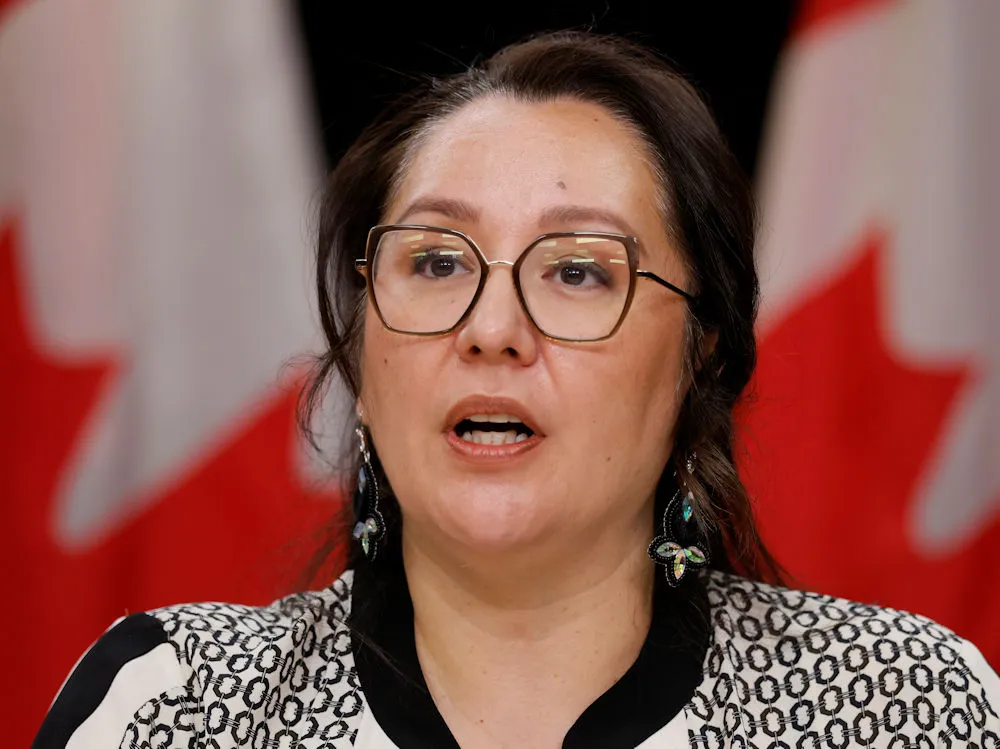
Skip to Content Subscribe Our Offers My Account Manage My Subscriptions FAQ Newsletters Canada Canadian True Crime Canadian Politics Health World Israel & Middle East Financial Post NP Comment Longreads Puzzmo Diversions Comics NP News Quiz New York Times Crossword Horoscopes Life Eating & Drinking Style Sponsored Play for Ontario Travel Travel Canada Travel USA Travel International Cruises Travel Essentials Culture Books Celebrity Movies Music Theatre Television Business Essentials Advice Lives Told Tails Told Shopping Buy Canadian Home Living Outdoor Living Kitchen & Dining Tech Style & Beauty Personal Care Entertainment & Hobbies Gift Guide Travel Guide Amazon Prime Day Deals Savings National Post Store More Sports Hockey Baseball Basketball Football Soccer Golf Tennis Driving Vehicle Research Reviews News Gear Guide Obituaries Place an Obituary Place an In Memoriam Classifieds Place an Ad Celebrations Working Business Ads Archives Healthing Epaper Manage Print Subscription Profile Settings My Subscriptions Saved Articles My Offers Newsletters Customer Service FAQ Newsletters Canada World Financial Post NP Comment Longreads Puzzmo Diversions Life Shopping Epaper Manage Print Subscription HomeNP CommentFIRST READING: Feds signal departure from 'harm reduction' approach to overdose crisis'More and more you see provinces who don’t want safe consumption sites, they want to act more on treatment,' said health ministerLast updated Jun 17, 2026 You can save this article by registering for free here. Or sign-in if you have an account.Minister of Indigenous Services Mandy Gull-Masty takes part in a press conference about federal response to the illegal drug crisis at the National Press Theatre in Ottawa June 15, 2026. Photo by Photo by Blair Gable/PostmediaFirst Reading is a Canadian politics newsletter curated by the National Post’s own Tristin Hopper. To get an early version sent directly to your inbox, sign up here.Enjoy the latest local, national and international news.Exclusive articles by Conrad Black, Barbara Kay and others. Plus, special edition NP Platformed and First Reading newsletters and virtual events.Unlimited online access to National Post.National Post ePaper, an electronic replica of the print edition to view on any device, share and comment on.Daily puzzles including the New York Times Crossword.Support local journalism.Enjoy the latest local, national and international news.Exclusive articles by Conrad Black, Barbara Kay and others. Plus, special edition NP Platformed and First Reading newsletters and virtual events.Unlimited online access to National Post.National Post ePaper, an electronic replica of the print edition to view on any device, share and comment on.Daily puzzles including the New York Times Crossword.Support local journalism.Create an account or sign in to continue with your reading experience.Access articles from across Canada with one account.Share your thoughts and join the conversation in the comments.Enjoy additional articles per month.Get email updates from your favourite authors.Create an account or sign in to continue with your reading experience.Access articles from across Canada with one accountShare your thoughts and join the conversation in the commentsEnjoy additional articles per monthGet email updates from your favourite authorsSign In or Create an AccountorDespite a longtime Canadian strategy of addressing record-high overdoses predominantly through “harm reduction,” a Carney government official revealed this week that the population hardest hit by drug overdoses is mostly asking for ways to get clean.“In almost every single meeting I’ve had this year, leadership has indicated to me that treatment centres are one of their big capital asks,” Indigenous Services Minister Mandy Gull-Masty told a Monday press conference on Parliament Hill.The press conference was an update on an illegal drug crisis that continues to hit Canada harder than almost any other country on earth. As per figures tracked by the Commonwealth Fund, Canada is second only to the U.S. in its rate of fatal overdoses.And as Gull-Masty noted on Monday, this has disproportionately impacted Indigenous communities, with more than 10 per cent of all Canadian First Nations having enacted states of emergency related to the drug crisis“There are presently 67 First Nations that have declared states of emergency in relation to drugs,” she said.Particularly over the last decade, harm reduction — the notion of making it safer to consume illicit drugs without dissuading their use — has been at the centre of Canada’s response to sky-high rates of fatal overdose.This newsletter from NP Comment tackles the topics you care about. (Subscriber-exclusive edition on Fridays)By signing up you consent to receive the above newsletter from Postmedia Network Inc.We encountered an issue signing you up. Please try againSafe consumption sites, once exclusively in Vancouver’s Downtown Eastside, were opened in every Canadian time zone. Low-barrier shelters became a feature of every major Canadian urban core.Government agencies massively expanded the availability of free drug paraphernalia, including syringes, crack pipes and “safer snorting kits.”And in B.C., provincial officials experimented both with regimes to decriminalize the possession of illicit drugs, as well as a “safer supply” program distributing free recreational opioids to addicts.In 2023, B.C. Provincial Health Officer Bonnie Henry would even publish a report recommending the expansion of “safer supply” drugs into First Nations communities, including “smokeable” varieties of fentanyl.“Without harm reduction services, more people will die,” one Liberal MP, Élisabeth Brière, told the House of Commons as recently as 2024. “Harm reduction is health care,” another Liberal MP, Ya’ara Saks, told a parliamentary committee around the same time.The reaction from overdose-wracked Indigenous communities has generally been a bit more hardline than that of provincial or federal health authorities.Multiple First Nations communities across Ontario, B.C. and the Prairies, for instance, have pursued banishment orders against residents engaged in the illicit drug trade.Ontario’s Pic Mobert First Nation is now one of several with signs at community entrances warning visitors that they may be asked for identification on suspicion of being drug traffickers.On Monday, Gull-Masty would focus almost entirely on efforts to treat and prevent Indigenous drug use, rather than manage and contain it.She said there are now 83 sites in First Nations communities across the country offering opioid agonist treatment — the use of medications such as methadone to taper addicts off an opioid addiction.She also cited the opening of four new drug treatment centres, including one on the territory of the James Smith Cree Nation, the Saskatchewan First Nation that suffered a drug-fuelled mass stabbing attack in 2022.Monday’s press conference would also see federal officials acknowledge a generalized Canadian retreat from the doctrine of harm reduction, and safe consumption sites in particular.“More and more you see provinces who don’t want safe consumptions sites, they want to act more on treatment. I cannot force a province to put safe consumption sites in place,” health minister Marjorie Michel told the event.A backgrounder for Monday’s press conference would mention “harm reduction” just two times. Even the name of the event was a departure from prior federal messaging on the issue of fentanyl and other illicit drugs.The event was advertised as an update on the “illegal drug crisis,” rather than the preferred term of “toxic drug crisis” favoured by bodies such as the Canadian Public Health Association.The latter term being favoured as it implies that the overdose crisis is being driven by tainted drugs obtained via the black market, rather than being an outcome of the drugs themselves.When it comes to Prime Minister Mark Carney’s handling of U.S.-Canada relations, arguably one of his most provocative actions was a deal with Beijing for Canada to import 49,000 Chinese-made EVs.The prior administration of U.S. president Joe Biden had actively warned Canada away from importing Chinese EVs, even sending then U.S. national security advisor Jake Sullivan to Halifax in order to make the case in person before a federal cabinet retreat.And since Ottawa’s Chinese EV deal was struck in January, it’s become one of the few issues for which Democratic politicians have urged U.S. President Donald Trump to take a harder line on trade than he is currently pursuing.In April, 74 members of Congress, including many Democrats, petitioned Trump to ensure that Chinese EVs were strictly sanctioned in any renegotiation of free trade with Canada.“Chinese automobiles could establish a foothold in Canada and seek to move into the United States market, and these trends create a clear and urgent risk that Chinese automakers are looking to use Canada and Mexico as a backdoor into the United States under the United States-Mexico-Canada Agreement (USMCA),” it read.So it’s perhaps to be expected that when Carney and Trump were recorded speaking to each other at the G7 summit in France, the topic was Chinese EVs.Carney was heard on a hot mic referring to the cars as “less than three per cent of our market” and “a cap; I thought you’d actually like that.”“That’s good, I like it,” replied Trump.The U.S. case against Chinese EVs — which, again, has been made more forcefully by Trump’s rivals than by Trump himself — is that they’re heavily subsidized by Beijing and thus threaten to undermine the U.S. EV sector. And also that they pose a unique national security risk in that there would be no way to guard against them being used as mobile surveillance platforms for the People’s Republic of China.First Reading is a Canadian politics newsletter curated by the National Post’s own Tristin Hopper. To get an early version sent directly to your inbox, sign up here. Join the Conversation This website uses cookies to personalize your content (including ads), and allows us to analyze our traffic. Read more about cookies here. By continuing to use our site, you agree to our Terms of Use and Privacy Policy.
FIRST READING: Feds signal departure from 'harm reduction' approach to overdose crisis
“More and more you see provinces who don’t want safe consumption sites, they want to act more on treatment," said health minister
1,557 words~7 min read