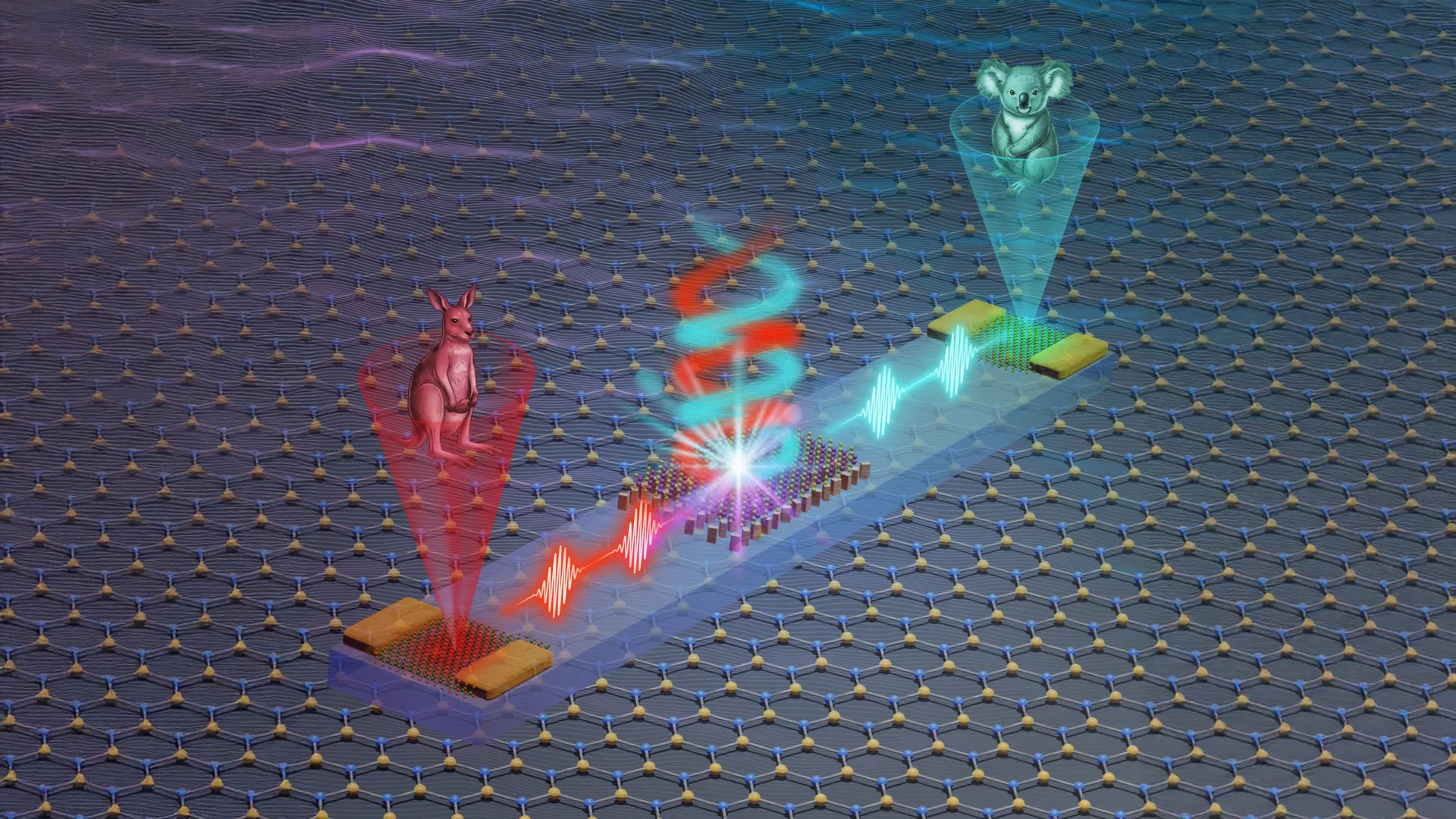
Electric fields control the flow of charge in modern electronic chips, powering computers, smartphones and other devices. But as chips continue to shrink, this approach is reaching its physical limits.
Now, a team led by researchers at the UCLA Samueli School of Engineering has shown that a small electric signal could trigger a response more than 100 times larger than what is typically observed in conventional electronic materials, potentially opening a path toward smaller, more energy-efficient devices.
Published in Nature Electronics, their study revealed a new way to control electricity using a quantum-like collective state of matter known as a charge-density-wave, in which electrons move together in a synchronized pattern rather than independently.
The researchers built prototype devices just a few nanometers thick using crystals of tantalum trisulfide, a material that naturally hosts charge-density waves. By combining advanced nanofabrication techniques with radio-frequency measurements, they directly observed the collective motion of electrons and measured how strongly the electronic state responded to an applied electric field.
“Our research reveals an unexpected amplification effect that emerges when electrons act collectively rather than individually,” said study co-corresponding author Alexander Balandin, the Fang Lu Professor in Engineering and a distinguished professor of materials science and engineering at UCLA Samueli. “This suggests a new strategy for controlling electricity in future devices.”