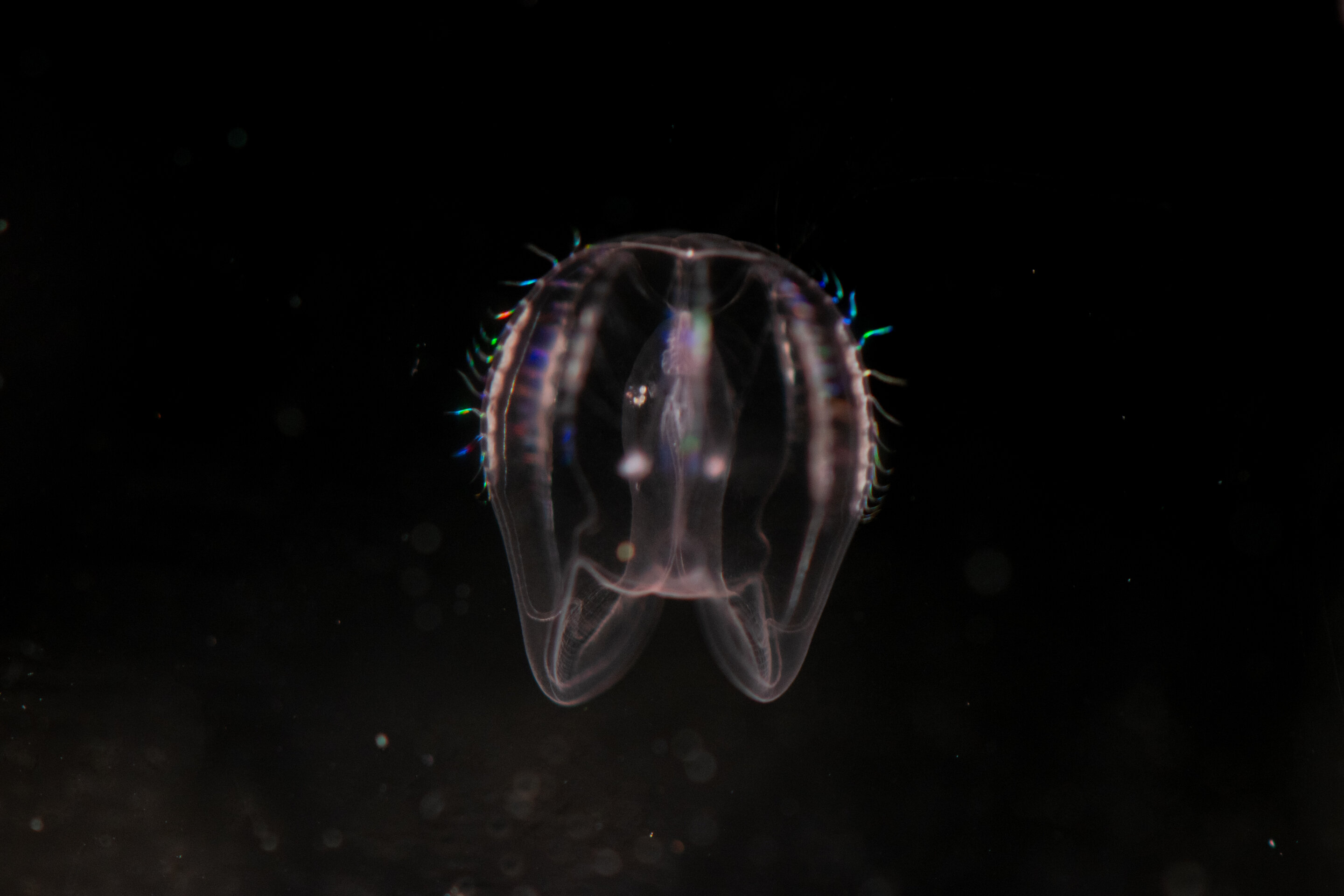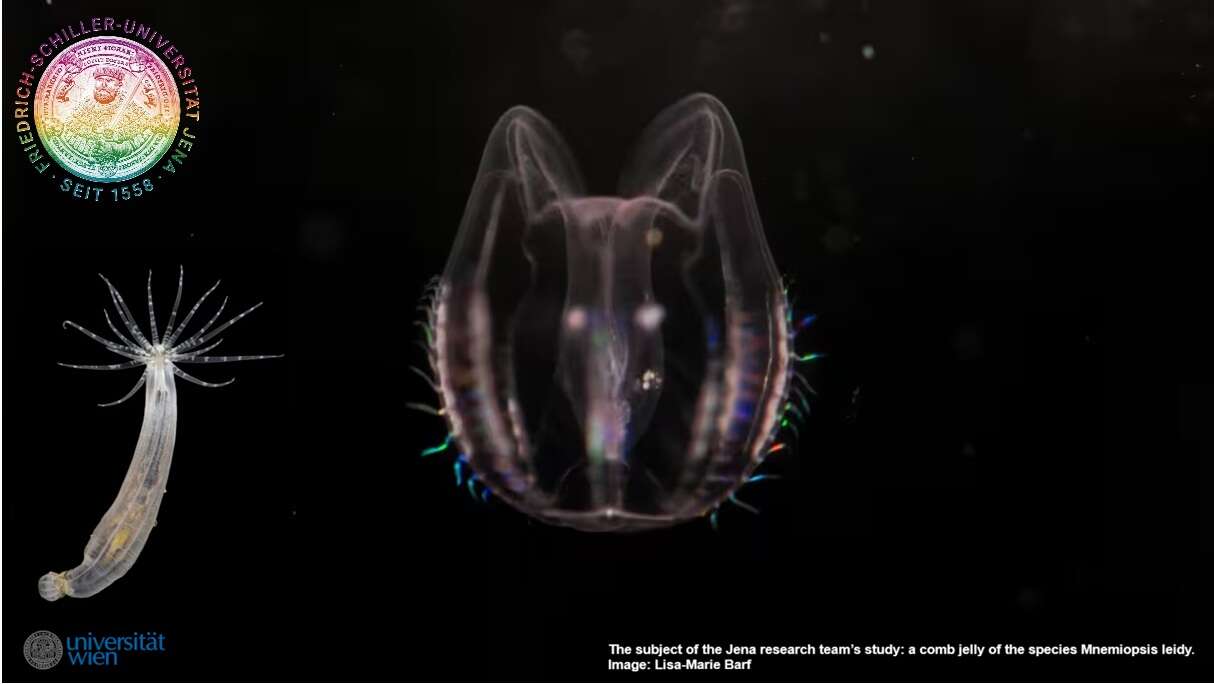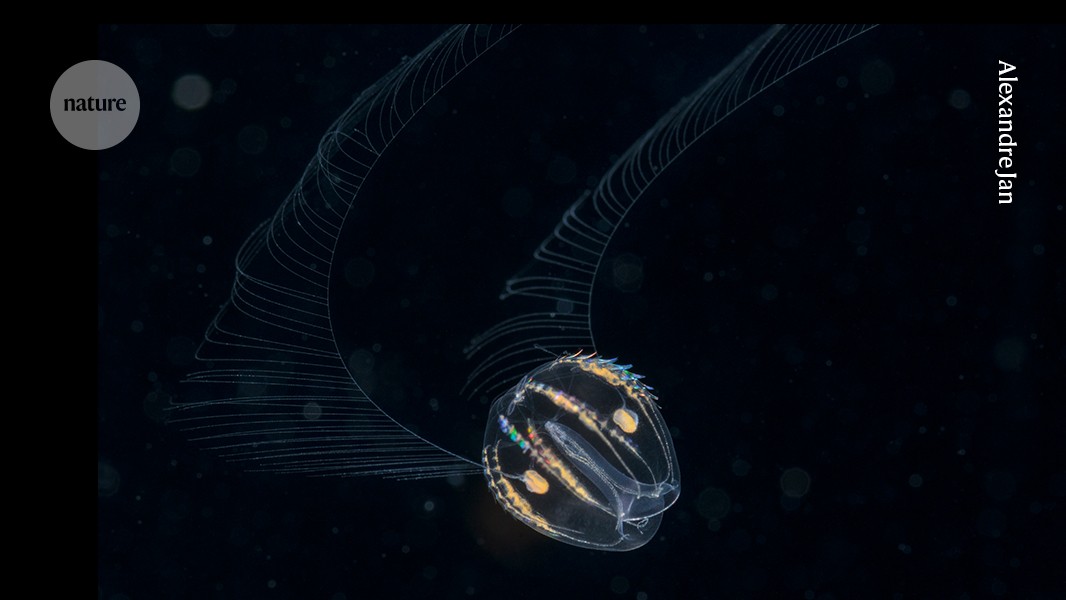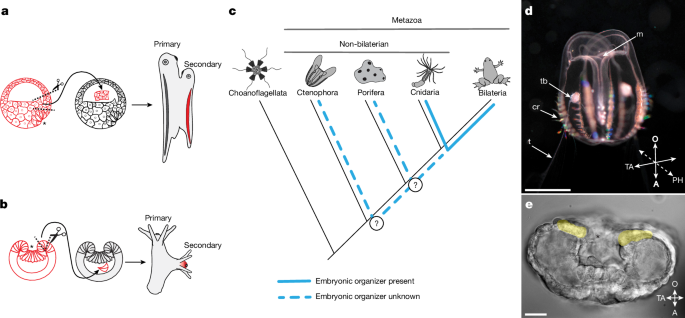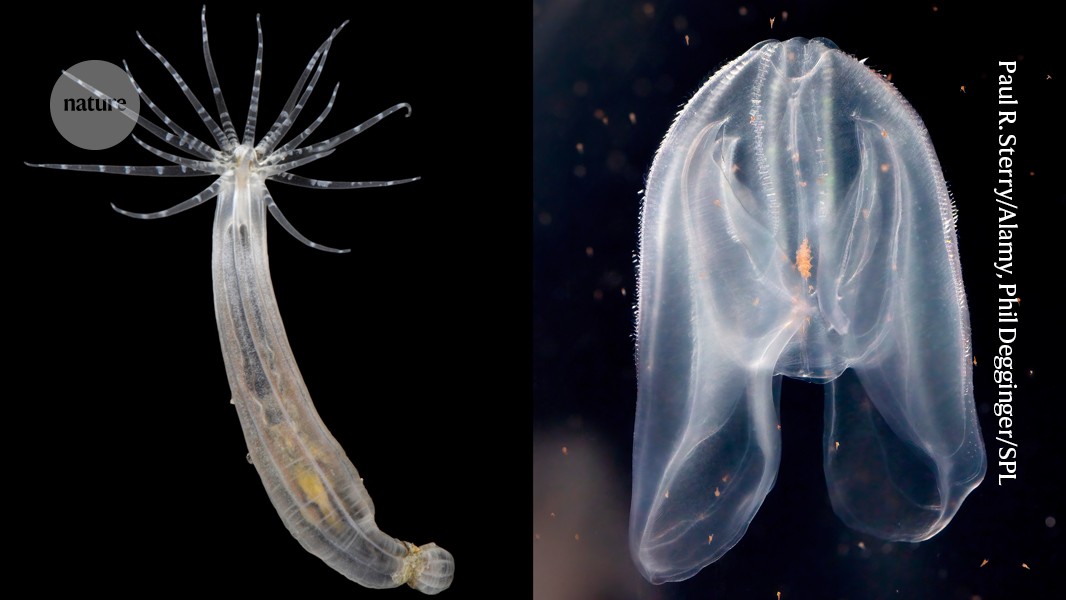
Researchers transplanted cells between embryos of a comb jelly (Mnemiopsis leidyi, right) and a starlet sea anemone (Nematostella vectensis, left).Credit: Paul R. Sterry/Nature Photographers Ltd/Alamy, Phil Degginger/Science Photo LibraryMore than a century ago, embryologist Hilde Mangold conducted a strange experiment that transformed biology. As a PhD student in the 1920s, she moved a lump of cells from embryos of one newt species into another. The transplanted cells caused a secondary ‘body axis’ to form in the host embryo, complete with a nervous system and a precursor to the spine. Mangold showed that much of the secondary body axis developed from the recipient embryo tissues.The discovery of an embryonic ‘organizer’ that orchestrates the formation of a body axis “established a whole new area of developmental biology”, says Stanislav Kremnyov, a developmental biologist at the Friedrich Schiller University Jena in Germany, who is now following in Mangold’s footsteps. In a study published in Nature this week1, Kremnyov and his colleagues report the discovery of an embryonic organizer in marine predators called comb jellies (Ctenophora) and their successful transplantation into sea anemones (Cnidaria) — which belong to an entirely different phylum — forming extra mouths and pharynxes.Many scientists think comb jellies belong to the earliest branch of the animal family tree. Kremnyov and his colleagues argue the appearance of an organizer helped transform single-celled organisms into animals.“I’m really excited to see this,” says Ulrich Technau, an evolutionary developmental biologist at the University of Vienna. But not all scientists are convinced by the claims.Building a second bodyMangold died tragically in 1924 in a home gas explosion,but the discovery garnered her supervisor, Hans Spemann, the 1935 Nobel Prize in Physiology or Medicine.Spemann’s laboratory became the centre of the developmental biology world, attracting leading scientists to probe the organizer and look for similar capabilities in other developing tissues.Ancient sea jelly makes tree of life wobble“They did insane things,” says Kremnyov, transplanting tissue from snails and mouse kidneys into frog embryos, showing that these, too, possessed organizational activity. Later, in the 1980s and 1990s, scientists uncovered the molecular basis for organizers: signalling molecules known as morphogens.Kremnyov says that that organizer cells and the morphogens they release act like a construction foreman in the developing embryo, telling “the cells what they have to do and what they have to build”.Research into the organizer has been focused mostly on vertebrates. But in 2007, a team led by Technau discovered such cells in the embryos of starlet sea anemones (Nematostella vectensis)2, which belong to an animal lineage that diverged after that of comb jellies. The findings raised questions about the evolutionary origins of the organizer.“Until our work, it was not known when it emerged,” says Kremnyov.Hilde Mangold, shown here holding her baby, discovered embryonic ‘organiser cells' in 1924 during her PhD.Credit: Science Source/Science Photo LibraryTwo mouthsKremnyov’s supervisor and study co-author, developmental biologist Andreas Hejnol at the Friedrich Schiller University Jena, maintains a menagerie of unusual invertebrates — including sea anemones, penis worms and flatworms — that he calls a microzoo. When he joined the lab, Kremnyov added a comb jelly (Mnemiopsis leidyi).What were the first animals? The fierce sponge–jelly battle that just won’t endM. leidyi are highly fecund and lay transparent embryos daily. While examining M. leidyi, Kremnyov observed the formation of embryo structures called blastopores — the location of the embryonic organizer in other animals. “I saw the blastopore — and what I wanted to do was just transplant it.” The structures appear during a process called gastrulation, which occurs hours after fertilization in comb jellies.
Cell transplant across the tree of life hints at how animals emerged
Embryonic ‘organizer cells’ can tell embryos of various phyla what kind of body to build.
587 words~3 min read