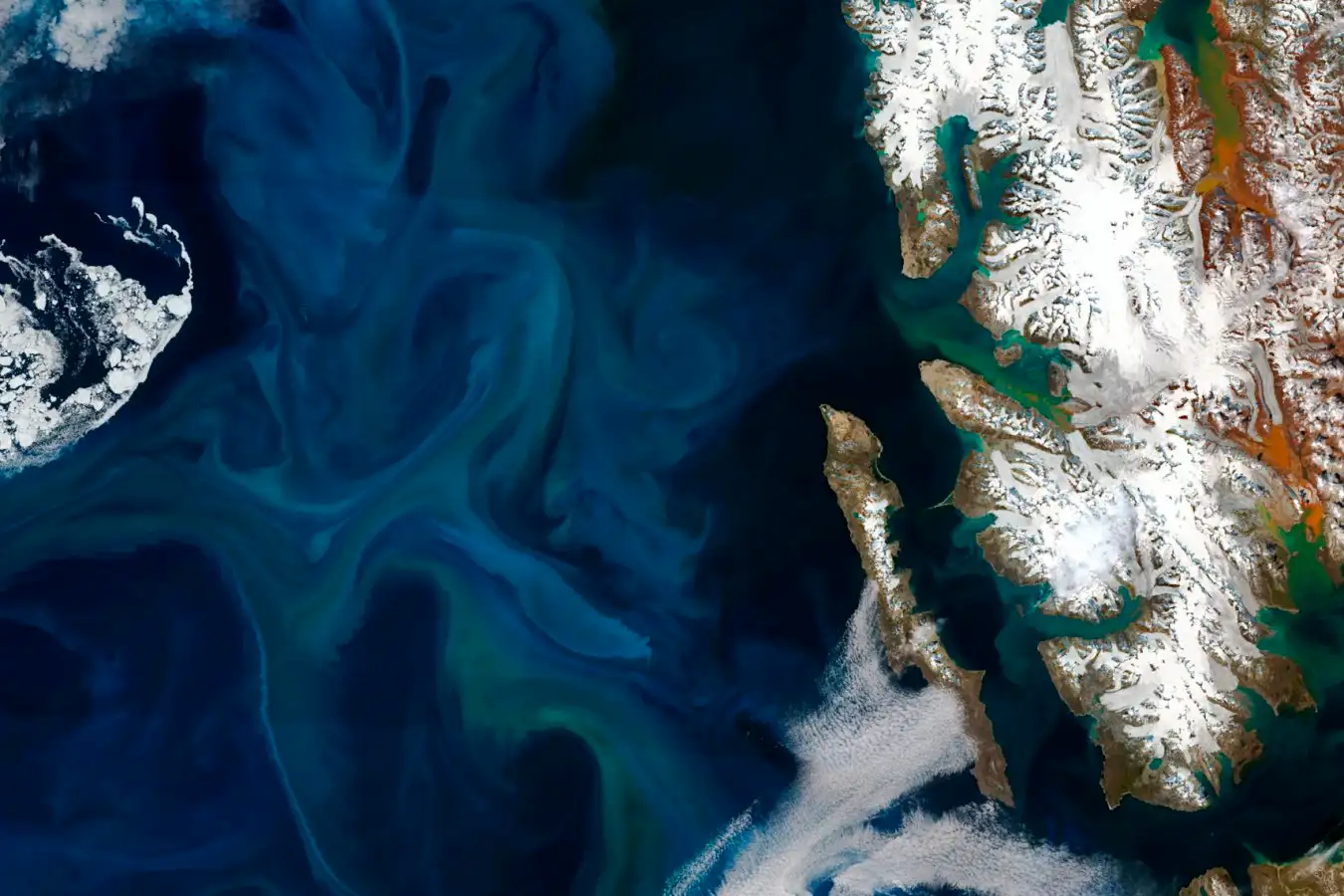
A phytoplankton bloom in the Arctic Ocean near Svalbard gives the sea a green hue visible in satellite imagesEuropean Union, Copernicus Sentinel-2 imagery
As sea ice melts, more light will infiltrate the Arctic Ocean, allowing phytoplankton and other marine life to flourish – or so we thought. In fact, phytoplankton growth in some parts of the Arctic is now starving other parts of a crucial nutrient, a tipping point that could spell trouble for seals, polar bears and even commercial fish in the north Atlantic.
Phytoplankton, the tiny photosynthesising organisms that form the basis of the marine food chain, have been increasing across the Arctic, according to satellite measurements of the green pigment chlorophyll. Algal blooms there have broken records.
But since 2009, overall phytoplankton growth has slowed in many areas and has even begun decreasing on the Atlantic side of the Arctic. New research by Raja Ganeshram at the University of Edinburgh, UK, and his colleagues suggests blooming phytoplankton on the Pacific side are depriving neighbouring areas of nitrate, a chemical that’s vital for growth.
Arctic warming “is not just a reduction in sea ice and temperature; it is more than that. It’s having an effect on the ecosystem,” says Ganeshram. “This has impacts on our food resources in ways that we don’t fully understand, both within the Arctic as well as in the north Atlantic, at our doorstep.”