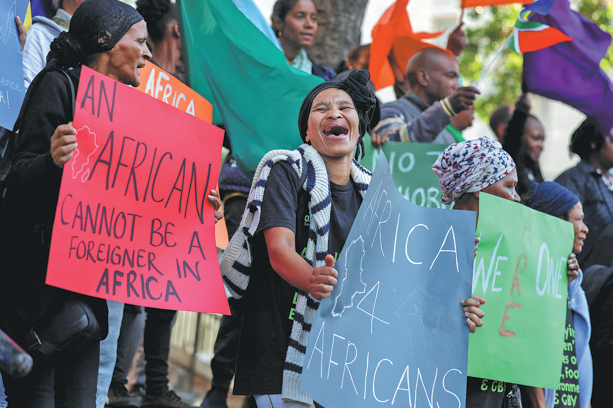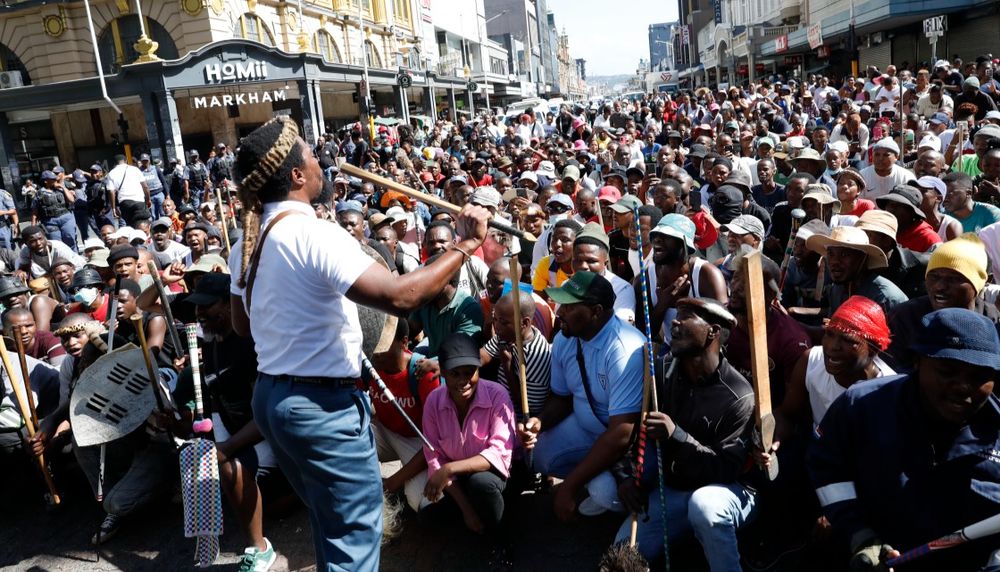
South Africans have always had a flair for declaring things over before the evidence has fully arrived: the economy is finished, politics is broken beyond repair, education is beyond rescue, and hope has packed its bags and left for Perth.Against the backdrop of public anger, communities turning on one another and a deepening struggle over jobs, services and dignity, a new phrase has entered the national vocabulary: “Ubuntu is suspended.” It arrives alongside a debate about immigration that is legitimate in its concerns but increasingly ugly in its expression.At the heart of Ubuntu is something simpler yet more demanding than policy: love. Not romantic love, nor naïve love, but the sort that looks at a frightened neighbour, whatever side of the border they were born on, and refuses to stop seeing a person.The anxieties in South African communities are not invented. Families competing for the same few jobs, the same clinic appointment, and the same space in an overcrowded school are not wrong to feel the strain. Frustration born from genuine scarcity deserves to be heard, not dismissed as bigotry. The danger is not the anxiety itself. It is when that anxiety is harvested by those who prefer a scapegoat to a solution.Equally real are the families on the other side of the border: the mother in Johannesburg worried about her child’s school place and the mother in Harare worried about whether her son arrived safely are both acting out of love. That is the shared ground. It does not dissolve the tension, but it is where any honest conversation can begin.This is not an argument against immigration law. Every country has the sovereign right to manage its borders, and South Africa is no exception. But there is a profound difference between policy and cruelty, between lawful repatriation and humiliation. Ubuntu does not require us to abandon rules; it requires us to carry them out with dignity.Moreover, the tension is not only between South Africans and immigrants. It runs through South Africa itself, between provinces competing for investment, between communities demanding that jobs belong to those born within certain boundaries, and between groups whose historical wounds have never been properly dressed. What is new is the accelerant. Social media algorithms do not create division, but they are extraordinarily good at finding it, feeding it and making it feel like the only truth. A young person growing up today can spend an entire day consuming content that confirms every fear and sharpens every grievance, and the platform profits from every click. That is not an incidental feature. It is the business model.This is where leadership matters most, not only in parliament or boardrooms but also in homes, congregations, community halls and school governing bodies. The parent who refuses to let fear become the dominant language at the dinner table. The pastor or imam who creates space for honest conversation without sanctioning hatred. The community leader who holds the tension without resolving it prematurely into blame. These are acts of leadership too, and now they may be the most important ones.Youth Month gives this debate a sharper edge. Every June South Africa honours young people who refused to accept the limits imposed on them in 1976. Yet today’s young South Africans are watching a different lesson unfold in real time. They hear how adults speak about migrants, outsiders, other tribes, other races, other beliefs and those who are easier to blame than the systems that have failed. They are learning, from us, what leadership sounds like when it is frightened.That should trouble us, because the future of this country will be shaped less by what we say to young people in commemorative speeches than by what we model for them in moments of strain. We can tell them to be innovative, ethical and globally competitive, but if the society around them teaches suspicion as a survival skill and exclusion as a policy instinct, they will inherit a smaller idea of South Africa than the one for which previous generations sacrificed.This has implications way beyond our own borders, too. From the Sahel to the Horn, from the Great Lakes to the Niger Delta, the same fault lines run: people competing for work, living alongside those who look different, pray differently, and arrived differently. The question of how human beings build shared lives across difference is the defining question of this century in Europe, in America, and in every African city growing faster than its infrastructure. South Africa, for all its wounds, has lived this question more intensely and more honestly than most. That is not a weakness. It is, potentially, a form of wisdom the world needs.What are we asking of our young people? Not to pretend the competition is not real. Not to perform a harmony that papers over genuine grievance. But to imagine, seriously and ambitiously, what their South Africa could look like. The person next to them in a classroom, a boardroom, a place of worship or a community meeting will come from a different province, a different culture, a different religion, a different generation or a different gender. That will not change. It will deepen. The question is not whether they can tolerate that difference. “Tolerance” is too thin a word for what is required. The question is whether they can find, in that difference, the fuller picture of humanity that no single background can provide alone.The countries, companies and communities that are likely to thrive in the next 50 years will not be those that achieved the most sameness but the ones that learnt earliest how to turn difference into energy. Young South Africans who grow up navigating province, culture, language, faith and gender across every classroom and workplace are not disadvantaged by that complexity. They are being educated by it, if we let them be. That is South Africa’s quiet, underestimated advantage: a generation already practised in the skill the world most urgently needs.They will not learn this from algorithms. They will learn it from elders who model it in how we speak, in how we disagree, and in whether we choose conversation over contempt, even when it costs us something to do so. It is in this spirit that we convene our fourth annual Youth Leadership Summit this month, bringing together 200 young leaders representing 13 African countries, to have these uncomfortable conversations and to face one another with love.Our future does not have to be determined by slogans but by whether we are willing to do the harder thing: to hold firm on human dignity and to let love, unsentimental, disciplined, and stubbornly present, be the abiding answer. For this we need to give young people more than words of encouragement, more than skills, education and networks; we will need to give them a vision of the society worth believing in. It starts with the daily practice of Ubuntu, a choice made under pressure, an act of love repeated until it becomes culture.Foster-Pedley is dean and director of Henley Business School Africa and associate pro-vice chancellor (global engagement, Sub-Saharan Africa) for the University of Reading. Mali is CEO of Lesaka Technologies and founder of the Lincoln Mali Leadership Foundation. Henley Business School Africa and the Lincoln Mali Leadership Foundation co-host the annual Youth Leadership Summit, which takes place on June 20 this year. The authors write in their professional capacities as leaders of the co-hosting organisations. The opinions expressed are their own and do not represent the University of Reading.
JON FOSTER-PEDLEY AND LINCOLN MALI | Is Ubuntu suspended until further notice?
Leaders called to model love over fear amid rising divisions
1,245 words~6 min read