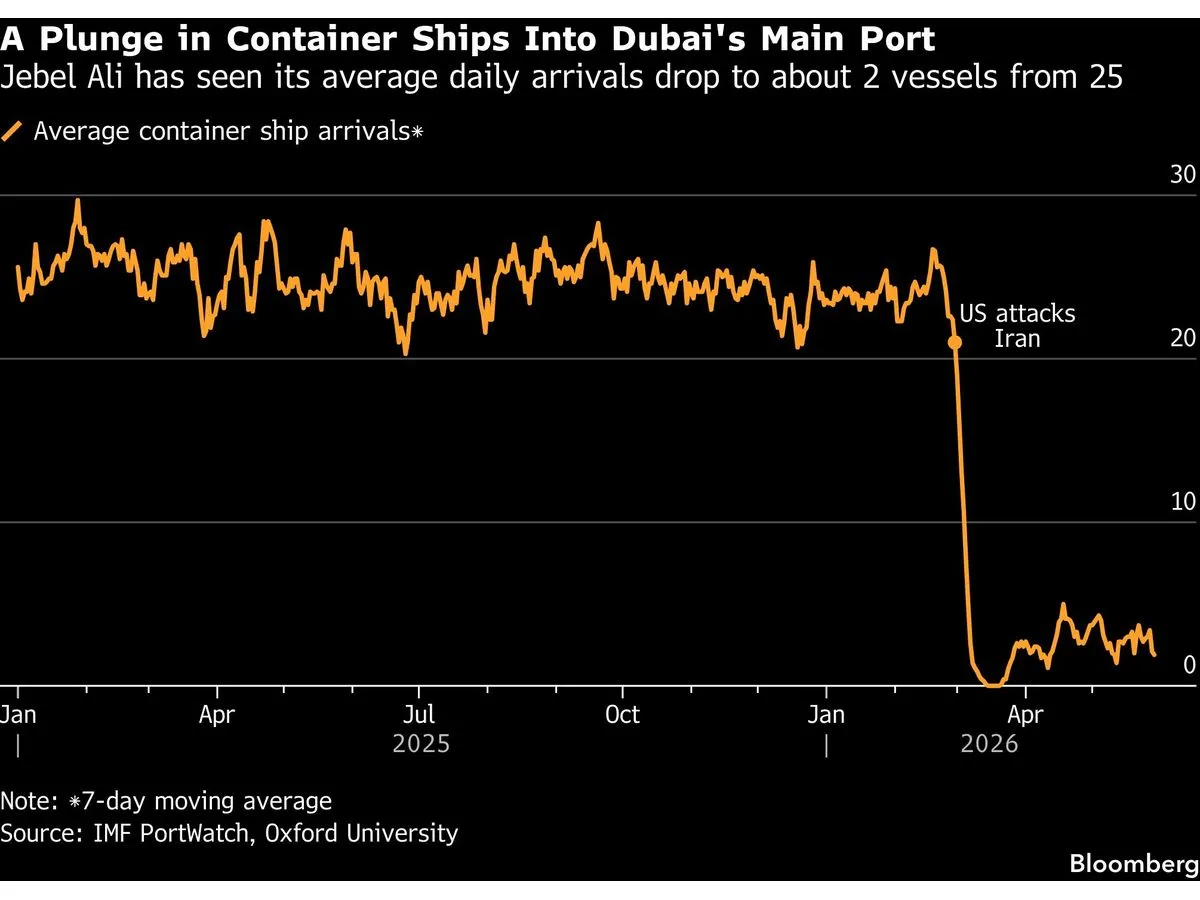
Skip to Content News Archives Economy Energy Oil & Gas Renewables Electric Vehicles Mining Commodities Agriculture Real Estate Mortgages Mortgage Rates Finance Banking Insurance Fintech Cryptocurrency Work Wealth Smart Money Wealth Management Investor Personal Finance Family Finance Retirement Taxes High Net Worth FP Comment Executive Women Puzzmo Newsletters Financial Times Business Essentials More Innovation Information Technology FP500 Podcasts Small Business Lives Told Tails Told Shopping Financial Post Store Obituaries Place a Notice Advertising Advertising With Us Advertising Solutions Postmedia Ad Manager Sponsorship Requests Classifieds Place a Classifieds ad Working Profile Settings My Subscriptions Saved Articles My Offers Newsletters Customer Service FAQ News Economy Energy Mining Real Estate Finance Work Wealth Investor FP Comment Executive Women Puzzmo Newsletters Financial Times Business Essentials HomePMN BusinessHormuz Halt Forces Middle East Trade Into Huge RewiringIn the wake of the 12-day US-Israel and Iran war a year ago, Siemens Energy AG sent a person driving from Saudi Arabia’s Red Sea port of Jeddah across the Arabian peninsula to the industrial hub of Dammam to study an alternative route in case the crucial Strait of Hormuz was shut down.Author of the article: You can save this article by registering for free here. Or sign-in if you have an account.g3wts0aji[ze4i}fhhgwh72m_media_dl_1.png IMF PortWatch, Oxford University(Bloomberg) — In the wake of the 12-day US-Israel and Iran war a year ago, Siemens Energy AG sent a person driving from Saudi Arabia’s Red Sea port of Jeddah across the Arabian peninsula to the industrial hub of Dammam to study an alternative route in case the crucial Strait of Hormuz was shut down.Subscribe now to read the latest news in your city and across Canada.Exclusive articles from Barbara Shecter, Joe O'Connor, Gabriel Friedman, and others.Daily content from Financial Times, the world's leading global business publication.Unlimited online access to read articles from Financial Post, National Post and 15 news sites across Canada with one account.National Post ePaper, an electronic replica of the print edition to view on any device, share and comment on.Daily puzzles, including the New York Times Crossword.Subscribe now to read the latest news in your city and across Canada.Exclusive articles from Barbara Shecter, Joe O'Connor, Gabriel Friedman and others.Daily content from Financial Times, the world's leading global business publication.Unlimited online access to read articles from Financial Post, National Post and 15 news sites across Canada with one account.National Post ePaper, an electronic replica of the print edition to view on any device, share and comment on.Daily puzzles, including the New York Times Crossword.Create an account or sign in to continue with your reading experience.Access articles from across Canada with one account.Share your thoughts and join the conversation in the comments.Enjoy additional articles per month.Get email updates from your favourite authors.Create an account or sign in to continue with your reading experience.Access articles from across Canada with one accountShare your thoughts and join the conversation in the commentsEnjoy additional articles per monthGet email updates from your favourite authorsSign In or Create an AccountorThe German company commissioned the person to take readings along the almost 2,000-kilometer (1,240-mile) route to compile a 250-page document analyzing whether it was possible to truck massive gas turbines across the desert to its facilities in Dammam. Less than a year later, those plans were put into action as the latest conflict and the closure of the strategic waterway forced companies to reroute supply chains to keep operations and economies running.“It adds more time, adds a bit of cost too, but it did not stop the business,” Karim Amin, head of the gas services unit of Siemens Energy, said last week.Get the latest headlines, breaking news and columns.By signing up you consent to receive the above newsletter from Postmedia Network Inc.A welcome email is on its way. If you don't see it, please check your junk folder.The next issue of Top Stories will soon be in your inbox.We encountered an issue signing you up. Please try againThe blockage of Hormuz caused one of the biggest logistics disruptions in years, sending countries and companies rushing to find bypasses to ensure availability of food, medicines and other critical material. Roadways crisscrossing Saudi Arabia, the United Arab Emirates and Oman have emerged as critical conduits, even though they can cover only part of the shipping capacity and add to both costs and time.The US and Iran have now agreed an interim agreement that should restore flows through the narrow corridor, but a return to normal trade is still months away. The two sides will meet on Friday to sign the deal but have yet to release the fine print, keeping shipowners and other logistics providers on edge.To keep shelves stocked, grocery chain Spinneys used a new route that included haulage by road to bring goods from the UK to the UAE, almost 5,000 kilometers away, according to an earnings presentation in May. DP World Ltd., one of the world’s biggest container port operators, has started using a network of roads running through the Arabian peninsula and as far away as Turkey and Iraq after the near-blockage of Hormuz cut traffic to its massive port of Jebel Ali in Dubai.“Alternative routing such as land bridges and smaller ports may be more cumbersome, but it is working,” said Peter Sand, chief analyst with Xeneta, a digital freight platform based in Oslo. “Even if the Strait of Hormuz reopens, shippers will be cautious about returning to an over-reliance on ports such as Jebel Ali because the geopolitical situation will remain fragile and a sudden deterioration puts them back to square one.”Hormuz risk means that some of the workarounds involving trucks and rail could become permanent. Spinneys plans to keep using the road-freight option to transport medium shelf-life products from Europe to the UAE.“Disruption made us move faster,” said Farid Belbouab, CEO of Gulftainer, which operates the Khor Fakkan port in eastern UAE, just outside the Persian Gulf and the Hormuz strait. “Long term, the east coast isn’t a backup — it’s core to the UAE’s trade architecture.”Gulftainer plans to link its Al Dhaid Dry Port, which is 50 kilometers from Khor Fakkan, with its expanded Sajaa Dry Port closer to Dubai that will create one continuous corridor. “We’re not just adapting. We’re rebalancing the ecosystem for resilience, not just the port,” Belbouab said.He said they’ve more than quadrupled the number of truck gates to nine and extended hours with 7,000 trucks every day, up from 100 before the war.Rail connections are next, Belbouab said — a mode that’s “no longer a concept here.” The goal is a fully multimodal system, he said.With cargo being disbursed to smaller ports across the region, container space is at a premium, with bonded warehousing — storage facilities where customs duties are temporarily deferred — running especially low. “Those are filling up very, very fast,” said Amadou Diallo, the CEO of Aramex, a Dubai-based logistics and delivery company.Saudi Benefits Saudi Arabia looks especially keen to pounce on the logistics gold rush — an opportunity for the kingdom to both cooperate with, and compete against, a regional rival in the UAE. Much longer journeys are being mapped out across the Saudi desert from the western ports of Jeddah and King Abdullah Economic City.Thousands of trucks are taking the 20-hour drive from Jeddah through Riyadh to Dubai, underscoring the need for the kingdom’s railway plans to gain steam. Among them, the nearly 600-mile Saudi Landbridge project aims to connect Jeddah and the capital city, with a focus on freight.The world’s largest container carrier MSC Mediterranean Shipping Co. SA is planning a service linking Europe with smaller Middle East ports, using trucking across Saudi Arabia. DP World is connecting the kingdom’s western Red Sea ports with a road network that spans thousands of miles from Istanbul in Turkey through Kuwait and into Oman, according to a map from the company. The Gulf Railway, which seeks to link the Gulf Cooperation Council states, is another plan involving Saudi Arabia Railways, with the company initially aiming for completion in 2030. In 2021, the kingdom launched a National Transport and Logistics Strategy with goals to double its rail network.Across Saudi Arabia, road haulage networks and rail operations are ramping up. The kingdom’s Public Investment Fund identified services such as transportation, warehousing and distribution as a core ecosystem in its latest long-term investment strategy in April.Saudi trucking prices have risen around 40% since the conflict began, said Trukker CEO Gaurav Biswas. Trucks at Jeddah Islamic Port are facing waits of around four to five days because of congestion and increased cargo volumes.“In its competition with the UAE, Saudi Arabia appears to have the advantages” of geography and economic heft, said Sumru Altug, an associate fellow at the Beirut-based Issam Fares Institute for Public Policy and International Affairs.On top of the need for investment are more practical changes like lowering trade barriers, accelerating visa processing for drivers and streamlining border-crossing regulations.Queen Elizabeth IIThe roots of the Middle East’s leading position as a container hub stretch back nearly a half century, when Britain’s Queen Elizabeth II endorsed the UAE’s plans to become a bustling hub for global trade.“One of man’s oldest dreams has been to turn the desert green,” she said in Dubai in 1979 at the opening of one of six new desalination plants, paying tribute to “a bold and imaginative industrial venture” on the Gulf’s southern shores.The site of that ribbon cutting is Jebel Ali, now the world’s busiest container port outside of Asia, and a free-trade zone hosting 12,000 companies. The docks and industrial area cover more than three times the square mileage of Manhattan.DP World, which considers Jebel Ali its flagship operation handling more than 15 million containers a year, has absorbed some of the wartime shocks with the reach of its network of more than 60 ports and terminals globally, particularly with recent investments in Saudi Arabia, India and Pakistan. Smaller ports and feeder vessels helped it store and redistribute containers that couldn’t cross Hormuz. State-owned DP World has also worked with ship operators and other partners to activate alternative land routes to ensure cargo flows through Jebel Ali for customs clearance and distribution. Since the war started the company has moved about 300,000 containers. Longer term, a person close to DP World’s operations said there’s still optimism and demand for the UAE’s logistics platforms. From January to April, the Jebel Ali Free Zone Authority attracted 854 million dirhams ($232 million) in investments, with 43% secured in March and April. The projects include warehousing, light industrial manufacturing, food production, health care and vehicle handling.Yet a look at Jebel Ali vessel movements shows only a trickle of traffic, opening up opportunities for rival logistics operators and governments.Road InfrastructureAt the moment, road infrastructure across the Gulf region isn’t capable of handling all the goods trade that’s caught up in the shipping restrictions, according to Patrick Schuster, head of road logistics strategy and sales development at Kuehne + Nagel International AG, one of the world’s largest freight forwarders.Schuster also noted a step in regional supply chains that wasn’t necessary in the region before: prioritizing the movement of critical items like food and medicine.Inventory levels in non-critical industries like the automotive parts “are lower than we’ve seen at any other stage, so there’s still a challenge on inbound flows. Critical supplies like life sciences and health care are not a problem – they get flown in, but the port needs to open before we see a full normalization,” said Hendrik Venter, the CEO of DHL’s supply chain division. “A lot of industries are depending on goods to start flowing through the normal routes and frequencies into that area.”Bonn, Germany-based DHL has seven large facilities in Dubai, including some linked to the Jebel Ali port and its industrial zone.While it’s not sustainable to ship goods to the UAE from Red Sea ports across 2,000 kilometers over the longer-term, and it’s difficult to operate in an environment with supply peaks and valleys, DHL continues to invest there and adapt to the disruptions. “We are well used to volatility and still believe in the viability of the region — we’re still very optimistic,” Venter said. “We have not slowed down in any of our planned investments, and it is significant.”—With assistance from Anthony Di Paola, Yassmin Jabri and Chloe Whiteaker. Join the Conversation This website uses cookies to personalize your content (including ads), and allows us to analyze our traffic. Read more about cookies here. By continuing to use our site, you agree to our Terms of Use and Privacy Policy.
Hormuz Halt Forces Middle East Trade Into Huge Rewiring
In the wake of the 12-day US-Israel and Iran war a year ago, Siemens Energy AG sent a person driving from Saudi Arabia’s Red Sea port of Jeddah across the Arabian p…
TL;DRAI
Logistics operators rerouted supplies via 5,000-km land routes across Saudi Arabia when Hormuz closed, proving alternatives work. Companies will retain these paths post-reopening, signaling permanent shift toward geopolitical hedging in global supply chains.
2,081 words~9 min read