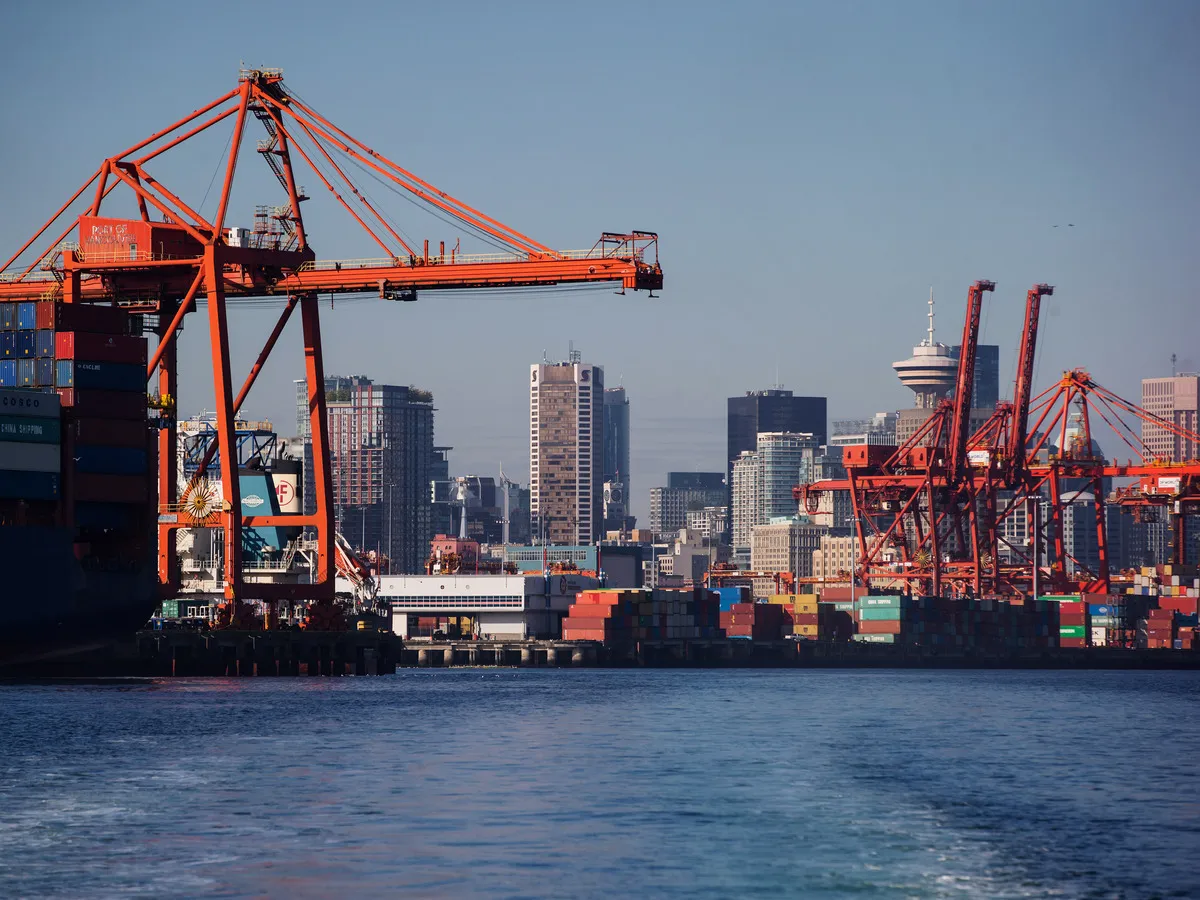
Skip to Content News Archives Economy Energy Oil & Gas Renewables Electric Vehicles Mining Commodities Agriculture Real Estate Mortgages Mortgage Rates Finance Banking Insurance Fintech Cryptocurrency Work Wealth Smart Money Wealth Management Investor Personal Finance Family Finance Retirement Taxes High Net Worth FP Comment Executive Women Puzzmo Newsletters Financial Times Business Essentials More Innovation Information Technology FP500 Podcasts Small Business Lives Told Tails Told Shopping Financial Post Store Obituaries Place a Notice Advertising Advertising With Us Advertising Solutions Postmedia Ad Manager Sponsorship Requests Classifieds Place a Classifieds ad Working Profile Settings My Subscriptions Saved Articles My Offers Newsletters Customer Service FAQ News Economy Energy Mining Real Estate Finance Work Wealth Investor FP Comment Executive Women Puzzmo Newsletters Financial Times Business Essentials HomeFP CommentPhilip Cross: Recession debate ignores Canada’s real economic problemWhether GDP was up or down a tenth of a per cent last quarter may be of concern. Its slow growth over the past decade clearly isLast updated 1 hour ago You can save this article by registering for free here. Or sign-in if you have an account.Gantry cranes over shipping containers in the DP World Ltd. terminal at Port Metro Vancouver in Vancouver, B.C. Photo by Darryl Dyck/Bloomberg filesFollowing Statistics Canada’s publication of this year’s first-quarter GDP estimates there has been much debate about whether or not Canada is in a “technical recession.” What happens to the economy in the short run is important but dwelling on it distracts from Canada’s real economic problem, which is its lack of growth over the past decade.Subscribe now to read the latest news in your city and across Canada.Exclusive articles from Barbara Shecter, Joe O'Connor, Gabriel Friedman, and others.Daily content from Financial Times, the world's leading global business publication.Unlimited online access to read articles from Financial Post, National Post and 15 news sites across Canada with one account.National Post ePaper, an electronic replica of the print edition to view on any device, share and comment on.Daily puzzles, including the New York Times Crossword.Subscribe now to read the latest news in your city and across Canada.Exclusive articles from Barbara Shecter, Joe O'Connor, Gabriel Friedman and others.Daily content from Financial Times, the world's leading global business publication.Unlimited online access to read articles from Financial Post, National Post and 15 news sites across Canada with one account.National Post ePaper, an electronic replica of the print edition to view on any device, share and comment on.Daily puzzles, including the New York Times Crossword.Create an account or sign in to continue with your reading experience.Access articles from across Canada with one account.Share your thoughts and join the conversation in the comments.Enjoy additional articles per month.Get email updates from your favourite authors.Create an account or sign in to continue with your reading experience.Access articles from across Canada with one accountShare your thoughts and join the conversation in the commentsEnjoy additional articles per monthGet email updates from your favourite authorsSign In or Create an AccountorAs applied to recessions, “technical” is vague and misleading. There is nothing especially “technical” about using consecutive quarterly declines in real GDP to define a recession. The convention first appeared years ago when the National Bureau of Economic Research, based in Cambridge, Mass., observed that U.S. recessions typically lasted about six months. But neither the NBER nor StatCan nor the C.D. Howe Institute, which has a committee that makes recession calls in Canada, has ever used that criterion alone to establish when a recession has taken place.People use “technical” to give the impression of authoritative expertise, when in fact using an arbitrary rule like consecutive quarterly declines sidelines the judgment needed to read the different signals that GDP, labour market and other data may be sending about the economy — not to mention assess the quality of the preliminary estimates of this data.Get the latest headlines, breaking news and columns.By signing up you consent to receive the above newsletter from Postmedia Network Inc.A welcome email is on its way. If you don't see it, please check your junk folder.The next issue of Top Stories will soon be in your inbox.We encountered an issue signing you up. Please try againIn this latest instance, quarterly GDP did not actually post back-to-back declines. Statistics Canada produces three estimates of it: one based on incomes (mostly wages, salaries and corporate profits), another that adds up expenditures on personal consumption, business investment, government spending and net exports, and a third composed of production by industries (such as mining, manufacturing and various services). In theory, these three measures are supposed to move the same way. In practice, they don’t.In the first quarter of this year, the income measure of GDP dipped 0.1 per cent, the expenditure measure was unchanged and the industry measure rose 0.1 per cent. The average of the income and expenditure measures, which dominates the media’s attention, yielded a microscopic dip of 0.036 per cent. Including the industry measure in the average actually generates a small increase: which means the economy avoided consecutive quarterly declines and the whole brouhaha has been about something that didn’t actually happen.StatCan would have done better not publishing a trivial decline in its income measure of GDP. Instead it should have released an unambiguously flat reading for GDP that would have short-circuited the inevitable focus on consecutive quarterly declines. If incomes had been $118 million higher at quarterly rates — a truly tiny difference well within the margin of calculation error — the annualized change in GDP would have rounded to a (neutral) 0.0 per cent.StatCan data on the consumer price index or unemployment rate cannot be fiddled with — they are what they are — but the data on GDP are just malleable enough that human intervention can nudge them one way or another to account for the uncertainty involved in preliminary data estimates. This is not a question of politics. The same arguments applied when StatCan published marginal declines for GDP in the first half of 2015, saddling the Harper government with the image of presiding over a recession in an election year.They may seem exact but in fact there is considerable uncertainty around the GDP estimates. That’s reflected in the many revisions they go through. The preliminary estimate of quarterly GDP just reported will be revised continually for years, usually upwards. Just last year, the estimated growth of real GDP was raised significantly as sources that are more comprehensive, such as tax data, supplemented preliminary estimates based on smaller survey samples. This is especially true for energy exports, as StatCan routinely revises its preliminary monthly estimates by $1 billion or more (as I outlined in FP Comment last year). This year’s first-quarter estimate for GDP included a preliminary estimate for exports in March, when oil prices began surging as a result of the war in Iran, making it very hard to estimate oil exports.The whole debate about whether or not Canada is in a recession misses the bigger picture. Whether or not Canada’s quarterly GDP grew or shrank fractionally over the past six months is of trivial importance compared with the inarguable fact that per capita growth has stalled since 2015. Our economy has not just had a bad couple of quarters, it has faltered for a decade, mostly because of persistently weak business investment. This is the major economic problem facing the country. Adopting yet another round of the short-term monetary or fiscal stimulus that recession talk likely will lead to certainly won’t fix it and probably would make it worse.Philip Cross, senior fellow at the Macdonald-Laurier Institute, was chief economic analyst at Statistics Canada. Join the Conversation This website uses cookies to personalize your content (including ads), and allows us to analyze our traffic. Read more about cookies here. By continuing to use our site, you agree to our Terms of Use and Privacy Policy.
Philip Cross: Recession debate ignores Canada’s real economic problem
Whether GDP was up or down a tenth of a percent last quarter may be of concern. Its slow growth over the past decade clearly is. Read more.
1,297 words~6 min read