view more
A spin qubit, in which quantum information is encoded in the spin state of an electron, is one of the most promising platforms for quantum computing. Spin qubits exhibit long coherence times and are compatible with advanced semiconductor manufacturing technologies. The leading implementation of spin qubits involves confined electrons inside quantum dots, a nanoscale semiconductor architecture that behaves like a controllable artificial atom. Recent advances have enabled high-fidelity operation of single- and two-qubit gates, exceeding the threshold required for certain surface code quantum error correction techniques.
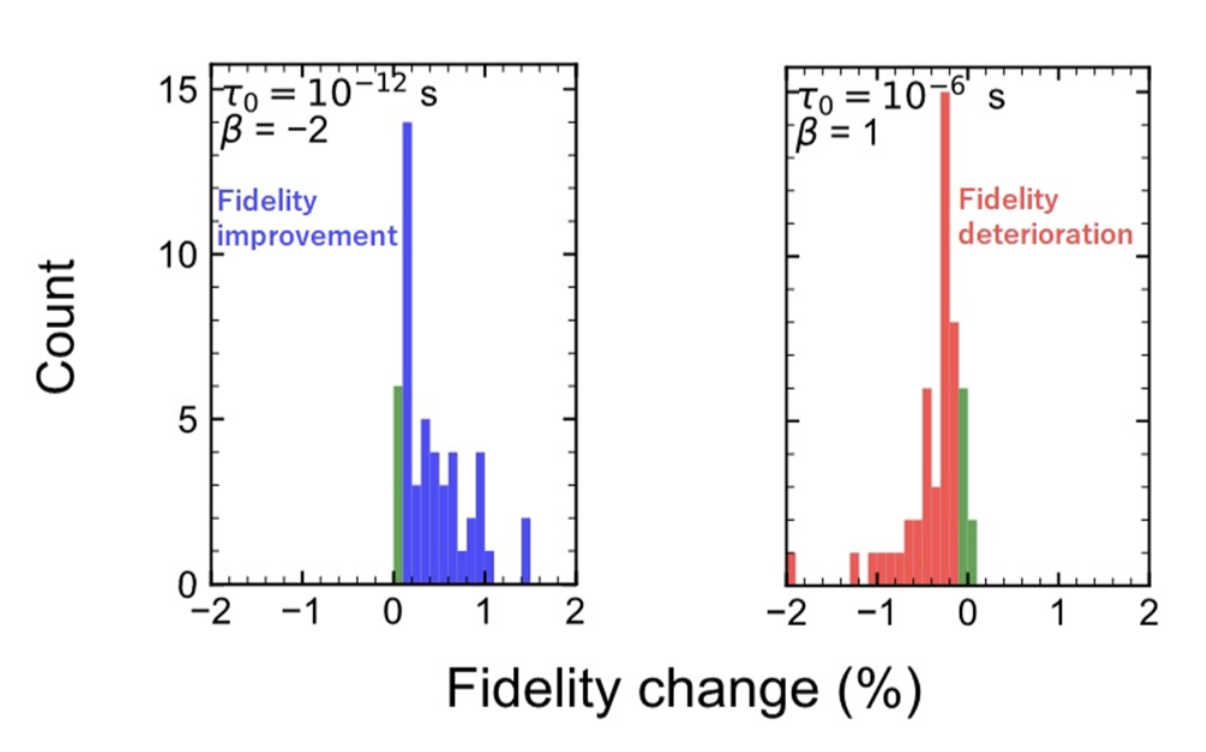
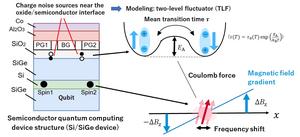
However, to achieve practical fault-tolerant quantum computing, the variability issues of spin qubit gates must be addressed. A key challenge in this context is fluctuations in the qubit resonance frequency caused by microscopic noise sources. A constant qubit resonance frequency (fq), also known as “Larmor frequency,” is needed for effective qubit operation. Recent studies have shown that microwave signals used to control qubits can generate heat that shifts the fq. Specifically, the fq exhibits a sharp increase at low temperatures, followed by a gradual decrease at higher temperatures. This non-monotonic temperature dependence disrupts resonance, thus deteriorating gate fidelity. Surprisingly, previous research has shown that a higher temperature of 200 millikelvin (mK), rather than the standard temperature of 20 mK, can mitigate the effect of fq shift on gate fidelity. Despite the importance of this phenomenon, its microscopic origin has remained unclear.