Insider Brief
Researchers from Tokyo University of Science and National Institute of Advanced Industrial Science and Technology identified charge-noise mechanisms that cause frequency shifts in silicon spin qubits and demonstrated why operating at 200 millikelvin can improve quantum gate fidelity.
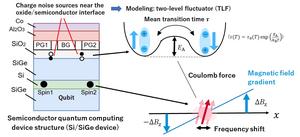
Using large-scale simulations of charge noise from two-level fluctuators, the team found that experimentally observed qubit behavior is best explained by rapidly switching charge traps with strong temperature dependence near semiconductor interfaces.
The results suggest that controlling semiconductor/oxide interface trap states and refining fabrication processes could reduce noise, stabilize qubit frequencies, and improve the performance of future large-scale silicon quantum computers.
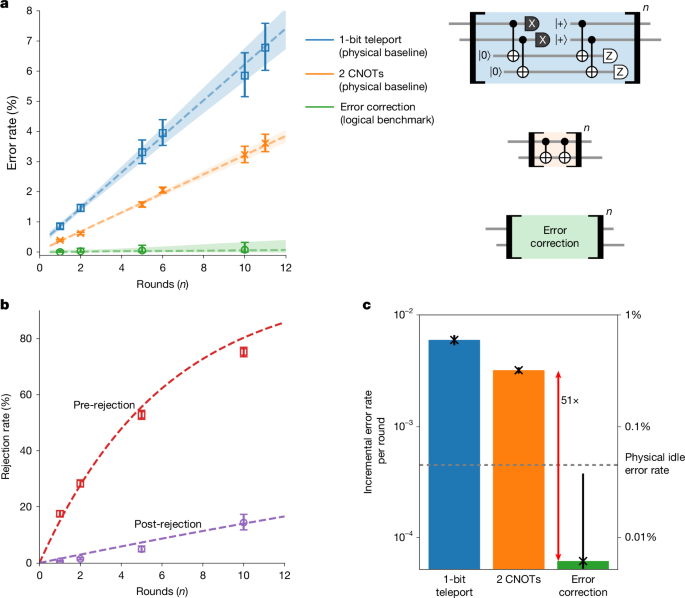
PRESS RELEASE — A spin qubit, in which quantum information is encoded in the spin state of an electron, is one of the most promising platforms for quantum computing. Spin qubits exhibit long coherence times and are compatible with advanced semiconductor manufacturing technologies. The leading implementation of spin qubits involves confined electrons inside quantum dots, a nanoscale semiconductor architecture that behaves like a controllable artificial atom. Recent advances have enabled high-fidelity operation of single- and two-qubit gates, exceeding the threshold required for certain surface code quantum error correction techniques.