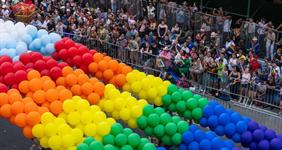
Pride Month is noticeably less colorful than just a few years ago.After policy changes and a pullback in public corporate support, social media feeds, parades and brand campaigns that used to be filled with rainbows and celebratory hashtags have gone quiet. The media has also lost interest. That corporate caution didn’t happen overnight. It follows a period of cultural friction that peaked in 2023 with conservative boycotts of brands like Target over trans-inclusive products and Bud Light over a partnership with trans actress and content creator Dylan Mulvaney. When President Donald Trump returned to office in 2025, his administration also put into place policies limiting DEI initiatives, creating potential financial liability Bospar SVP Shaun Leavy dubs 2026 Pride the “gray area.”“The story has been told and nothing drastically has changed,” he says. Leavy has participated in Bospar’s work with San Francisco Pride for the past four years. Last year was “particularly bleak,” he says, citing an exodus of brands from parade sponsorships and a lack of support for the LGBTQ community due to the fear of political or consumer backlash. Now companies are “cautiously creeping back,” but the pendulum hasn’t fully swung back, he says, leaving the future of Pride at a standstill.Participation levels at other Pride celebrations back up his assertion. Brands like Converse, Old Navy and Abercrombie & Fitch launch Pride-themed collections annually, while conglomerates such as Nissan and Diageo have historically sponsored large Pride marches like NYC Pride and San Francisco Pride.Last year, a number of companies walked back their visible representation — some moving to roles as silent sponsors — yet a year later, there is a promising rebound in the number of partners returning to Pride parades, says Chris Piedmont, SlideNine VP and media director for NYC Pride | Heritage of Pride.NYC Pride has secured more than 90 partners this year, up from 77 in 2025 and 70 in 2024. However, the amount of funding from corporate organizations is continuing to skew downward, Piedmont says.Several former multi-year Platinum sponsors — including Garnier and Mastercard — have either completely removed their public branding from the NYC Pride lineup or significantly reduced their financial visibility compared to previous years.Major Pride celebrations operate as nonprofits and receive virtually no state or city municipal funding. The massive overhead costs required to stage world-class public events — including city permits, security, sanitation and baseline infrastructure — have historically been covered by corporate dollars, with that burden now shifting to other areas. Corporate sponsors for NYC Pride this year, including Out at L’Oreal, Deutsche Bank, Yahoo and Target, are supporting the nonprofit through avenues that do not necessarily include public branding, he says. For instance, Target, which has faced backlash for its pullback on trans-inclusive Pride products in previous years, may be providing water at events such as PrideFest instead of sponsoring a giant float. “Everyone can acknowledge companies are navigating an unprecedented moment,” says Jonathan Lovitz, Human Rights Campaign SVP of campaigns and communications. “Trying to navigate a world where consumers are demanding transparency, but government and other forces are demanding compliance is not an easy place to be.”HRC’s Corporate Equality Index is a benchmark for companies’ LGBTQ+ affirming policies that affect employees, shareholders and communities. It’s also a resource for consumers to assess which brands are authentically showing support. Fewer employers chose to publicly document their practices through Equality Index submissions this year, including a 65% decline among Fortune 500 companies, many of which hold federal contracts. Many companies that do business with the federal government have pulled back on public displays of support for DEI and diverse or underrepresented communities due to policies put in place by the Trump administration. The decline doesn’t indicate a withdrawal from inclusive policies, Lovitz says, but rather a reassessment of how commitments are externally documented and communicated.As one of the largest Pride celebrations in the U.S., San Francisco Pride faced funding challenges in 2025 after the Trump administration’s policies limiting DEI initiatives forced companies to reconsider public support.Levi Strauss & Co. offers a blueprint for legacy-driven Pride messaging rooted in intentional, culturally grounded advocacy. Rather than treating June as an isolated marketing window, the denim brand anchors its narrative in more than three decades of history supporting the LGBTQ+ community.“None of this work exists in isolation. It is the continuation of a thread that runs through more than three decades of [company] history,” says Anna Walker, Levi Strauss & Co. VP of impact and issues.This year, Levi’s Pride Collection, Together, We Ride, pays homage to the queer motorcycle community and financially supports advocacy groups like Outright International and Dykes on Bikes, a queer biker group that was part of the inspiration for the collection.While other companies have taken the route of corporate neutrality, Walker says Levi’s remains committed to diversity and inclusion, both within its workforce and for consumers, because it's the right thing to do for its people and business.The brand is continuing its sponsorship of the San Francisco Pride Parade this year as well as Pride celebrations in Amsterdam, Paris, Warsaw and Mexico City. Other sponsors of San Francisco Pride include Alaska Airlines, Genentech, Hilton, Red Bull, San Francisco International Airport, Diageo, Squealing Pig and ViiV Healthcare, according to Leavy.Under pressure to allocate marketing dollars more wisely, the companies that go out of their way to show their support will be rewarded by LGBTQ+ consumers — and their $1.4 trillion in consumer spending power, Lovitz says.Other brands have stepped back entirely from supporting Pride, forcing organizations to pivot to grassroots survival. This year, NYC Pride is chasing a $100,000 individual, peer-to-peer fundraising goal to offset corporate shortfalls, relying on local, small, queer-owned businesses like BlissBomb Baked Donuts and Gilded Age Jewelry to fill the gaps, Piedmont says.Because national ad campaigns draw centralized political fire, many brands are adopting a hyper-local communications approach. By decentralizing their activities, companies can directly interact with individual communities through regional volunteerism and local recruitment events without triggering national polarization.“The brand exposure that you get at Pride is great if people see it, but the majority of people who are going to interact with your brand in the community are probably not going to be at the big parade,” Lovitz explains.E-scooter and e-bike company Lime launched its Pride campaign this month with the intention of transporting riders to Pride events through local partnerships in more than 21 cities worldwide.The Pride in Motion campaign, developed by Lime’s in-house marketing, communications and creative teams, provides riders with rainbow-wrapped vehicles and transportation access initiatives while supporting local organizations in the cities in which it operates. Lime chief brand and communications officer Carolyn Rosebrough says she hopes people see the campaign as a celebration of “community, connection and access.”While Pride is synonymous with colorful celebrations, this year’s events are more urgent, taking place during midterm primary races and putting an invigorating perspective on the future of LGBTQ+ rights. More than 90% of LGBTQ+ people in the U.S. plan to vote this year, according to an HRC community insights survey — and they make up 10% of the electorate. “If you combine that voting power with our consumer power, mess with equality at your own financial and political peril,” Lovitz warns.Pride is getting back to its roots in many ways, Piedmont says, after taking for granted the “substantial level” of corporate support it had 10 years ago, particularly in the fight for marriage equality. It’s disheartening to see the lack of that same support for issues such as trans rights, Piedmont says, but it’s also reignited a fire to fight for fundamental rights.“The community is more energized than ever, fighting back and pushing back,” Leavy says. “We've come a long way, but it can easily be taken away. We need to fight harder.”This story first appeared on PRWeek U.S.
Pride 2026: How brands are navigating political backlash and DEI rollbacks
Brands are reducing visible 2026 Pride sponsorships, forcing organizations to pivot toward hyper-local campaigns and grassroots funding.
1,298 words~6 min read