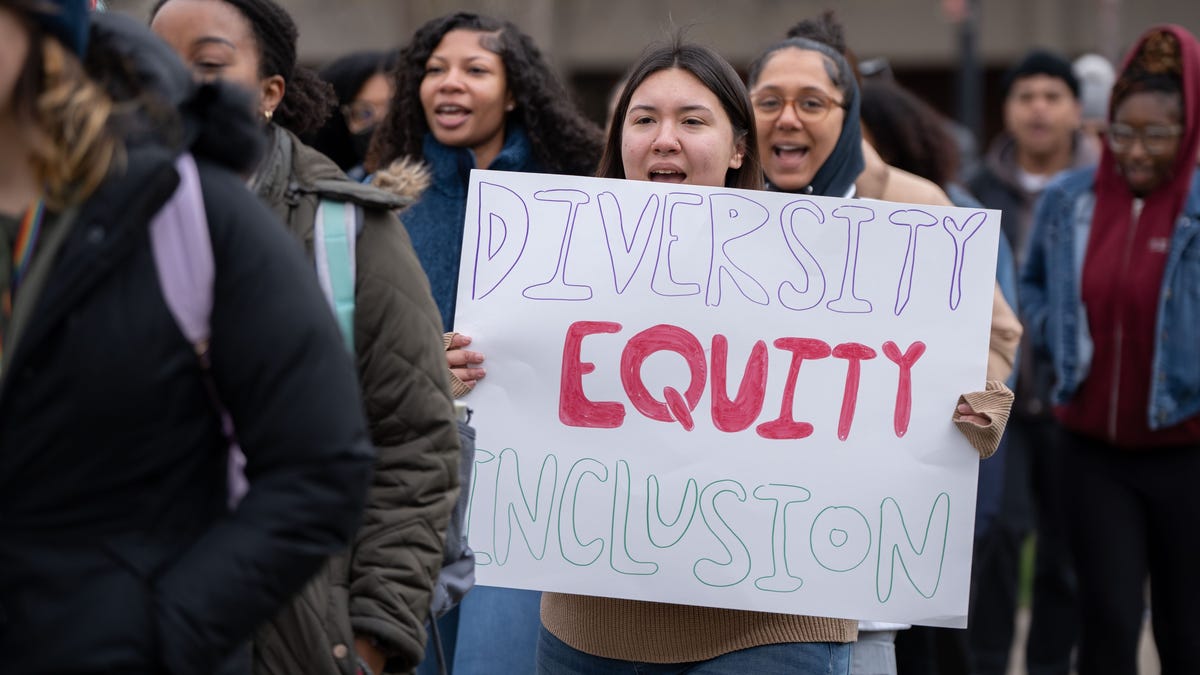
The executive orders signed by President Donald Trump on the first day of his second term in office began a significant shift for corporate DEI initiatives. Executive Order 14151, or Ending Radical And Wasteful Government DEI Programs And Preferencing, ordered the “termination” of “illegal” federal diversity, equity, inclusion and accessibility mandates. The LGBTQ+ community was no exception to these policies, with the Trump administration focusing especially on transgender individuals. Defending Women from Gender Ideology Extremism and Restoring Biological Truth to the Federal Government — Executive Order 14168 — declared that the term gender identity is “disconnected from biological reality” and “does not provide a meaningful bias for identification and cannot be recognized as a replacement for sex.”Some U.S. states, primarily those that lean toward conservative, traditional beliefs, have followed suit. On March 31 of this year, Gov. Brad Little of Idaho signed into law House Bill 752, which threatens up to five years in prison for using a public restroom of the opposite sex. Although it was set to take effect July 1, a federal judge blocked its enforcement earlier this month.The dissolution of DEI policies on both the federal and state levels also trickled down to the advertising and marketing industry. Throughout both 2025 and 2026, a number of brands — namely Amazon, Meta and Walmart — have either reduced or eliminated several of their DEI policies and programs. Additionally, during Pride Month in 2025, brands were noticeably quiet.“Last year was the equivalent of a dead year,” said Jeff Hastedt, cofounder and MD at Brkthru, a digital media and marketing services company. “At least this year, I don’t see a repeat of that. I see more concerted effort.”This year, other brands have either maintained or doubled down on DEI efforts. For example, although JPMorganChase switched up the abbreviation to DO&I (diversity, opportunity and inclusion), the brand’s dedicated page on its website includes the designated offices for marginalized groups and programs that elevate them.Overall, consumers have noticed how brands have shifted their focus to Pride Month. Although chatter persists regarding the lack of action taken by brands to celebrate Pride Month, it seems some brands used this year to test the waters once more.“It’s a mixed bag. We see both trends happening at the same time,” said Evan Horowitz, cofounder and CEO of Movers+Shakers. “On one end of the spectrum, there are brands that are very focused on celebrating Pride and other DEI-type moments. There are [also many] brands that are more concerned with the changes in the social and political climate, and are wanting to take a little bit more of a conservative approach.”In this context, this “conservative” approach implies that brands are likely becoming more strategic (or even subtle) with how they choose to acknowledge Pride Month — a stark contrast to the past decade, in which many companies appeared louder and prouder during the month of June.“Before, it was the ‘cool’ thing to do,” said Matthew Conrado, founder and CEO of Alphabet Mafia Consultancy, a New York City-based LGBTQ+ marketing and brand strategy firm. “[Now], brands are realizing that there are brands that make sense, and there are brands that don’t make sense.”Conrado told Campaign that companies are also learning that “culture dictates who’s in the conversation.”“Queer people have always liked culture, so [brands are] more okay leaning into it this year,” he added. The strategySo, should brands stick with what makes sense for them when it comes to Pride Month? Even that question in itself is hard for industry experts to answer. Horowitz said it really depends on the company’s overall marketing strategy. “[It] should always do what makes sense for its brand, but whether Pride makes sense or not is a hard thing to be black-and-white about,” he explained. “We see a lot of brands having winning strategies that are Pride-forward, but we would never say, ‘every brand should be doing that.’” No matter what a company’s strategy entails, consumers’ reactions to even minor details will be mixed. For example, if a brand adopts a rainbow logo or sponsors a local Pride parade, some consumers will view the action as performative while others welcome it. “Some brands might not necessarily know the best way to do it, and so it comes across as performative,” Hastedt said. “There’s a subset of folks that thinks just sponsoring a Pride parade isn’t enough. No, it’s important for visibility and to help further the message by establishing your brand as a welcoming place to do business.”As underrepresentation in marketing campaigns continues to be prominent in today’s industry, Horowitz told Campaign that agencies have a role to play in “advocating for diversity and inclusion” with their clients by ensuring talent from minority communities, such as the LGBTQ+ community, contribute to the work.“That’s part of our responsibility as an agency,” he said. “It’s just a business motivation that inclusion works with most consumers, and so most of our clients would do well to be thinking about pushing the envelope in terms of inclusion; not to an extreme.”The people Ideas for campaigns and other creative work stem from the people of this industry. However, a less diverse workforce generates fewer creative concepts.Hastedt said that what leads to this dynamic isn’t usually malicious intent from an agency’s or brand’s leadership. Sometimes, he added, they simply don’t know any different.“We can’t assume bad intent every time someone misses the mark,” Hastedt said. “Sometimes they just haven’t thought about it because it’s not part of their day-to-day experience. That’s why education is so important. We have an opportunity to help people see things from a different perspective.”Thus, with diverse hiring comes more exposure, and in turn, additional ideas that cover a higher number of topics and incorporate more groups of people. Conrado, whose consultancy works with both agencies and brands to ensure proper representation in the work, told Campaign that the No. 1 thing companies can do for Pride Month is employ those from the LGBTQ+ community who also understand that community.“The biggest mistake a lot of agencies and consultancies have [is they] throw a rainbow logo or do something that we think is good, but we actually don’t have an understanding [of their stance],” he said. “That’s where actual recruitment comes into play. Having people on the team who understand the culture [and] live the day-to-day — that’s showing true allyship.”Both bringing in LGBTQ+ creators and giving employees within that community creative control (even behind-the-scenes) will lead to the best outcome for the agency, client and consumers.“Queer people just want to be hired,” he continued. “They want to have creative control. We are just a very creative and high-performing group.”Hastedt added that companies — agencies and brands alike — also need to provide their LGBTQ+ staff with designated employee resources. Additionally, benefits such as paternity leave assist opposite-sex couples just as much as same-sex couples.Although incorporating diverse hires and accommodating benefits are internal efforts, the true DNA of a company shows in places less seen by the masses.“What you do internally, too, as a company, is really important,” Hastedt said. “Are they performative, or do they own it? Is it part of who they are and representing their people as a whole?”The messageA company’s strategy, the people it employs and its resulting work all contribute to its overall message to consumers. If the message is misinterpreted or is all bark and no bite, it falls flat.If a brand switches its original messaging, it can be detrimental to its business. Target is a prime example of how walking back on DEI commitments in the name of “what’s best for business” alienates not only an already large portion of its LGBTQ+ consumers, but also their allies.“If you, as a brand, welcomed a diverse community — such in this case the LGBTQ+ community — who you made yourself an ally of, you have an obligation [to support them],” Hastedt said. “Walking away [from them] is where it hurts.”For companies that are unsure about how they can properly support the LGBTQ+ community, what works best is a balance between moving away from a one-size-fits-all message while simultaneously being selective about what groups to represent.“You don’t need to be all things to all people,” Horowitz explained. “Consumers would rather support and engage with a brand that is clear [and] consistent on what it stands for. That drives real emotional connection and love for the brand.”At the end of the day, cutting off a brand, agency or individual because actions surrounding Pride Month fall flat not only ceases to work, but also turns them “away to the other side,” Conrado said.“We’re at an inflection point where companies [and] queer people are figuring it out,” he told Campaign. “Let’s give everyone a little bit of grace and be kinder to each other.”
Navigating Pride Month in a post-DEI advertising landscape
After a quiet 2025, brands and agencies should take a more strategic, culture-first approach to LGBTQ+ marketing.
1,461 words~7 min read