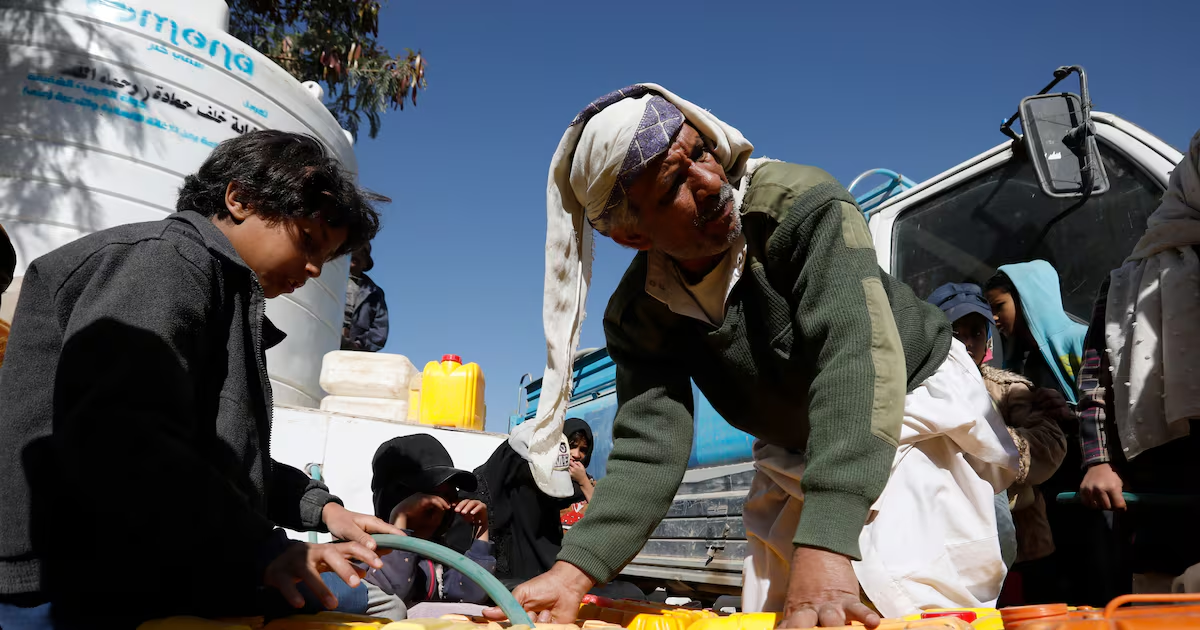
As the world marks World Environment Day today, increasing pressure on natural resources brings into sharper focus the complexity and interconnected nature of our environmental challenges.While global discourse continues to centre on climate indicators and environmental change, there is an equally important need to examine how essential systems, particularly water, can adapt to evolving environmental, geopolitical and operational pressures. At the same time, rising demand, climate change and population growth are intensifying water scarcity and placing sustainable resource management higher on the global agenda, reinforcing the growing importance of water security within the broader sustainability framework.This urgency is further underscored by findings from the UN World Water Development Report 2026, which indicates that 2.1 billion people still lack safely managed drinking water. This highlights the growing strain on global water systems and the widening gap in achieving the UN’s Sustainable Development Goal 6 on water and sanitation.A cloud-seeding plane flies over Sheikh Zayed Grand Mosque in Abu Dhabi. Courtesy: National Centre for Meteorology and SeismologyInfoIn parallel, evolving geopolitical dynamics continue to reinforce the need for resilience and preparedness across critical systems, including water infrastructure and resource management. Addressing these overlapping pressures requires not only long-term planning but also the advancement of adaptive, science-driven solutions capable of responding to shifting environmental and operational realities.While conventional water systems have historically relied on centralised infrastructure, including desalination, groundwater extraction, and large-scale distribution networks – and remain fundamental to securing supply – their structure underscores the need for complementary approaches that enhance flexibility and responsiveness.Strengthening water security requires diversification, integrating a range of solutions that collectively ensure continuity under varying environmental conditions and support a more resilient framework capable of withstanding gradual shifts and sudden disruptions.Within this evolving landscape, the role of locally developed scientific solutions is becoming increasingly significant. Environmental challenges are inherently region-specific, requiring responses grounded in local climate, geography and atmospheric conditions. In arid environments such as the UAE, where annual rainfall averages less than 100mm, water scarcity remains a persistent structural challenge. This reality has driven targeted investments in innovation and research aimed at developing practical and scalable solutions. Rainfall enhancement represents one such approach, working with natural atmospheric processes to support precipitation and improve water resource availability.QuoteThe UN says that 2.1 billion people still lack safely managed drinking waterIn this context, the Emirates has established a structured and internationally recognised platform to advance research in this field through the UAE Research Programme for Rain Enhancement Science. This plays a key role in developing locally relevant solutions that enhance water availability and strengthen environmental resilience, particularly in arid and semi-arid regions.Established in 2015 under the patronage of Sheikh Mansour bin Zayed, Vice President, Deputy Prime Minister and Chairman of the Presidential Court, UAEREP supports innovative research projects through competitive grants awarded to leading researchers from around the world. In each cycle, selected projects receive funding of up to $1.5 million (Dh5.5 million), distributed over a period of up to three years with a maximum annual allocation of $550,000. This enables in-depth investigation into the scientific and operational dimensions of rainfall enhancement.The research supported by UAEREP reflects a strong emphasis on scientific rigor and practical application. Projects have advanced the understanding of cloud microphysics, improved the identification of seedable cloud systems, and assessed aerosol–cloud interactions that influence precipitation efficiency. Projects are also expanding research into land–atmosphere interactions to strengthen the scientific basis of rainfall processes.Other research efforts have focused on the development of optimised seeding materials and the integration of advanced tools such as unmanned aerial vehicles, remote sensing, artificial intelligence, and numerical modelling to improve targeting and evaluation. Collectively, these advancements enhance the ability to translate scientific insights into operational decisions, improving the effectiveness and reliability of rainfall enhancement practices under UAE-specific conditions.At the same time, the programme places equal importance on operational readiness and local capacity development. Through continuous technical support provided by the National Centre of Meteorology, researchers are equipped with data, facilities, and logistical expertise that enable field validation and real-world application of their findings. This integration of research and operations ensures that innovation is not confined to theory, but is actively contributing to practical solutions that reinforce national water capabilities.Beyond its national impact, UAEREP contributes to the broader global scientific community. By fostering collaboration between international experts and institutions, the programme supports knowledge exchange and the advancement of rainfall enhancement science at a global level. This dual focus, strengthening local capacity while contributing to global research, positions the UAE within a wider effort to develop sustainable, science-based solutions to water challenges.As environmental uncertainty continues to shape global priorities, the importance of investing in resilient and adaptive water systems becomes increasingly clear. Ensuring long-term water security requires a balanced approach that combines established infrastructure with innovative, complementary solutions grounded in scientific evidence. It also requires continued collaboration across borders, alongside the development of approaches tailored to specific regional conditions.World Environment Day provides an opportunity to reflect on these priorities and the pathways needed to address them. Building resilience in water systems is not only a technical challenge but also a strategic imperative that underpins environmental sustainability and long-term development.By advancing diversified, science-driven approaches such as rainfall enhancement, and by aligning global co-operation with locally grounded innovation, countries can strengthen their preparedness and navigate an increasingly uncertain environmental and geostrategic landscape with greater confidence.
The world is missing global water targets | The National
This World Environment Day is a time to redouble efforts to tackle water scarcity
886 words~4 min read