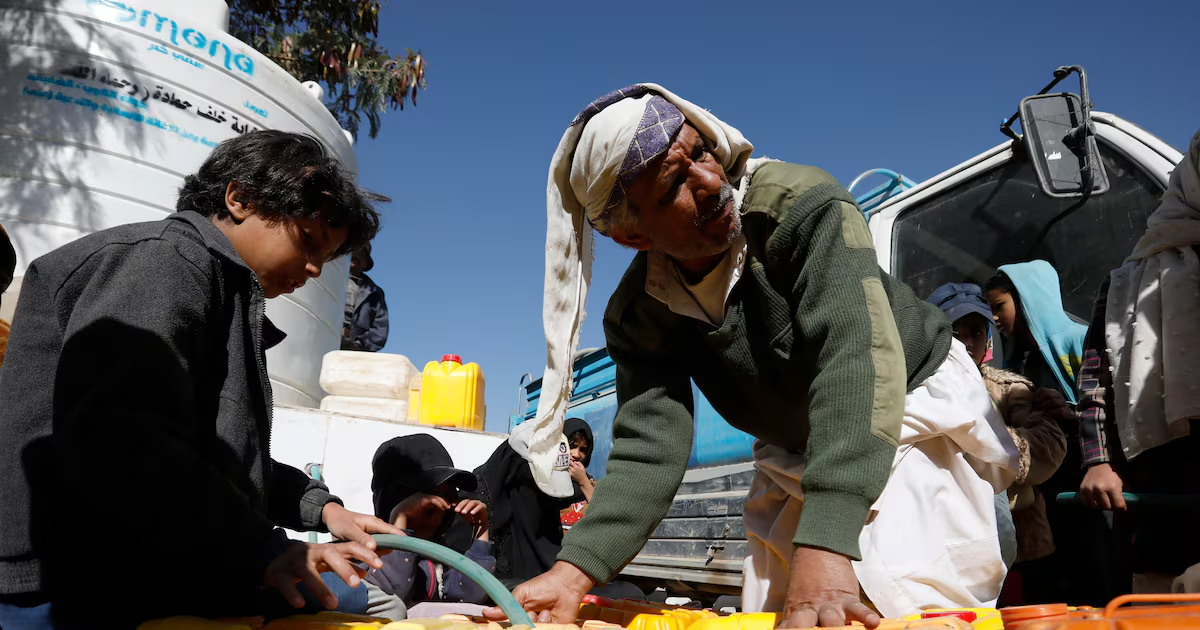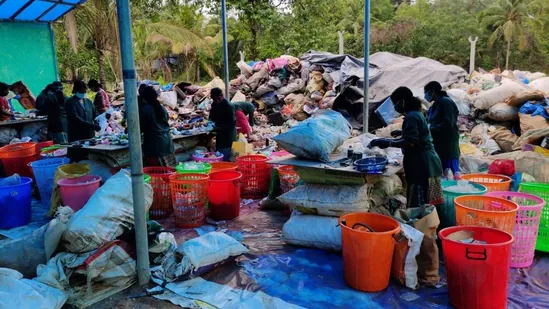
Every year, World Environment Day serves as a reminder of humanity's shared responsibility towards the planet. Discussions often focus on reducing carbon emissions, protecting biodiversity, and conserving natural resources. While these efforts remain critical, one challenge is becoming increasingly difficult to ignore: water security. Across continents, communities are confronting shrinking freshwater reserves, declining groundwater levels, erratic rainfall patterns, and growing demand driven by population growth and urbanisation. In this changing reality, conservation alone is no longer enough. The future demands a new approach—one that treats water not as a finite resource to be consumed and discarded, but as a valuable asset that must continuously circulate through our economies and ecosystems.Circular water economy (HT PHOTO)For decades, water management has largely followed a linear model. Water is extracted from rivers, lakes, and aquifers, used by households, industries, and agriculture, and then discharged as waste. This model may have appeared sustainable when populations were smaller and resources more abundant, but it is proving increasingly inadequate in the face of modern environmental pressures. The climate crisis is intensifying droughts in some regions while causing destructive floods in others. Groundwater, which supplies nearly half of the world's drinking water, is being depleted faster than it can naturally recharge. At the same time, economic development and rising living standards continue to increase water demand.The challenge before us is not merely about using less water. It is about using water differently. One example of such innovation is Atmospheric Water Generation (AWG), a technology that extracts water directly from the moisture present in the air. As climate change places increasing pressure on conventional freshwater sources, AWGs are emerging as a valuable addition to the global water portfolio. By creating potable water at the point of consumption, they reduce dependence on overstretched groundwater reserves and complex distribution networks. Particularly useful in water-scarce regions, remote communities, and urban environments facing growing demand, AWGs demonstrate how technology can help diversify water sources and strengthen resilience. While not a substitute for conservation or recycling, they represent an important component of a future-ready, circular water economy.A circular water economy offers a promising path forward. Inspired by the broader principles of the circular economy, this approach seeks to maximise the value of every drop of water by reducing waste, promoting reuse, recycling wastewater, recovering resources, and creating alternative water sources. Rather than allowing water to leave the system after a single use, a circular model ensures it remains in productive circulation for as long as possible.The concept is already gaining momentum around the world. Cities are investing in advanced wastewater treatment facilities that enable treated water to be reused for industrial processes, landscaping, and even potable applications. Industries are adopting closed-loop systems that recycle water within manufacturing facilities, significantly reducing freshwater withdrawals. Agricultural sectors are exploring precision irrigation technologies that optimise water use while maintaining productivity. These developments demonstrate that sustainable water management is not merely an environmental aspiration but an achievable reality.However, building a circular water economy requires more than technology alone. It demands a shift in mindset. Water has traditionally been viewed as an abundant and inexpensive resource. In many parts of the world, this perception persists despite mounting evidence of scarcity. A circular approach requires governments, businesses, and citizens to recognise water as a strategic resource that underpins economic growth, public health, food security, and environmental sustainability.Businesses, in particular, have an important role to play. Water risks are increasingly becoming business risks. Supply chain disruptions, regulatory changes, and resource shortages can all affect long-term growth and resilience. Forward-thinking organisations are therefore integrating water stewardship into their sustainability strategies, investing in efficient technologies and exploring innovative ways to reduce their water footprints. Such measures are not only environmentally responsible but also economically prudent.Innovation will remain central to this transformation. Emerging technologies are creating new opportunities to diversify water sources and strengthen resilience. From advanced desalination systems and smart water networks to atmospheric water generation and decentralised treatment solutions, technology is expanding the possibilities for sustainable water access. These innovations can complement traditional water infrastructure and help communities adapt to a future where water availability becomes increasingly uncertain.Importantly, a circular water economy aligns closely with global sustainability goals. It contributes to climate adaptation, supports sustainable cities, protects ecosystems, and promotes responsible consumption and production. By reducing pressure on natural freshwater sources, circular water practices can help preserve rivers, wetlands, and groundwater reserves that are essential for ecological balance.The transition to a circular water economy is not a distant vision reserved for the future. It is an urgent necessity that must begin today. Conservation will always remain important, but it must be complemented by innovation, reuse, recycling, and smarter management. The question is no longer whether we can afford to adopt circular water practices. The real question is whether we can afford not to.As we reflect on our collective responsibility towards the environment, let us recognise that securing the future of water requires moving beyond conservation and embracing a model that values every drop. In doing so, we can build a more resilient, sustainable, and water-secure future for generations to come.(The views expressed are personal)This article is authored by Ramkrishna Mukkavilli, founder & managing director, Maithri Aquatech.
The future depends on a circular water economy
This article is authored by Ramkrishna Mukkavilli, founder & managing director, Maithri Aquatech.
863 words~4 min read