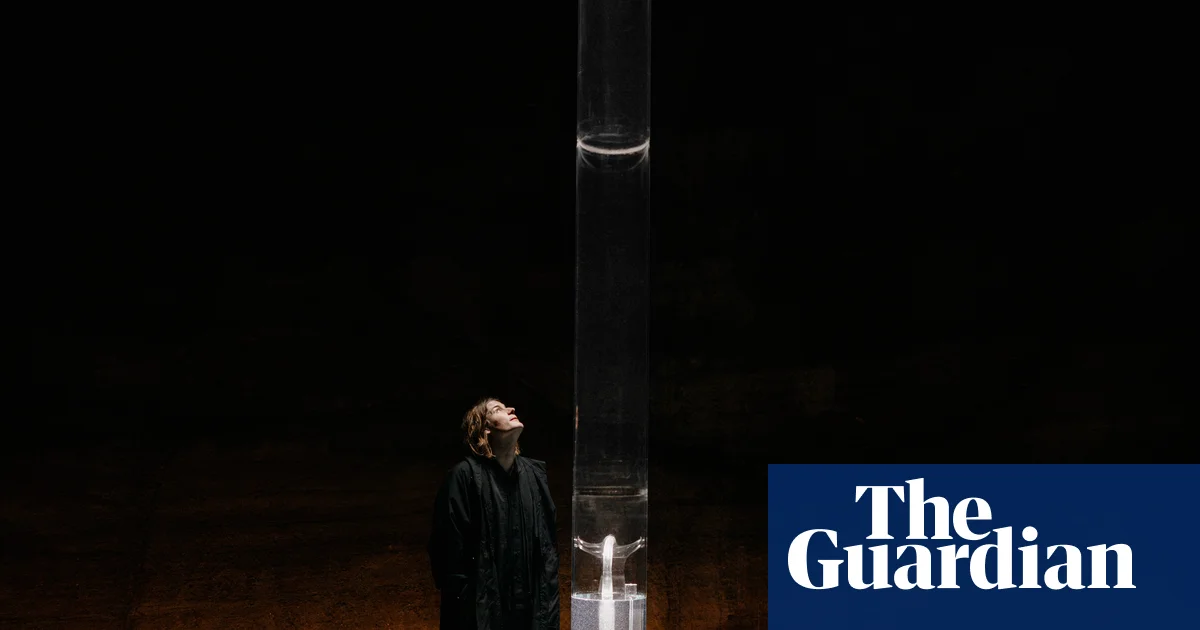
More than 2bn years ago, during the Paleoproterozoic era, the Earth’s atmosphere began to fill with free oxygen, enabling the rise of aerobic life and, ultimately, humans. It’s known as the Great Oxidation Event, and deep in the subterranean belly of the Museum of Old and New Art (Mona) in Tasmania, a new artwork offers visitors the chance to inhale oxygen that’s been trapped in iron ore since then.When French-Swiss conceptual artist Julian Charrière came up with the idea, Mona’s owner David Walsh not only said yes but created a bespoke space for it.“I want people to get all the way back to the beginning of the earth,” Charrière tells the Guardian at the media call on Friday. “It’s like a time machine.”He has sourced ancient iron ore from Australia’s Pilbara region, which is put through machinery in an on-site lab each day to have water extracted. The water is then put through a Hofmann apparatus – a piece of scientific equipment that electrolyses water – to pull oxygen out. That oxygen is then released into the room to be breathed in by visitors for the very first time, connecting each person “to the beginning of life on earth”.Artist Julian Charrière at Mona’s Breathe lab. Photograph: Mona/Jesse Hunniford. Copyright the artist; VG Bild-Kunst, Bonn, Germany. Courtesy the artist and Mona.Breathe is designed as a solitary experience.One by one, visitors are given access to a vault-like corridor reminiscent of a huge mining drift. Walking through the tunnel, flanked by raw sandstone and lined with deep red rocks from the Pilbara, you can pause to peek into a side room with the aforementioned lab.The temperature drops with each step as the tunnel opens into a high-ceilinged cylindrical room, like an underground windowless tower, with the lighting dependent on the amount of sun that can be reflected through a small opening above (so, in Tasmanian winter, pretty dim).Walking over tiles made of polished ancient tiger ore, you’ll circle another cylinder: a floor-to-ceiling clear glass tube that houses the Hofmann apparatus.Sit in front, and you’ll see a small opening. Here is your closest access to Charrière’s pure, ancient oxygen.Breathe runs alongside Charrière’s major new exhibition, Hard Core. Artwork pictured: Not all Who Wander Are Lost (detail), 2019. Photograph: Mona/Jesse Hunniford. Courtesy the artist and MonaIn inhaling, “you are connected to the beginning of life on Earth but you are also – and that is the crazy thing about this space – you are also the first person to inhale that oxygen,” he says.“You are breathing something which is so pure and has not been touched by any being before you … And the beauty of the piece is you will carry it until you die.“You’re going to become a small part of this installation and you become a big part of the great oxygen cycle, and you will only finally free this oxygen once ….” He pauses: “Once you’re going in the other world.” He means: once you die.
I just inhaled 2.4bn year old oxygen in Tasmania. Now I’m part of an exhibition until I die
In Mona’s new permanent installation, visitors can breathe air so pure it ‘has not been touched by any being before you’
892 words~4 min read