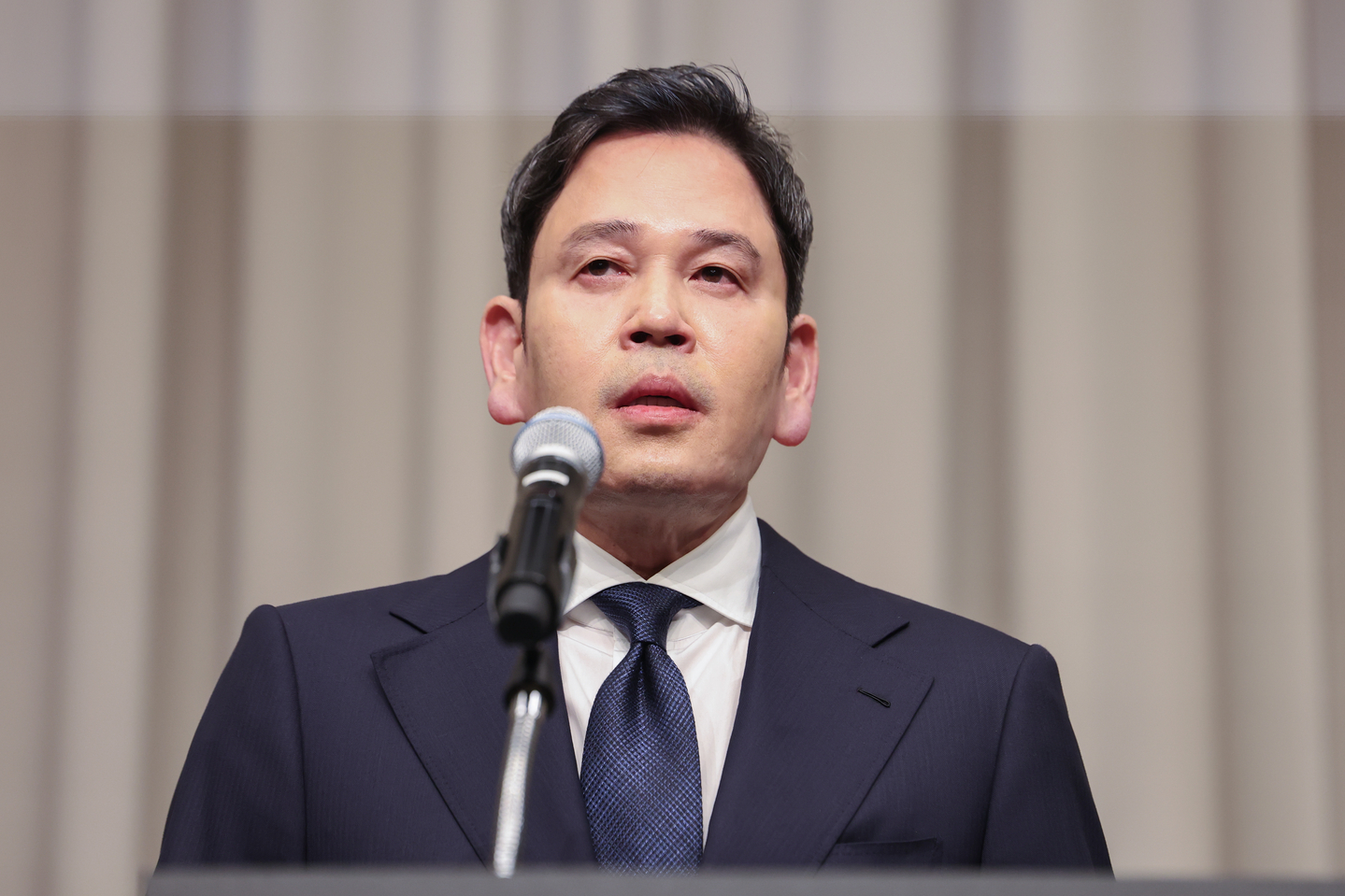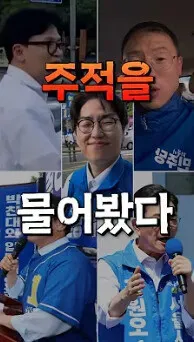
Still from a YouTube video asking Democratic Party candidates who South Korea’s “main enemy” is.
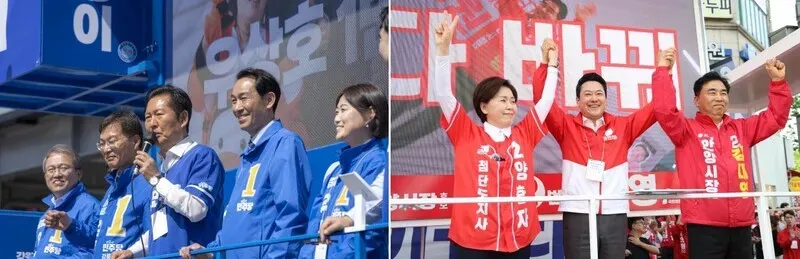
By Kwon Tae-ho, executive editorIf you’re Korean and you’ve been watching short-form content on Instagram or YouTube over the past few weeks, as candidates hit the campaign trails for Wednesday’s local elections, you’ve probably seen a video that goes a little like this: Someone abruptly approaches a candidate campaigning on the street and springs this question on them: “Who do you think is South Korea’s main enemy?”This so-called “main enemy challenge” was used to attack candidates from the liberal ruling camp — the Democratic Party, the Rebuilding Korea Party, and the Progressive Party. Candidates who were caught off guard by the unexpected question and hesitated, dodged it, or appeared flustered were frequently labeled as “pro-North Korea.”On the other hand, People Power Party candidates who replied with “North Korea” have been lauded for their honesty and confidence.Clips of major Democratic candidates — Seoul mayor candidate Chong Won-oh, Incheon mayoral candidate Park Chan-dae, Ulsan mayoral candidate Kim Sang-wook and Busan National Assembly candidate Ha Jung-woo — have been shared over and over again online. How is this any different from the ideological litmus tests Christians were subjected to in Edo Japan, when they were forced to step on likenesses of Jesus or Mary to prove that they were not Christians?This viral challenge is supposedly the brainchild of conservative youth provocateurs associated with the right-wing Freedom University group — supporters of the “Yoon Again” movement who have been staunch supporters of Korea’s disgraced former president, Yoon Suk-yeol, ever since his failed coup in December 2024. When Yoon was still running for president himself, his campaign relied on relentlessly bombarding the public with short slogans such as “Abolish the Ministry of Gender Equality and Family!” Another slogan that appeared during that campaign was “Our main enemy is North Korea.”This backwards trend of asking who our country’s “main enemy” is in the year 2026 is unsettling, to say the least. While the context is widely different, this situation does bring to mind how, after the Kanto Earthquake, the Japanese “identified” and massacred ethnic Koreans by forcing them to pronounce “15 yen,” believing that ethnic Koreans pronounced the phrase differently.North Korea was first designated as South Korea’s “main enemy” in the 1995 defense white paper during the Kim Young-sam administration. This was immediately after North Korea’s declaration in 1994 that, in the case of a war between the two Koreas, Seoul would “become a sea of fire.”Following the June 2000 inter-Korean summit, a subsequent defense white paper was not issued after the “main enemy” phrase caused controversy. The white paper issued in 2004, during the Roh Moo-hyun administration, omitted the “enemy” phrase, instead stating that North Korea was a direct, existing military threat. After the sinking of the ROKS Cheonan in 2010, during the Lee Myung-bak administration, rhetoric escalated, with the defense white paper including the phrase “As long as such threats continue, the main agents of the provocative acts, which are the North Korean regime and its military, will remain enemies of the South.”During the Moon Jae-in administration, the defense white paper did not pinpoint North Korea as Seoul’s principal enemy, but stated, “The ROK Armed Forces considers any force that threatens and violates the sovereignty, territory, people, and properties of the ROK as an enemy.”The Yoon Suk-yeol administration revived the phrasing used by the Lee Myung-bak administration. As such, the “main enemy” description has never been categorically factual.Also, the last time the “main enemy” phrase was used was in 2000. When the time comes for the Lee Jae Myung administration to publish its defense white paper, conservatives, led by the People Power Party, will engage in a meaningless debate about whether the “main enemy” phrase should be included. It is worth remembering that the term “main enemy” comes from a military context. In a society that belongs to its citizens, why should ordinary civilians be identifying a “main enemy” at all?Politicians' participation in the “main enemy” challenge is a relic of an earlier era and feels increasingly out of place today. After Chong shook the hand of Ko Jae-hyun, the PPP’s Seongdong District mayoral candidate, after running into him on the street, Ko randomly asked Chong who he thought the main enemy of South Korea was. Han Dong-hoon, the independent candidate for Busan Buk-A’s parliamentary seat, uploaded a compilation of various “main enemy” challenge videos on his personal social media account on May 23, posting, “Democratic Party politicians do not consider North Korea to be our main enemy.”After being ridiculed by his opponents during the by-election debate on May 28 with a photograph of him bowing deeply to Yoon, Han abruptly changed the subject to ask, “Who is the main enemy of South Korea?” Han claims that he will reform the conservative bloc. Is asking about our so-called "main enemy” his idea of reform? If anything, it is a method of interrogation adopted by national security agents. Also, this specific challenge is being led by stalwart Yoon supporters; does this mean that he also wants Yoon back in office?Far-right YouTuber Jeon Han-gil has been roaming the streets with Kim Hyeon-tae, an independent candidate running for the Incheon Gyeyang-B by-election who also, as a soldier, stormed the National Assembly during the 2024 insurrection, asking people who they think the “main enemy” is.Jeong Min-cheol, a researcher known for his work on teenagers and young adults in Korea, warned in his book, “The Far-right in Their Teens and 20s are Coming,” that those of this generation are being rapidly drawn into far-right ideology through platforms such as Instagram, gaming, and internet forums. Far-right viral challenges are an example of this phenomenon, and it is deeply concerning and condemnable that political circles are uncritically latching onto this trend. “The Instagram algorithm has been dominated by ‘Yoon Again’ forces. As the youth learn about politics through social media, they consume it like they would other trends. Platforms create these trends, the algorithm spreads them, and political parties do their homework. This cannot be called a temporary deviance. This is an intentional design,” Jeong said. A young man in his 20s who started his military service not too long ago told me that he stays with around 10 other privates in his barracks at the training center. “All of them support the PPP, insult Roh Moo-hyun, and believe in the election fraud conspiracy theories,” he said.Youth in their 20s, who were in diapers when Roh was president, are using caricatures of Roh from the far-right website Ilbe (Daily Best Archive) as memes and as rap lyrics, treating his legacy as if it were nothing more than a source of entertainment. One such example is the trend of morphing recordings of Roh’s speeches with rap music, creating the “MC Moo-hyun” meme. Not everyone in barracks and classrooms will agree with these sentiments. But in such suffocating echo chambers, dissenters can scarcely imagine speaking out against those at the forefront of these trends while surrounded by people who overwhelmingly share the same sentiments.The situation we find ourselves in has been created by the rage felt by those in their 20s over the contradictory circumstances they face, combined with a system that leads to the consumption of biased information. If we fail to combat this trend, ten years from now it may no longer be political candidates who are asked, “Who is our main enemy?” but ordinary people on their way to work.Please direct questions or comments to [english@hani.co.kr]