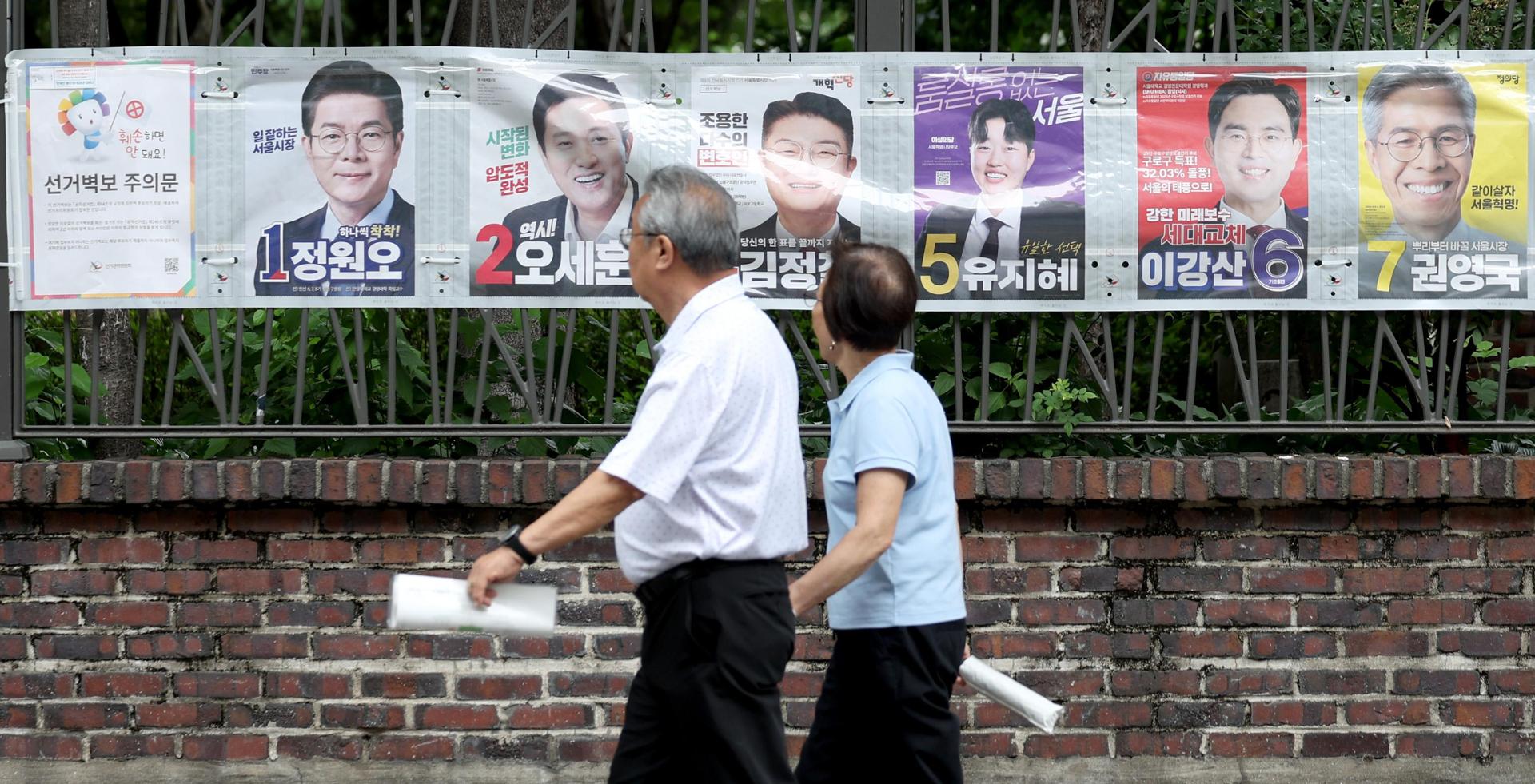
WANG SON-TAEK The debate over the “principal enemy” has resurfaced in Korean politics. The controversy arose amid the ongoing local election campaign. It began when some of the conservative candidates across the country demanded that candidates from the progressive camp identify who South Korea’s principal enemy is. Progressive candidates responded that the question itself was a maliciously simplistic, binary trap and countered by asking why such an inappropriate question was being raised in the first place. Conservatives, in turn, launched attacks, arguing that North Korea is obviously the principal enemy and that the refusal to name North Korea as the principal enemy reveals a dangerous security mindset.The “principal enemy” controversy is not new in South Korea. It is a classic example of the ideological labeling and red-baiting that have repeatedly appeared in a divided nation. Yet history has shown that such ideological tactics do not strengthen the nation's security or contribute to its development. On the contrary, they deepen social division and weaken national cohesion. What makes the current debate especially troubling is the apparent social amnesia surrounding why the “principal enemy” argument is so absurd and fundamentally flawed. The problem is not merely that the debate lacks legitimacy or justification. It is also strategically obsolete and self-defeating. Why is this so?First, politically speaking, the concept of a “principal enemy” has become increasingly ambiguous in an age of globalization and interdependence following the end of the Cold War in 1991. During the Cold War, identifying a principal enemy was relatively straightforward. For socialist countries, capitalist states were the enemy. For countries aligned with the US-led Western bloc, the Soviet-led communist bloc constituted the principal enemy. But after the Cold War ended and the world was reorganized under a US-led unipolar order, international relationships were fundamentally redefined.Countries still experience conflicts, contradictions and strategic rivalries. Yet even adversarial states often cooperate in selected areas. In an era of deep economic interdependence, nations must maintain trade relations with one another, even while navigating geopolitical conflicts. In such an environment, formally designating another country as the “principal enemy” has become increasingly impractical and diplomatically awkward.Second, from a military and strategic perspective, labeling another country as the principal enemy offers little practical benefit while creating significant costs. Conflicts between states can escalate into war. Yet no country begins a dispute with the intention of resolving it through war alone. Even a victorious war imposes enormous costs in lives and economic damage. For that reason, war is generally treated as a last resort, while diplomacy proceeds in parallel or takes priority. However, once a country officially designates another state as its “principal enemy,” it narrows its own strategic flexibility and reduces room for diplomatic solutions. In effect, it places unnecessary constraints upon itself.Some might argue that abandoning the “principal enemy” concept would weaken military morale because soldiers might struggle to identify the enemy. At first glance, such concerns may appear reasonable. Yet this argument contains a serious flaw: It cannot explain how militaries function in peaceful times and situations where no officially designated “principal enemy” exists. Armies exist not to perpetually pursue a predefined enemy, but to protect the nation against evolving external threats. The claim that soldiers’ morale would collapse without a “principal enemy” concept is therefore fundamentally mistaken.Third, reflecting these realities, many countries today no longer use the concept of a “principal enemy.” Instead, they speak in terms of “threats.” The relationship between the US and China illustrates this point. The US remains the global hegemon, while China is widely viewed as the most consequential challenger to US primacy. Serious contradictions and strategic conflicts undeniably exist between them. Yet neither side formally defines the other as a “principal enemy.” Even when competition intensifies, major powers increasingly frame their strategies in terms of risks, threats and competition rather than formally designating permanent enemies.This reflects the fact that neither country denies the legitimacy of the other’s existence or views the other solely as an enemy to be eliminated. Rather, both acknowledge the necessity of partial cooperation and coexistence. This is not an ideological approach. It is a pragmatic search for the optimal national security strategy.Seen in this light, reviving the “principal enemy” debate during local elections is simply absurd. The concept of a “principal enemy” is relevant in actual wartime conditions when soldiers must distinguish friend from foe on the battlefield. The Korean Peninsula is not presently in active war. The primary mission of its armed forces is therefore to prepare for military threats surrounding the Korean Peninsula. Local elections are not exercises in selecting battlefield commanders, nor are they training programs designed to evaluate soldiers’ combat readiness. They are political events to choose public officials and representatives responsible for governing the nation. Those elected leaders bear responsibility not only for maintaining robust military preparedness but also for strengthening peaceful security conditions through diplomatic efforts. Therefore, the political focus should shift away from sterile debates over the “principal enemy” and toward serious discussions about how to prepare for real military threats.Therefore, if someone insists on asking who the “principal enemy” is, an appropriate answer might be this: “The question belongs to the Cold War era. In South Korea in 2026, the appropriate national security question is not 'Who is the enemy?' but 'What are the threats?'" Our most serious threat is North Korea’s nuclear and missile program. Therefore, we must maintain military readiness against possible nuclear and missile attacks while simultaneously pursuing diplomatic efforts to reduce those threats through dialogue with North Korea. One thing we have to agree on is that the real critical danger comes from divisive rhetoric that fractures national unity in the name of security for the sake of domestic political calculations. Maintaining national cohesion is therefore not separate from national security policy, but part of it.- - -Wang Son-taekWang Son-taek is an adjunct professor at Sogang University. He is a former diplomatic correspondent at YTN and a former research associate at Yeosijae. The views expressed here are the writer’s own. — Ed.
[Wang Son-taek] The futility of the ‘principal enemy’ debate
The debate over the “principal enemy” has resurfaced in Korean politics. The controversy arose amid the ongoing local election campaign. It began when some of t
1,002 words~5 min read