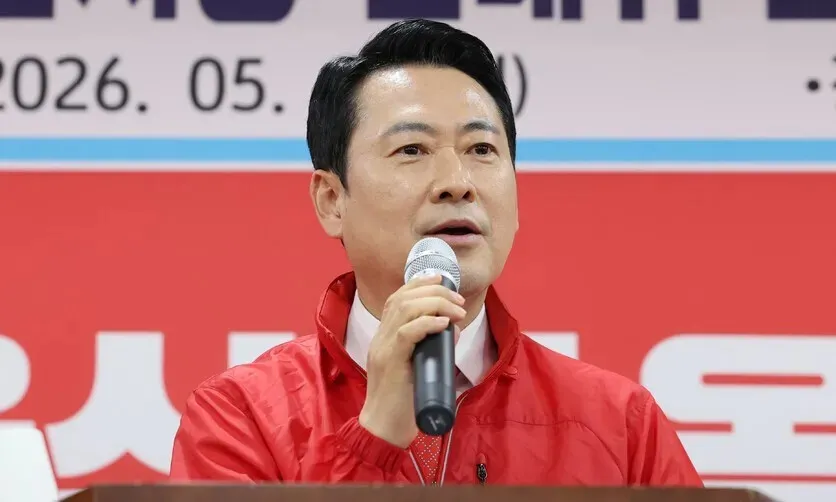
Jang Dong-hyuk, the leader of Korea’s conservative opposition People Power Party, speaks at the launch of a local campaign headquarters in Ulsan on May 11, 2026. (Yonhap)
By Seong Han-yong, senior political writerIn countries that use a presidential system, voters tend to look to the future when they cast their ballots for president. They want to pick the best possible leader of the country going forward.There are exceptions to that general rule. In 2017, and then again in 2025, a presidential election was held to fill a vacancy left by the impeachment of Park Geun-hye and Yoon Suk-yeol. As such, the disastrous performance of those impeached presidents weighed heavily on voters’ minds.But in Korea’s parliamentary elections and regional elections, which are held on different years than presidential elections, voters tend to be looking back, rather than forward. Those elections often function as a referendum on the current administration, which makes them a nerve-racking experience for whoever happens to be in the Blue House.Again, there are exceptions — namely, elections that take place not long after presidents take office. Early-term high approval ratings tend to override the belief that elections should be used to put the current administration in its place. The 2008 general election, which took place after President Lee Myung-bak’s inauguration, the 2018 local elections, which took place one year and one month after President Moon Jae-in stepped into office, and the 2022 local elections that took place after Yoon’s inauguration are good examples. On June 3, exactly a year after President Lee Jae Myung was elected, Koreans will head back to the polls to vote in the local elections. Will they be looking to the future as they cast their ballots, or basing their decisions on the past? Attempts to frame these elections as a way to rein in the administration are unlikely to work on the public considering that Lee’s approval rating is sitting steady in the 60% range. The more that the People Power Party cries that the administration must be taught a lesson, the more that voters are reminded of how high Lee’s approval is. If the PPP had any sense, it would focus less on insisting that elections are referendums and more on issues related to the lives of the people, such as real estate prices, taxes and transportation. Also, the PPP has nominated incumbents in many races for local heads of government, giving ample opportunity for the candidates to emphasize their achievements and advocate for continuity. On April 1, the PPP revealed its first campaign pledge for the July 3 local elections: slashing key deposit prices in the metropolitan area in half. Under the plan, Seoul would provide long-term housing at 50% of the market rate, eventually expanding this initiative throughout the metropolitan area. For his No. 1 pledge in his reelection campaign, Seoul Mayor Oh Se-hoon of the PPP put forward a plan that would provide people with places to exercise within a 10-minute walk of their homes. Busan Mayor Park Heong-joon, also running for reelection on the PPP’s nomination, introduced a comprehensive income plan that would allow young people in Busan to accumulate 100 million won within 10 years as his first campaign pledge. All of these are excellent pledges. However, voters are largely unaware of such platforms. Why? Because someone is pushing all agendas related to day to day lives of the people aside to focus on how the election must be used to punish the current Democratic administration. That someone is none other than Rep. Jang Dong-hyuk, the leader of the PPP. During a press briefing with foreign correspondents on Friday, Jang said that “impeachment isn’t the only way to deal with martial law,” regarding the removal of Yoon from office after his abortive coup in 2024. “Internal conflict prevented us from persisting long enough to see what other methods were available to us, and instead, we were the ones to open up the doors for impeachment,” he said. Such balderdash is typical of someone who believes that Yoon should be returned to power. Pray, what were some of the methods aside from impeachment that could have been utilized to end Yoon’s attempt at insurrection? “We will not waver or forsake the values of our party, nor will we step forward in a direction that caters more to the wants of centrists simply to win them over,” Jang also said. He has basically declared that he will not focus on growing the PPP’s tent to include centrists but go into the elections riding solely on hardcore Yoon supporters. Puzzling, is it not? In an op-ed published by a conservative American media site, Jang recently slammed the Lee administration for cozying up to China, North Korea, embracing communism, and eroding the rule of law. By writing that “the current regime has declared the full restoration of Korea-China relations. It declared Seoul respects the North Korean system,” Jang claimed that the Lee administration had adopted a conciliatory approach to North Korea and China. Jang is making the interesting decision to parrot Yoon and his insistence on partisan attacks, which were used as a pretext for his declaration of martial law. When elections become a contest of pragmatism versus ideology, pragmatism wins every time. Korea’s conservative parties have never once won by resorting to far-right tactics of making partisan attacks in national elections.When during his tenure as the leader of the conservative Liberty Korea Party in 2018, Hong Joon-pyo lambasted the US-North Korea summit as a “charade of peace,” his party experienced a crushing defeat in the local election. During the campaign for the 2020 general election, Hwang Kyo-ahn, the leader of the United Future Party, attempted to politicize COVID-19 by referring to it as “Wuhan pneumonia,” only to be annihilated in the elections. Is Jang unaware of the blunders of his predecessors? He must be — why else would be taking the path of certain demise? The Democratic Party must be counting their blessings that Jang is the way that he is. The Democratic Party has recently had to address various controversies. After proposing a bill that would grant the special counsel investigating the manipulation of indictments the authority to dismiss charges related to the president, the party backed down after facing public backlash. Rep. Park Sung-joon recently made a gaffe by saying that the public doesn’t really understand the concept of dropping charges. Rep. Jung Chung-rae, the leader of the Democratic Party, made a scandalous remark by telling a first grader to call him “oppa.” These incidents shook the president’s approval rating and support for the Democratic Party considerably. Jang is failing to capitalize on this good fortune and, instead, is placing the PPP at a disadvantage. A masterful gambit indeed. At times, those who win elections do not win because they ran a better campaign, but because their opponents ran a worse one. Right now, the Democratic Party and the PPP are competing to see who can give the most atrocious performance, and the PPP is currently winning. It is indeed a sorry sight to behold.Please direct questions or comments to [english@hani.co.kr]