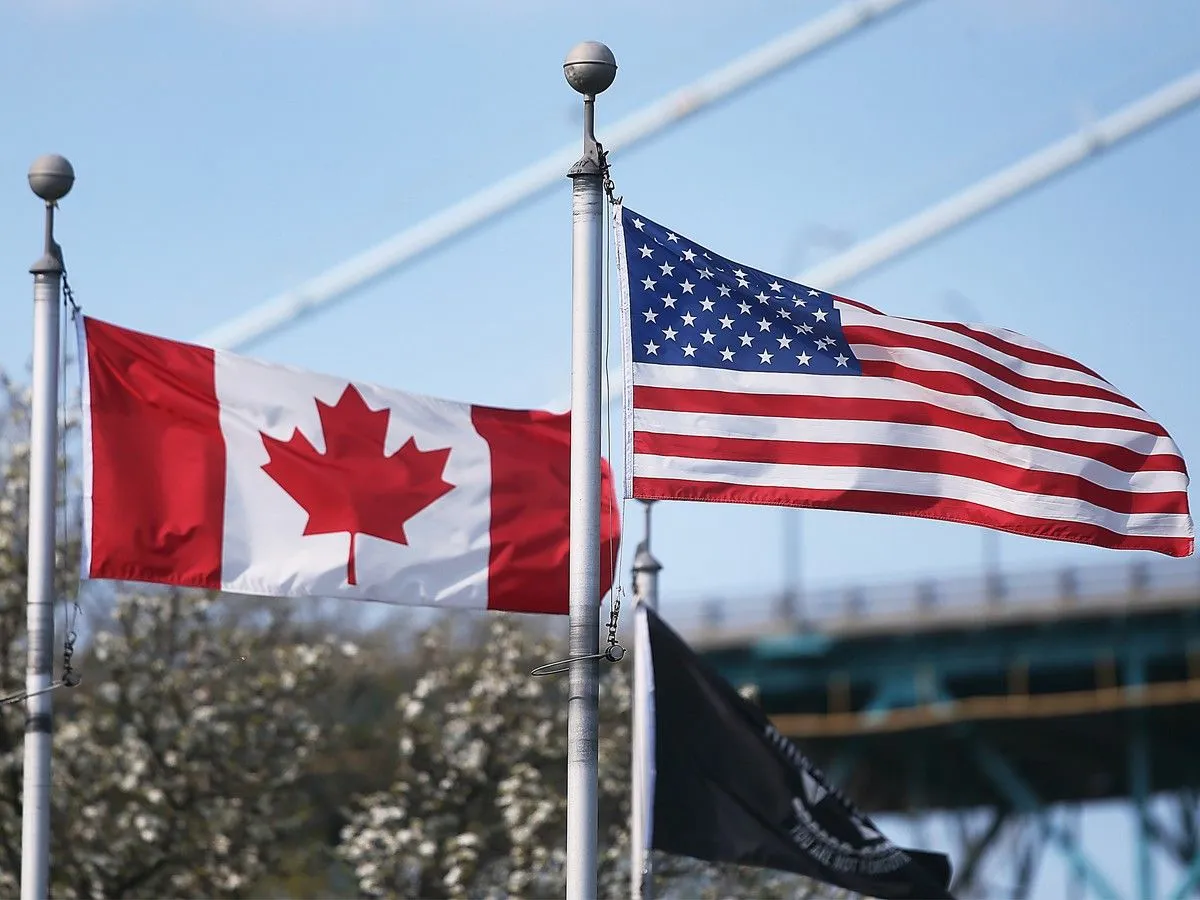
Skip to Content News Archives Economy Energy Oil & Gas Renewables Electric Vehicles Mining Commodities Agriculture Real Estate Mortgages Mortgage Rates Finance Banking Insurance Fintech Cryptocurrency Work Wealth Smart Money Wealth Management Investor Personal Finance Family Finance Retirement Taxes High Net Worth FP Comment Executive Women Puzzmo Newsletters Financial Times Business Essentials More Innovation Information Technology FP500 Podcasts Small Business Lives Told Tails Told Shopping Financial Post Store Obituaries Place a Notice Advertising Advertising With Us Advertising Solutions Postmedia Ad Manager Sponsorship Requests Classifieds Place a Classifieds ad Working Profile Settings My Subscriptions Saved Articles My Offers Newsletters Customer Service FAQ News Economy Energy Mining Real Estate Finance Work Wealth Investor FP Comment Executive Women Puzzmo Newsletters Financial Times Business Essentials HomeEconomyAutosCanadian auto industry divided on Trump's proposed 50% U.S. content ruleFirst real indication that Trump may not be seeking to completely shut Canada out of North American supply chain You can save this article by registering for free here. Or sign-in if you have an account.A Canadian and American flag are shown along the Detroit River in Windsor on Tuesday, April 21, 2026. (Windsor Star - Dan Janisse); logo Canada U.S. border Photo by Dan Janisse /The Windsor StarUnited States President Donald Trump’s push that all vehicles built in North America contain at least 50 per cent U.S. content is dividing leaders in Canada’s largest automotive manufacturing cluster over whether it represents an opportunity.Subscribe now to read the latest news in your city and across Canada.Exclusive articles from Barbara Shecter, Joe O'Connor, Gabriel Friedman, and others.Daily content from Financial Times, the world's leading global business publication.Unlimited online access to read articles from Financial Post, National Post and 15 news sites across Canada with one account.National Post ePaper, an electronic replica of the print edition to view on any device, share and comment on.Daily puzzles, including the New York Times Crossword.Subscribe now to read the latest news in your city and across Canada.Exclusive articles from Barbara Shecter, Joe O'Connor, Gabriel Friedman and others.Daily content from Financial Times, the world's leading global business publication.Unlimited online access to read articles from Financial Post, National Post and 15 news sites across Canada with one account.National Post ePaper, an electronic replica of the print edition to view on any device, share and comment on.Daily puzzles, including the New York Times Crossword.Create an account or sign in to continue with your reading experience.Access articles from across Canada with one account.Share your thoughts and join the conversation in the comments.Enjoy additional articles per month.Get email updates from your favourite authors.Create an account or sign in to continue with your reading experience.Access articles from across Canada with one accountShare your thoughts and join the conversation in the commentsEnjoy additional articles per monthGet email updates from your favourite authorsSign In or Create an AccountorSome in Windsor-Essex, Ont., a region deeply tied to North America’s automotive supply chain, are welcoming the departure from Trump’s earlier rhetoric against Canada-made vehicles.“It seems like this is a progression on a stance that was very much America only; American cars, we don’t need Canadian cars,” Windsor Essex Chamber of Commerce chief executive Ryan Donally said.Get the latest headlines, breaking news and columns.By signing up you consent to receive the above newsletter from Postmedia Network Inc.A welcome email is on its way. If you don't see it, please check your junk folder.The next issue of Top Stories will soon be in your inbox.We encountered an issue signing you up. Please try again“This isn’t them saying we’re shutting out all Canadian-made content or we’re shutting out all Canadian-made cars. They’re obviously setting the stage for what they expect to see in negotiations, but I do think that this is a good starting point. It’s at least a movement forward.”Donally said North American-built vehicles already contain close to 50 per cent U.S. content and that Windsor-Essex, home to an abundance of Tier 2 and Tier 3 lower-level auto suppliers, would not be extremely affected by the proposed U.S. content requirement since many of these suppliers sell components to American companies that manufacture auto parts in the U.S.“If you’ve got a (Windsor-based) dye maker, a mould maker, they’re likely selling that product to the United States,” he said. “Then that car part itself would be an American car part, but could then be installed in a Canadian vehicle down the road. The full integration is important.” Ryan Donally, president and CEO of the Windsor Essex Chamber of Commerce speaks on Tuesday, April 22, 2025 in Windsor. Photo by Dan Janisse /Windsor Star Ensuring that Tier 2 and Tier 3 suppliers are considered as part of this overall (CUSMA) negotiation is extremely important, he said.Throughout his second term, Trump has often declared that the U.S. does not need Canadian-built vehicles, but has also introduced tariffs that have increased pressure on manufacturers to move production south of the border.The latest proposal is the first real indication the Trump administration may not be seeking to completely shut Canada out of the North American supply chain.Under current CUSMA rules, 75 per cent of a vehicle’s content must come from North America, though there isn’t a U.S. content condition. But the agreement does require that 40 per cent to 45 per cent of a vehicle’s auto parts be built in plants where workers earn an average of at least US$16 an hour, giving Canadian and American manufacturers an edge over Mexico.“We all know that CUSMA is vital to Canada,” Chris Vander Park, international business manager at Windsor-based Cavalier Tool & Manufacturing Ltd., said.The automotive sector remains an important part of Cavalier’s business, but he said it only represents about 20 per cent of exports, so he does not expect a 50 per cent U.S. content requirement to affect his company, which provides custom tooling to Tier 1 and Tier 2 suppliers.“Our business revolves around CUSMA. We’ve built our business on CUSMA,” he said. “Does 50 per cent of a car having to come from the United States hurt? I don’t think so.”But Unifor Local 200 president John D’Agnolo, who represents approximately 2,200 auto workers in the region, said the proposal should not be looked at through rose-coloured glasses while the tariffs that have battered the region’s automotive industry remain in place.“They’ve fallen into the trap,” he said. “Looking at something positive here, but (Trump) does this all the time. He went to the extreme in saying we don’t need Canada when he does know he needs us. Now he’s looking at, ‘OK, we do need you, and this is what we’re going to do for you.’ Meanwhile, he’s just beating us up. You need to start off with a clean slate and then sit at the table.”D’Agnolo said it’s premature to discuss parts-of-origin rules before Canada sits down at the negotiating table with the U.S. to remove existing tariffs.Canada has not yet entered formal negotiations with the U.S. and was not part of the latest round of talks in Mexico City. On Tuesday, Canada formally notified its U.S. and Mexican counterparts in a letter that it wants to renew the CUSMA agreement when it comes up for review July 1.“We’ve got people’s livelihoods on the line here,” D’Agnolo said. “We’re a border city. Everything that we do goes back and forth across this border within our auto industry, within our parts industry. These deals are important because of the impact they would have, especially on a border city where a lot of the manufacturing is based.” Join the Conversation This website uses cookies to personalize your content (including ads), and allows us to analyze our traffic. Read more about cookies here. By continuing to use our site, you agree to our Terms of Use and Privacy Policy.
Canadian auto industry divided on Trump's proposed 50% U.S. content rule
The latest details to emerge from U.S. trade talks with Mexico are viewed as a potential opportunity for some Windsor-Essex manufacturers.
1,285 words~6 min read