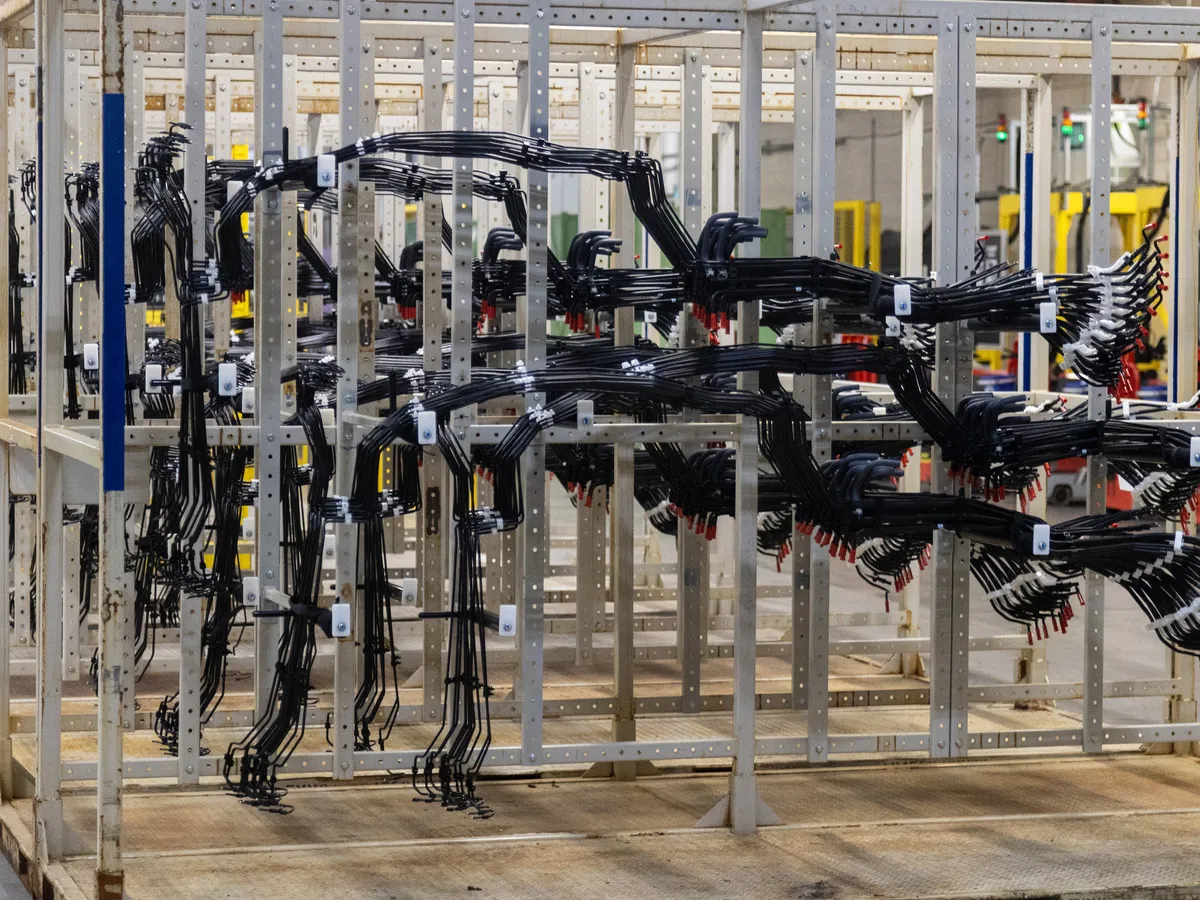
Skip to Content News Archives Economy Energy Oil & Gas Renewables Electric Vehicles Mining Commodities Agriculture Real Estate Mortgages Mortgage Rates Finance Banking Insurance Fintech Cryptocurrency Work Wealth Smart Money Wealth Management Investor Personal Finance Family Finance Retirement Taxes High Net Worth FP Comment Executive Women Puzzmo Newsletters Financial Times Business Essentials More Innovation Information Technology FP500 Podcasts Small Business Lives Told Tails Told Shopping Financial Post Store Obituaries Place a Notice Advertising Advertising With Us Advertising Solutions Postmedia Ad Manager Sponsorship Requests Classifieds Place a Classifieds ad Working Profile Settings My Subscriptions Saved Articles My Offers Newsletters Customer Service FAQ News Economy Energy Mining Real Estate Finance Work Wealth Investor FP Comment Executive Women Puzzmo Newsletters Financial Times Business Essentials HomeNewsEconomyTransportationAutosCanada's auto sector will survive trade upheaval with U.S., negotiator says'There’s some simple math that isn’t getting through,' says Janice Charette You can save this article by registering for free here. Or sign-in if you have an account.Racks of hydraulic lines await their turn to be installed at Toyota’s Woodstock manufacturing plant in the new edition of the 2026 Toyota Rav4. Photo by Mike Hensen/The London Free Press filesCanada’s chief trade negotiator with the United States says she believes this country’s auto manufacturing sector will survive the current trade upheaval with its long-time partner.Subscribe now to read the latest news in your city and across Canada.Exclusive articles from Barbara Shecter, Joe O'Connor, Gabriel Friedman, and others.Daily content from Financial Times, the world's leading global business publication.Unlimited online access to read articles from Financial Post, National Post and 15 news sites across Canada with one account.National Post ePaper, an electronic replica of the print edition to view on any device, share and comment on.Daily puzzles, including the New York Times Crossword.Subscribe now to read the latest news in your city and across Canada.Exclusive articles from Barbara Shecter, Joe O'Connor, Gabriel Friedman and others.Daily content from Financial Times, the world's leading global business publication.Unlimited online access to read articles from Financial Post, National Post and 15 news sites across Canada with one account.National Post ePaper, an electronic replica of the print edition to view on any device, share and comment on.Daily puzzles, including the New York Times Crossword.Create an account or sign in to continue with your reading experience.Access articles from across Canada with one account.Share your thoughts and join the conversation in the comments.Enjoy additional articles per month.Get email updates from your favourite authors.Create an account or sign in to continue with your reading experience.Access articles from across Canada with one accountShare your thoughts and join the conversation in the commentsEnjoy additional articles per monthGet email updates from your favourite authorsSign In or Create an Accountor“There’s some simple math that isn’t getting through,” Janice Charette said on Thursday at the Auto Parts Manufacturers’ Association’s automotive conference in Vaughan, Ont. “Like we have a surplus, the United States has a surplus in terms of our auto trade with them. There’s a lot of powerful arguments that we could make.”Her remarks provided an upbeat note at a conference dominated by reports that Canada’s auto sector is at a hinge moment and faces pressures that could lead to severe decline if not corrected.Get the latest headlines, breaking news and columns.By signing up you consent to receive the above newsletter from Postmedia Network Inc.A welcome email is on its way. If you don't see it, please check your junk folder.The next issue of Top Stories will soon be in your inbox.We encountered an issue signing you up. Please try againHer team, along with Minister of International Trade Dominic LeBlanc, is focused on eliminating the sectoral tariffs that U.S. President Donald Trump has enacted on finished vehicles as well as on key inputs such as steel and aluminum.She said her team is also dealing with the upcoming Canada-U.S.-Mexico Agreement (CUSMA) negotiations. On July 1, the three countries must decide whether to renew the agreement and extend it for an additional six years to 2042.Leblanc has publicly indicated this would be in Canada’s best interest, but the U.S. has not yet made its position clear.If CUSMA is not extended, it remains in place until 2036, but under the pressure of annual reviews.Charette said the best-case scenario is that the parties come together in July and agree to remove tariffs and renew the agreement to 2042.She also said the integrated North American auto sector represents the “coal face” or “ground zero” of Canada’s relationship with the U.S. because both countries have benefitted.The U.S. benefits because Canada represents the largest export market for vehicles made in the U.S. and Canada benefits because auto manufacturing represents a cornerstone of the economy.Charette’s optimism contrasted with some of the other speakers at the summit.Honda Canada Inc. chief executive Dave Jamieson blamed domestic policies for weakening the country’s auto sector at a time when it is already dealing with trade tensions with its main export market and a “once-in-a-generation” electric vehicle (EV) transition.Too often, he said, environmental policies in Canada are not aligned with industrial policy, pointing to Quebec and British Columbia requiring automakers to meet escalating sales of zero-emission vehicles and not placing enough emphasis on hybrid vehicle sales.Honda Canada in April indefinitely suspended its planned $15-billion investment in an EV and battery manufacturing complex in Alliston, Ont. Jamieson said it’s not a “cancellation,” but cited three long-term threats to the future of Canadian auto manufacturing.The first is maintaining predictable access to the U.S. market, without which, he said, it is difficult to justify the scale of investment needed to manufacture vehicles.Jamison also warned that trade tensions with the U.S. may rise in the short term.“We’re in for a very difficult 90-day period,” he said at the conference. “I hope Canadians have a stomach for it. It’s going to get nasty.”Secondly, he said Canada needs to put guardrails in around new entrants. Although he did not specifically mention China, he said “low-cost, state-subsidized non-market” competitors would create market imbalances.“We didn’t arrive on Canadian shores with kits from Japan, using Japanese workers and parts from Japan,” he said. “In contrast, Honda very quickly integrated itself into the fabric of Canada.”Jamieson also called for changes to the regulatory environment to encourage investment.He said hybrid vehicles are the best path forward since they cost less, perform well in Canadian winters and still reduce emissions by 25 per cent to 30 per cent.Last year, Honda produced 400,000 of the 1.2 million vehicles in this country, but Jamieson said both of the vehicles the company produces here, the Civic and the CRV, are also produced in the U.S. and allocation could shift if Canada becomes more expensive or less competitive.“We stand to lose future production allocation to another more favourable place,” he said. “This loss rarely happens all at once. It unfolds gradually.” Get the latest from Gabriel Friedman straight to your inbox Join the Conversation This website uses cookies to personalize your content (including ads), and allows us to analyze our traffic. Read more about cookies here. By continuing to use our site, you agree to our Terms of Use and Privacy Policy.
Canada's auto sector will survive trade upheaval with U.S., negotiator says
Janice Charette said she believes Canada's auto manufacturing sector will survive the current trade upheaval with the U.S. Find out more.
1,178 words~5 min read