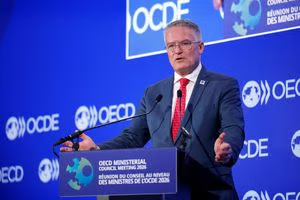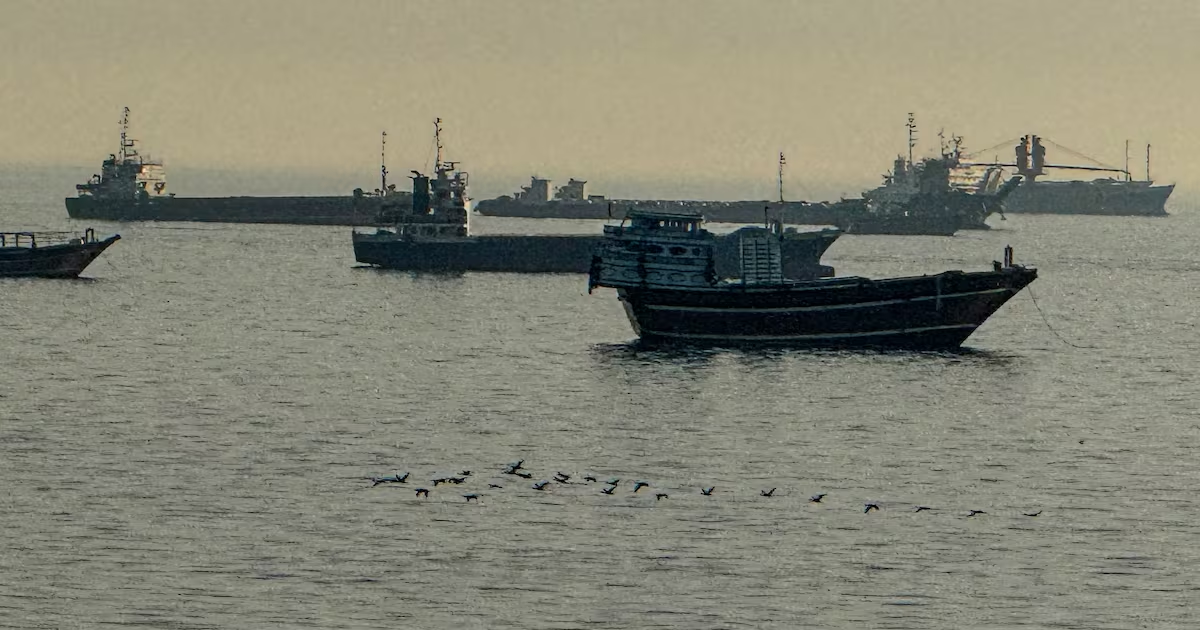
Failure to resolve the energy crisis in the Middle East would plunge the world into a “dark scenario” of tumbling growth and sharply higher interest rates, the OECD has warned.The Paris-based organisation said a “prolonged disruption” to energy flows that lasts into the second half of 2027 would cut global growth to 2.1 per cent this year and just 1.8 per cent next year.Such rates are “extremely low outside of big global recessions such as the global financial crisis or the pandemic”, the OECD warned, adding that big central banks such as the US Federal Reserve would need to respond by lifting interest rates at least a half-point to curtail inflation risks.Efforts to move beyond the fragile truce between Washington and Tehran have faltered in recent days as Iran attacked a US military base in Kuwait in response to American strikes against military targets in southern Iran. This has damped hopes that a deal may be close to reopen the Strait of Hormuz to more ships.In its latest global outlook, the OECD’s central scenario assumes that the crisis can be resolved soon. If energy prices follow current levels on the futures market, global growth will decline this year to 2.8 per cent from 3.4 per cent in 2025. It will rise to 3.1 per cent in 2027, the OECD said. Under this central scenario, US growth will slow to 2 per cent this year from 2.1 per cent in 2025. US inflation will hit 3.7 per cent this year, far above the Fed’s 2 per cent target, but less than the 4.2 per cent the OECD had forecast in March.Among G7 countries, the UK will have the joint highest inflation rate this year alongside the US, with price growth of 3.7 per cent.In Europe, under the baseline scenario, euro zone growth is seen slowing from 1.4 per cent to 0.8 per cent this year before rising to 1.2 per cent next year as resilient labour markets and higher defence spending help offset government belt-tightening.The OECD says Ireland’s economy is projected to contract by 1 per cent in 2026, due to the unwinding of a front-loading of exports, geopolitical uncertainty and higher energy prices. GDP will grow by 2.9 per cent in 2027, helped by an export market recovery. “Underpinned by a relatively resilient labour market, modified domestic demand, which controls for the main distortions arising from multinational activity, is projected to moderate but grow by 2.1 per cent in 2026 and 2.5 per cent in 2027″ the report says.“Amid windfall corporate tax gains, a binding domestic fiscal rule will be vital to ensure medium-term fiscal sustainability,” it cautions.Minister for Finance and Tánaiste, Simon Harris welcomed the OECD forecasts for the Irish economy.“While these forecasts remain broadly consistent with our own assessment of the economy, they underline the more challenging international environment that now exists,” Harris said. “All-in-all, the OECD’s analysis highlights why we must plan for all eventualities at this very uncertain time.”Among other things, the OECD says Ireland should consider more targeted measures to blunt the impact of the energy shock and calls for more streamlined planning for “accelerate the deployment of renewable generation capacity” to enhance energy security.“Around one-third of OECD economies are projected to experience negative real wage growth this year. Workers in these countries will see their living standards fall, which is the human reality behind the inflation numbers,” OECD secretary general Mathias Cormann said.Global trade growth is set to moderate following a strong 2025, though robust demand for AI-related goods and investment, especially in Asia, should provide some support.Stefano Scarpetta, the OECD’s chief economist, said: “I hope we are not already into the prolonged disruptions scenario, because this is a very dark scenario.”Under this outlook, energy prices would be 50 per cent higher than levels currently implied by futures markets. There would be “substantial shortages” of energy products and agricultural and industrial inputs produced by the Gulf economies.This would result in “scarring effects on potential output”, with knock-on effects for financial markets and confidence, the OECD said.It could also damage AI investment because of the sector’s high energy demands and given the importance of commodities from the Gulf in industries such as semiconductors.Major central banks would need to lift interest rates by between 0.5 and 0.75 percentage points to prevent so-called second-round effects from the energy price surge diffusing into the wider economy.Pressures on governments’ finances would increase, the OECD added, especially in weaker economies. Higher interest rates would limit the space available for governments to introduce “discretionary measures to help stabilise activity”. – Copyright The Financial Times Limited 2026
OECD warns of ‘dark scenario’ if Gulf energy crisis drags on
Growth rates would tumble to levels rarely seen outside of big global events such as the Covid-19 pandemic, report says
765 words~3 min read