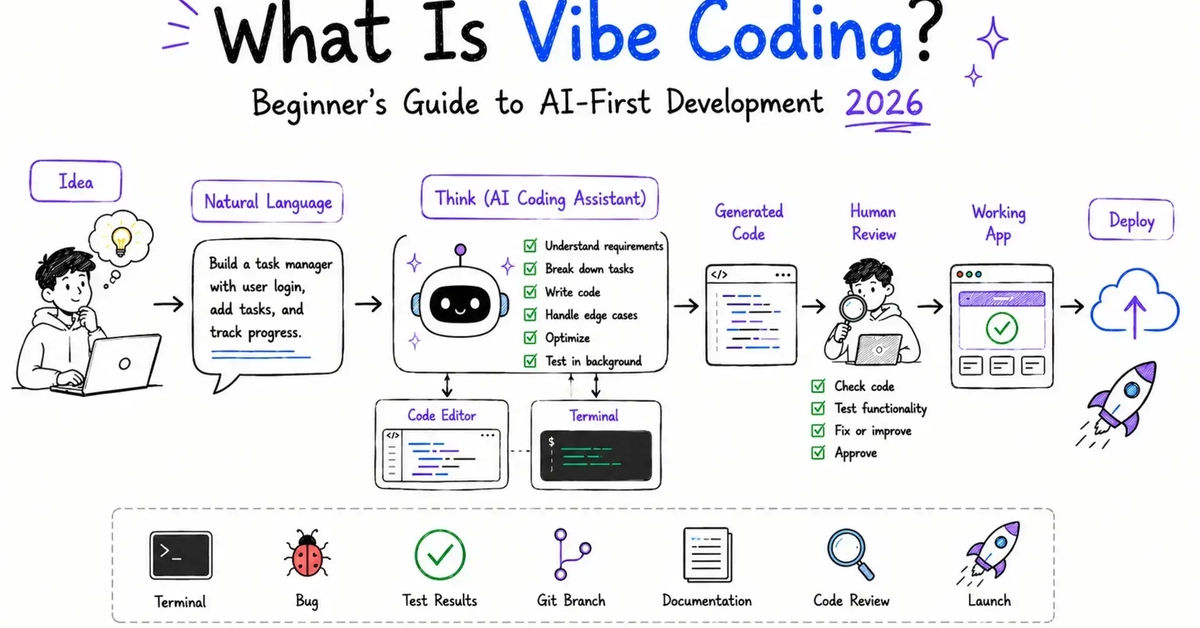
Alexey Spas is the founder and CEO of Instinctools, a software engineering company focused on AI-powered digital solutions.gettyWhen developers started kicking tires on vibe coding, what had been taking late nights and a minor collapse in morale could suddenly be built before lunch, or over a cup of coffee (if not just a sip). That kind of speed made the old development calendar look ridiculous. Faster code generation put pressure on the rest of the system. When teams gained speed at the keyboard, the unfinished work started to pile up in testing, security review, release management and operations.The Backlog Has Changed ShapeFor years, software leaders measured pain in features waiting to be built. Although AI coding has started to shrink that queue, so far it looks like it’s taking away with one hand and giving back with the other. The truth is coding accounts for roughly a quarter of the trip from idea to launch. Once its generation speeds up, the other three quarters of the work (review, integration, release, maintenance) do not vanish, but rather inherit the strain.I speak with developers almost every day, and here are the vibe-coding side effects they keep describing—in their own words:“Codebases are rapidly putting on weight.”“Simple features come back bloated, verbose and over-engineered, with layers of abstraction no one asked for.”“Documentation multiplies, but the system is no easier to understand.”“Vulnerabilities slip through because the code is arriving faster than security teams can inspect it.”“Senior engineers have been turned into slop janitors, while junior engineers accept whatever the model produces.”“When something breaks, debugging takes longer because no one fully understands the AI-generated code they are now responsible for.”Those may sound like developers’ routine grumblings—always one complaint or another—but don’t rush to chalk it up as such. The moment shady AI-written code touches customer data, regulated processes, financial workflows or operational systems that other teams depend on, it can create serious business problems, slowing down future work and making it more expensive.Enterprise Pain In Context, Testing And TrustEnterprise systems are full of local history: brittle integrations, odd edge cases and policies that make little sense until a regulator or a customer complaint explains them. That is where the gap between SMBs and large companies becomes visible. An enterprise has to think several moves ahead—it cannot build its future on shiny one-day apps that no one can govern, secure or maintain.In other words, “almost right, but not quite” is not an option. If a prototype can live on vibes, a production system cannot tolerate rough edges. Somebody has to trace the logic, reconstruct the assumptions and decide whether the code is merely awkward or materially unsafe.Security raises the stakes even higher. However impressive AI models may be at generating lines of code in seconds, they are not yet at their top game when it comes to reasoning through how that code will behave in a live environment with real users, permissions, inputs and dependencies.This is also why the good ol’ human-in-the-loop reassurance does not go very far on its own. A human where? Reviewing what? With how much context, and under what time pressure? If teams are suddenly producing ten times more code while understanding stays flat, a nominal human checkpoint can become little more than a comforting ritual.Vibe Coding Creating A Cleanup EconomyMarkets have a way of forming around whatever becomes scarce. In the case of AI-powered software engineering, it is a disciplined judgment. Enterprises need to know whether what was generated is readable, secure and safe to run inside a real system. And just like that, vibe coding cleanup is morphing into a serious service category, picking up where prompts leave off.One can think about AI-assisted development in terms of three overlapping layers: code quality, code security and supply-chain security. The playbook is still being written, but established developers have already cut their teeth on some practices that are becoming table stakes. The first is a controlled development environment: approved tools, clear security and privacy rules, token controls and custom agents that operate within defined boundaries. The second is data preparation. Before delegating software engineering to AI agents, teams need clean schemas, consistent formats and a reliable context layer; otherwise, the model simply amplifies ambiguity. Reusable context bundles can help here, giving the system stable architectural patterns, naming conventions and coding rules instead of asking it to improvise each time.Then come the guardrails. Serious teams define where AI can write, which modules it can touch and which architectural rules are non-negotiable. Non-compliant output should be rejected early, before it becomes a pull request someone has to untangle.Validation has to be layered as well. Every AI-generated output should be treated as untrusted until it passes tests, static analysis, dependency scanning, secret scanning and security checks.Speaking of the human role, it needs to be specific, with things like senior sign-off on meaningful change where the stakes are high and accountability for what gets merged. Some teams now add AI-to-AI review, using one model to generate, another to challenge, and another to test structure, edge cases or consistency. Anthropic’s code review documentation points in this direction too, describing parallel agents that inspect proposed code changes and surrounding code from different angles.ConclusionNow, when code generation feels almost effortless, what still requires effort is making that code safe, maintainable and worthy of production. So, in this next era of software development, speed is becoming a small matter, while trust is definitely a much bigger one. Forbes Technology Council is an invitation-only community for world-class CIOs, CTOs and technology executives. Do I qualify?
How The Real Cost Of Enterprise Vibe Coding Shows Up After The Prompt
Markets have a way of forming around whatever becomes scarce.
923 words~4 min read