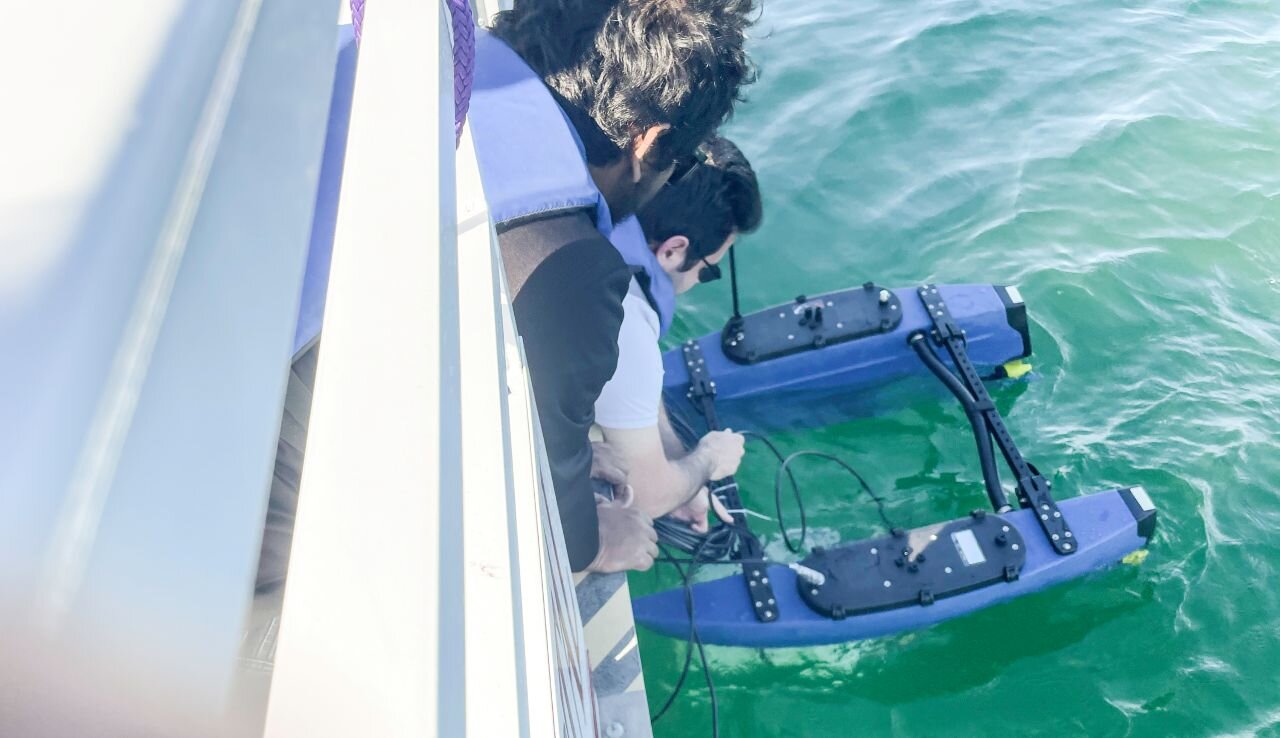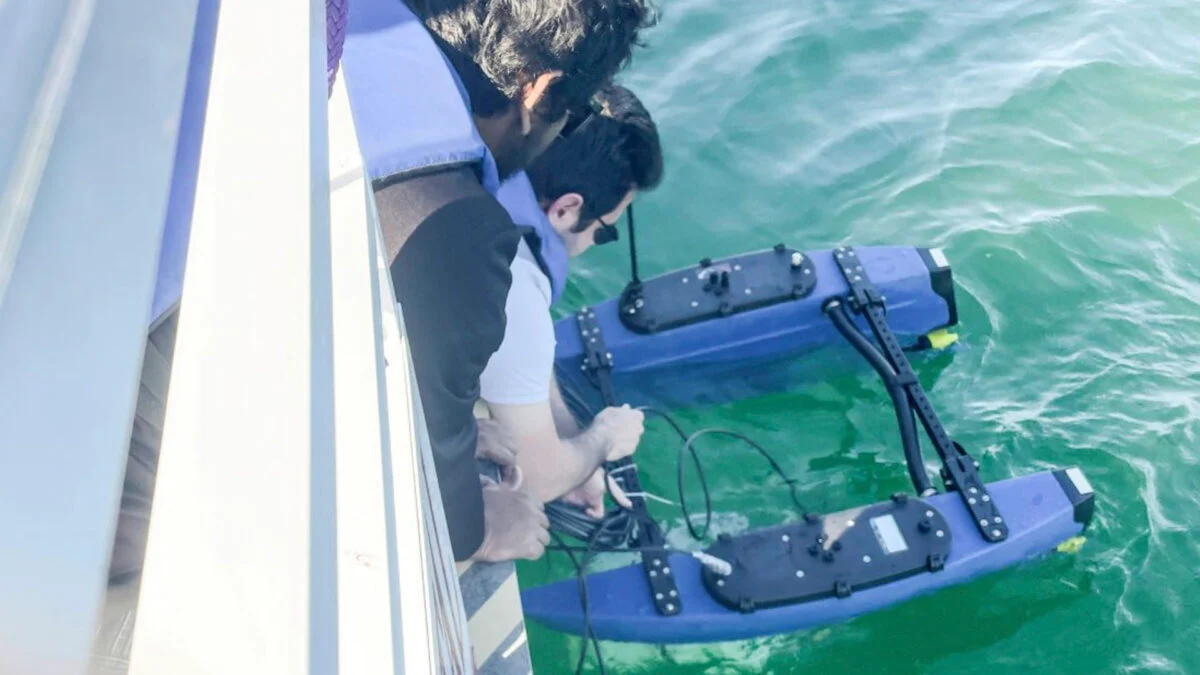
Wireless underwater communication is just hard. A vacationing friend (or maybe even your own experience) has perhaps already shown you, for example, that the ocean just totally absorbs a Bluetooth wireless signal due to water’s 2.4 GHz resonance frequency. Scientists and military contractors have been tinkering for decades on innovations that might bridge this communications lag, testing out optical laser pulses, radio-frequency schemes, magnetic induction relays, and anything really to get faster than sonar’s sluggish speed of sound. But, last month, engineers with the University of Florida (UF) published what they promise is a cost-effective breakthrough: a magnetoelectric antenna capable of efficiently transmitting and receiving very low and low-frequency (VLF/LF) electromagnetic signals underwater. “Our design benchmark was to keep power consumption very low, ideally lower than a standard stereo camera system, while maintaining robust communication performance,” one of the project’s leaders, UF computer scientist Md Jahidul Islam, explained in a press statement.
“Our compact, energy-efficient BlueME system achieves that balance, operating around 10 watts of power at maximum capacity,” according to Islam, whose ocean experiments confirmed that these antennas can communicate quickly across 2,296 feet (700 meters) on their frugal energy budget.