view more
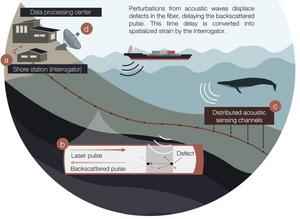
Fibre-optic cables lace the planet’s oceans, carrying everything from telephone conversations to banking information. In 2020, researchers at the Norwegian University of Science and Technology (NTNU) figured out that those cables can also serve as a passive listening device, allowing them to detect the deep rumbles of whale sounds in the frigid waters off Svalbard.
When we saw this, we knew the next step was to look for whales.
Now researchers have discovered how to use fibre optic cables to “listen” to whales, even when they don’t make any sound. The secret is that whales, like ships, push water ahead of them as they swim – which creates a very low frequency pressure wave that the fibre-optic cables can detect.
“If the whales are silent, their body movement causes disruptions in the water and the sediments, so that we can detect them, even if they aren't making any noise,” said Martin Landrø, head of NTNU’s Centre for Geophysical Forecasting and the senior author of a new paper just published in PNAS, the Proceedings of the National Academy of Sciencs.