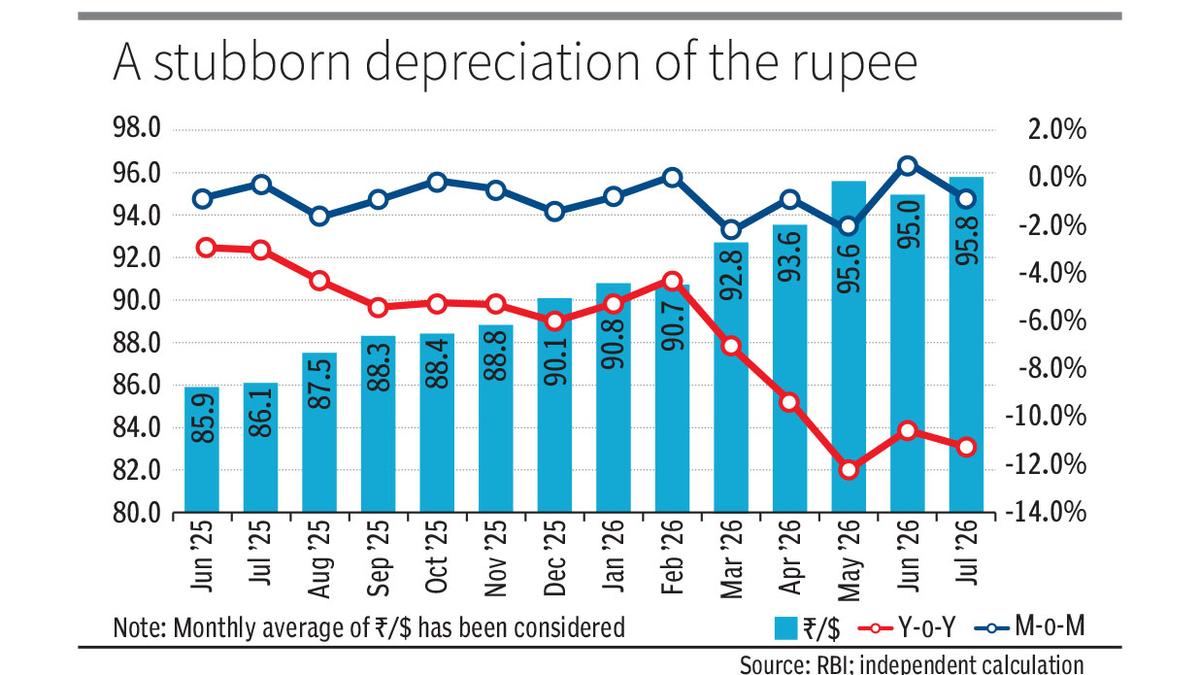
India’s exchange-rate debates often proceed as though the price of the rupee were merely another financial price best left to market correction and macroeconomic adjustment. In theory, a weakening currency performs a useful balancing function. Imports become costlier, domestic demand adjusts, exports become more competitive, and external imbalances gradually stabilize. It is a clean textbook mechanism, elegant in abstraction, and widely accepted within orthodox macroeconomics.
But, economies, especially emerging market economies, do not experience exchange-rate depreciation in abstraction. They experience it through speculative attacks, fuel prices, transport costs, electricity bills, food inflation and falling real wages.
What often disappears in these debates is that currencies do not depreciate uniformly across society. Their effects travel unevenly through economies, across classes, sectors and regions.
India imports nearly 88.6 percent of its crude oil requirements, close to half of its natural gas consumption, substantial fertilizer inputs, edible oils, electronics components, and industrial intermediates. These are not discretionary imports that households or firms can easily reduce in response to a weaker currency. Their demand remains structurally inelastic in the short run.