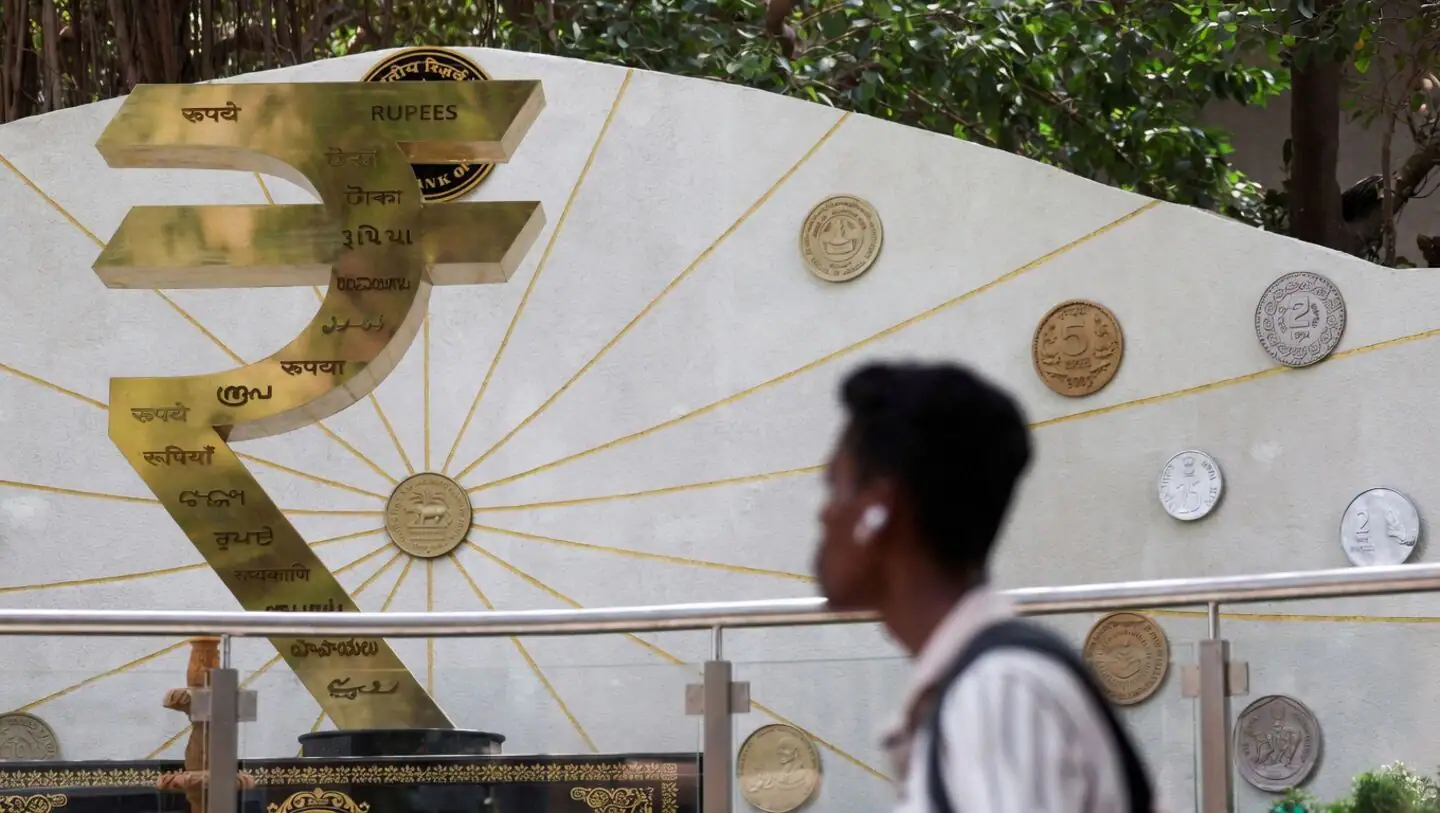
Falling rupee: Managing the consequences
| Photo Credit:
Rasi Bhadramani
The rupee touching 96.96 to the dollar on May 20 was not simply a story of crude oil, dollar strength, or foreign portfolio outflows. Those were the triggers. The deeper issue is that India is operating inside the classic open-economy trilemma: the attempt to preserve currency stability, monetary-policy autonomy, and access to global capital at the same time.India does not sit at any pure corner of this triangle. It has partial capital controls, a managed float, and an inflation-targeting central bank. But partial insulation is not full insulation. The pressure is visible in the data: the current account deficit widened to 1.3 per cent of GDP in the December quarter of FY26, driven by a higher merchandise trade deficit, even as services exports and remittances continued to provide a partial cushion.RBI actionThe RBI’s response has been deliberately layered. Rather than using the policy rate as a blunt exchange-rate defence tool, it has relied on foreign-exchange intervention, liquidity management, and balance-sheet instruments. The $5 billion dollar-rupee swap auction, which attracted bids of $9.8 billion, showed the RBI’s preference for managing currency and liquidity pressures without turning monetary policy into a permanent rupee-defence mechanism.This distinction matters more than most commentary acknowledges. If monetary policy becomes a standing support mechanism for the currency, the RBI loses the flexibility to respond to the domestic growth and inflation cycle. Rates calibrated to defend the rupee are not rates calibrated to support credit, investment, or consumption. That may be a worse outcome than allowing some orderly rupee adjustment. A central bank that conflates exchange-rate management with monetary policy ends up doing neither well.Falling shortThe standard response to a slide in rupee typically involves calls to raise rates, intervene more, and attract portfolio flows. Each of these address symptoms rather than causes. Portfolio inflows are reversible by design. Higher rates can attract short-term capital while slowing investment. Forex reserves can smooth volatility but cannot substitute for genuine external competitiveness.Three structural gaps deserve more attention than they are currently receiving.First, India’s energy import bill remains one of the largest sources of current account vulnerability. Despite significant progress in renewable capacity, oil dependence has not declined enough to remove external vulnerability. Policy needs to accelerate the energy transition with greater specificity: fuel-pricing reform, faster electrification of transport, and a credible demand-side strategy. Political convenience has too often delayed these choices.Second, India’s export basket remains too narrow in goods. Services exports, particularly in technology and business process work, are a genuine strength and a stabiliser. But goods exports have repeatedly underperformed their potential, partly because logistics costs remain elevated and partly because India has been slow to embed itself in the regional supply chains that anchor more durable trade flows. The China-plus-one moment offered a real opening. It has been only partially captured, and the window is not permanently open.Third, the composition of capital inflows matters as much as the volume. Foreign direct investment and long-term debt and stable external borrowing are far more reliable anchors than equity and short-duration portfolio flows, which move with global risk sentiment rather than India’s fundamentals. The broader architecture of capital account management needs to tilt incentives more deliberately in this direction.The fiscal dimensionThere is also a fiscal dimension that is often left out of currency commentary. When external balances are under pressure, the fiscal stance matters. Demand-stimulating expenditure can worsen import demand and add pressure to the current account at exactly the wrong time. Fiscal consolidation, in this context, is not merely an austerity argument. It is also an external-stability argument. A government running expansionary policy while the current account is widening and the currency is under stress is adding to the trilemma rather than managing it.The honest reckoningIndia is not in an external crisis. Its reserves are substantial, its services surplus is real, and its growth story remains intact. But the rupee’s weakness is a signal that the comfortable conditions of recent years, low global interest rates, moderate oil prices, and abundant portfolio flows, may not persist indefinitely. The trilemma does not disappear in calm periods; it merely becomes invisible.The rupee is not asking for panic defence. It is asking for a more honest macroeconomic strategy: less dependence on volatile capital, stronger export competitiveness, lower energy-import vulnerability, and a fiscal stance that recognises external constraints rather than ignoring them until they bite.There are no free lunches in open-economy policy. The trilemma is not just a theory. It is the budget constraint of macroeconomic sovereignty in an open economy.Sharma is Assistant Professor, Bennett University; Rahman is Assistant Professor, IILM Lodhi RoadPublished on June 4, 2026