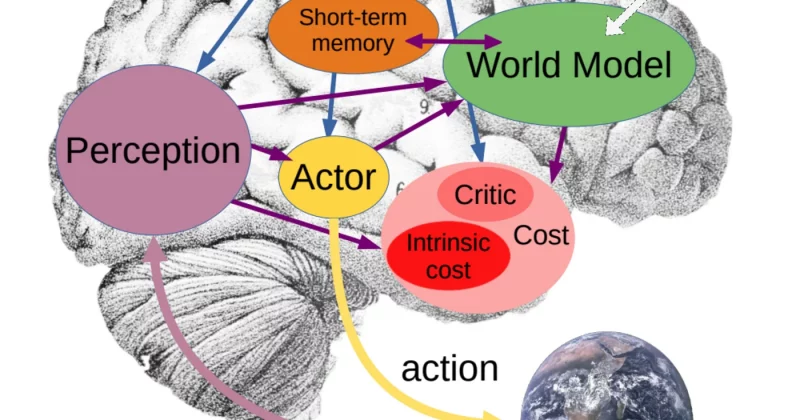
Yann LeCun has spent years arguing that the future of AI isn’t about bigger chatbots or better image generators. It’s about building systems that understand the world the way humans do, by learning predictive models of how things work under the hood. His latest paper puts mathematical rigor behind that vision, and the answer involves a surprisingly specific set of conditions.
The paper, titled “When Does LeJEPA Learn a World Model?” and co-authored with Randall Balestriero and David Klindt, was submitted to arXiv on May 25, 2026. Its core finding: the LeJEPA architecture can reliably recover the true hidden causes behind observations, but only when those latent variables follow a Gaussian distribution and evolve through stationary, additive-noise dynamics.
What LeJEPA actually does, and why it matters
LeJEPA belongs to a family of architectures called Joint-Embedding Predictive Architectures, or JEPAs. Instead of trying to reconstruct raw pixel data, JEPAs learn to predict abstract representations of future states.
The original LeJEPA framework was introduced in 2025 and brought with it a technique called Sketched Isotropic Gaussian Regularization, or SIGReg. That’s a mouthful, but in English: it forces the model’s internal representations to be well-behaved Gaussian distributions, which eliminates a lot of the hand-tuned tricks that earlier self-supervised learning methods relied on.