Yann LeCun, arguably the most credentialed skeptic in artificial intelligence, went on Bloomberg’s “The Close” on May 21 and said what he’s been saying for years, only louder: large language models are not the path to real intelligence. They’re a detour.
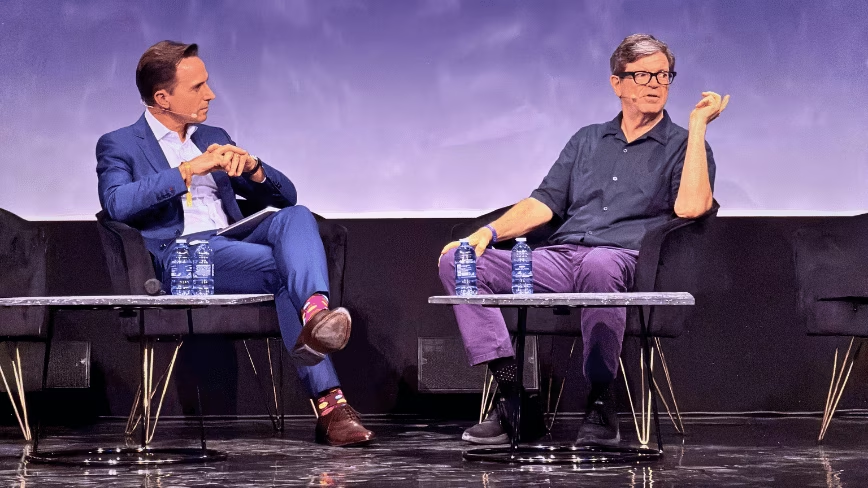
The Turing Award winner and former Chief AI Scientist at Meta sat down with Jean-Philippe Vert to lay out a case that LLMs, the technology underpinning ChatGPT and its many imitators, are fundamentally limited by design. His core argument is deceptively simple. Language is just one thin slice of how humans understand the world, and building intelligence on text tokens alone is like trying to learn to swim by reading about water.
The sensory gap
LeCun’s critique centers on what you might call the sensory bottleneck. Humans process a continuous flood of visual, tactile, auditory, and spatial information every second. We build mental models of how objects behave, how gravity works, how a glass will shatter if you knock it off a table. LLMs process none of that. They process discrete chunks of language, sequences of tokens that represent words, and they do it extraordinarily well.
LeCun has made this point before, many times. What made the Bloomberg appearance notable is the specificity of his timeline. He predicted that LLMs will become “largely obsolete” across most applications within five years. That’s not a vague “someday” dismissal. That’s a clock ticking.