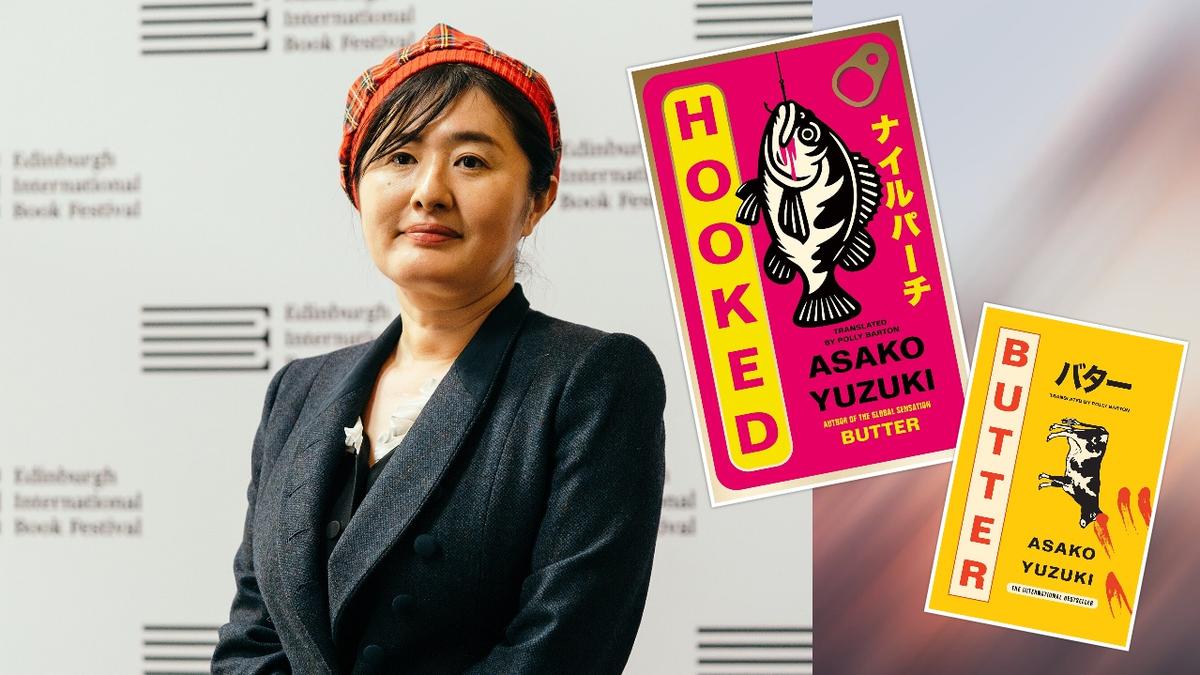
As I turned the last page of Japanese author Asako Yuzuki’s new novel Hooked, Indian social media was in an uproar over an Instagrammer by the name of Pujarini Pradhan (@lifeofpujaa). Based in rural West Bengal, she makes reels on literature and cinema, bringing up her son, wearing make-up, speaking four languages — frequently surprising and startling her close to 8 lakh followers with her feminism, perception and insight. Well, most of them, because some doubt her authenticity, insinuating she is “an industry plant”, wondering how a middle-class woman with heavily accented and grammatically incorrect English could possibly access Ray and Lynch and Premchand.I have no unique take on Puja but the furore cuts close to one of the primary themes of Yuzuki’s Hooked, translated from the Japanese by Polly Barton. In the novel, Eriko Shimura, a high-achieving 30-year-old businesswoman, becomes obsessed with a blog titled ‘The Diary of Hallie B, The World’s Worst Wife’. To all appearances, it’s an irrational fascination: Eriko, the only other woman in her large division in a Japanese multinational, has nothing in common with Shoko, the blogger, who revels in cheap food and slipshod laundry. But scratch a little deeper — and is it possible that in Hallie B/ Shoko, Eriko finds a tantalising glimpse of another way of life, removed from the pressures of quarterly targets and perfect performance assessments?Facade of Japanese societyIf Japanese fiction is having a moment in translation, much of the credit must go to a clutch of women writers and their genre-defying work. Butter (2017), Yuzuki’s first work translated into English (also by Barton), was a blockbuster but writers such as Mieko Kawakami, Yoko Agawa, Banana Yoshimoto, Yoko Tawada have been consistently exploring themes of alienation, isolation, sexism, identity and technology from a peculiarly Japanese feminist perspective. Butter didn’t work for me but, with Hooked, Yuzuki lays claim to this very select coterie of brilliance.That said, it’s difficult to appreciate Hooked (or, indeed, any of the writers mentioned above) without a certain understanding of Japanese society. On a recent visit, we found a stunningly functioning country: public transport is as clean as it is punctual, the food is as beautiful as it is delicious, the people are as courteous as they are efficient. But a little more every day, the façade disguises a deeply entrenched and all-powerful patriarchy that invisibilises women while thriving on their labour, holding them to impossible standards and actively disparaging and discouraging female solidarity.That is why, when Eriko tracks down Shoko, expecting friendship on the basis of her blogposts, it feels like a transgression. (It’s worth noting that the Japanese original was published in 2015, when personal blogs were still a thing; though social media has changed rapidly since then, intimacy and consequent trust continue to be the currency, as evident in the @lifeofpujaa kerfuffle.)
Review | Asako Yuzuki’s Hooked cuts closer to the bone than her previous bestseller, Butter
Asako Yuzuki's "Hooked" explores modern womanhood and connection within a facade of perfection, surpassing her previous work, "Butter."
TL;DRAI
Asako Yuzuki's *Hooked* (tr. Polly Barton) surpasses her bestseller *Butter*, tracing two women's collision through corporate Japan's entrenched patriarchal structures. The book's central argument — that female workplace rivalry is institutionally engineered, not innate — is a sharp prompt for any leader serious about inclusion strategy.
725 words~3 min read