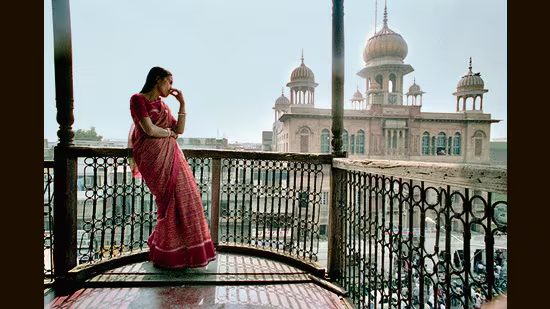
Every unhappy family is unhappy in its own way, but when a writer connects a character’s inner life with broader social forces that mirror it, a single house can reveal an entire country.A woman in a Delhi balcony, 1980s. (David Turnley/Corbis/VCG via Getty Images)We see this dynamic in Akhil Sharma’s An Obedient Father (2000), for example. Set against the backdrop of Rajiv Gandhi’s assassination, it shows how a Delhi bureaucrat’s domestic abuse echoes the corruption of the state. Both the household and the office operate under the same principles of hierarchy, exploitation, and the public performance of respectability.Similarly, in Karan Mahajan’s bleak and accomplished new novel, The Complex, family dysfunction reflects the state of the nation. There’s a small suggestion of this in the title itself: the main characters live in a ramshackle New Delhi housing complex and, more than once, their nature is described as “complexed”.The author’s earlier The Association of Small Bombs (2016) dealt with the aftermath of a blast in a New Delhi market. Here, he does the opposite: he shows how the accretion of moral rot leads to life-defining circumstances.The cast of characters isn’t as sprawling as in some 19th-century Russian novels, but it is substantial nonetheless. The Complex revolves around the surviving members of the family of the late SP Chopra who, we are told, was a framer of India’s Constitution and a former Reserve Bank governor. The descendants of his six sons now occupy separate flats in the residential enclave that serves as the novel’s primary setting over the years.Not all members of the family are given equal emphasis. Mahajan focuses on Laxman, the youngest son, as though to indicate the distance between the patriarch’s vision and that of the next generation. He also shows us the shifting tides in the lives of Laxman’s nephews Sachin and Brij, and their wives Gita and Karishma. Other characters, such as Vibha, Laxman’s older sister, also play significant roles. (Thank goodness the book includes a family tree.) Before circling back to the New Delhi complex proper, the narrative follows Gita and her packaging engineer husband Sachin to the US to establish an adjacent concern: the friction of immigrant assimilation and the pull of the homeland.Mahajan skilfully explores the impact of a traumatic incident on Gita and her relationship with Sachin, and goes on to interweave the mindset and motivations of the other characters. The members of the Chopra family aren’t given to empathy or nuance, and there’s “a menu of idiosyncrasies and dysfunctions to choose from”. Mahajan conveys this in many ways, such as their eating habits, fractured domestic lives, and often callous treatment of others, including their children.The feckless Laxman drifts from his “piddly women’s bobby pin factory in Shahdara” to manage a family temple trust and then set up an ayurvedic balms enterprise. Finally, after the anti-Sikh riots following Indira Gandhi’s assassination, he joins the TPP, where his talent for opportunism turns him into a political henchman. Behind closed doors, he also embarks on an affair with a member of the family. Despite the events unfolding in Indian politics at the time, the real shifts, he feels, were happening in his personal realm: “an individual rotation of stars that would, by affecting him, possibly also affect political matters”.Gita, however, sees this self-absorbed realisation more clearly. “How had the worst person in the family become its doyen?” she thinks. “Or was this the fate of all groups? That power accrued to the person with the most energy, regardless of whether that energy was good or evil?”The challenge that Mahajan sets himself is to enter the mind of this thoroughly unpleasant character and show us what propels him. In this, he succeeds, even if at times by spelling out Laxman’s psychology a little too plainly, in an unadorned prose style.The reader is initially tempted to hold Laxman at arm’s length; as the novel proceeds, his self-justifying actions remain inexcusable but one comes to realise how self-pity, among other qualities, can blind a person. Early on, we’re told: “Say what you would about Laxman Chacha, but he had been exactly what he appeared to be. There was no artifice. He saw the world and he took and took. He never apologised.”The novel also features a “hidden narrator” who brings us the story, a narrative that is further extended by Mahajan himself, as he informs us in his Afterword. The first tries to create suspense; the second aims at verisimilitude. These metafictional devices don’t detract from the book, but they do seem unnecessary. Mahajan has sufficient control of character and atmosphere to make the novel work without such contrivances.By the end, the housing enclave can be viewed as “a dry bed of pettiness, meanness, violence, squalor”. The Complex forcefully reminds us that cruel appetites and private compromises do not remain constrained within narrow domestic walls.Sanjay Sipahimalani is a Mumbai-based writer and reviewer.
Review: The Complex by Karan Mahajan
A bleak and accomplished novel that shows how the accretion of moral rot leads to life-defining circumstances
813 words~4 min read