There’s a lot going for Lila De – a publishing job in New York City, a father and stepmother and a half family who adore her, a sweet man who is enamoured with her, colleagues and a job she actually likes, and her mother, with whom she has a fraught relationship, is safely many thousand miles away in Kolkata. Everything in Lila’s life in the US is carefully constructed, in stark contrast to the messy, difficult childhood she’s left behind in India.The home and the worldNayantara Roy’s sprawling immigrant novel, family drama, The Magnificent Ruins, pulls the immigrant daughter right back into what she has hoped to escape all her life. Her maternal grandfather Tejen, the Lahiri scion and former member of one of the wealthiest families in Kolkata’s Ballygunge, has died, and it is to her that he has left the five-storey mansion where the Lahiri clan resides. The mansion, quite dilapidated now and long past its glorious days, is in desperate need of a makeover. Lila, only 29, has two options – either to sell it off and divide the inheritance equally, or repair it so that the family can live in better comfort.A house, of course, especially one that has lived through history and neglect, is never just that. The Lahiris all but believe that Tejen’s senility made him leave the house to the American granddaughter. Lila’s mother Maya, who is Tejen’s daughter, is outraged she’s not considered a worthy heir. Maya, whom Lila hates unabashedly, is a strange creature in Ballygunge – divorced in the 1980s, raising a daughter as a single parent, with a male admirer appearing in her life in her late forties. What has been constant throughout the decades has been her quicksilver temperament and her shame. The shame, unlike what Lila believes, did not stem from the divorce, but from a lifelong neglect she has faced, beginning in her childhood, when her mother, desperate for a boy, preferred her much younger brother-in-law Hari to her own daughter.It is in this web of detestation, anger, regret, grudges, grief, and vengeance that Lila gets stuck. On Lila’s side are her great-uncle and aunt’s children, Biddy and Vik, and her young aunt, Rinki. Biddy, a YouTube content creator, is gearing up for her wedding and the Lahiris race against time to get the house in order to host a grand celebration. But the excitement cannot conceal for long the fact that the Lahiris have challenged Lila’s inheritance – there will be a legal battle. And if this was not complicated enough, Lila’s childhood sweetheart, Adil, turns up, his marriage no deterrent to pursuing an unfinished chapter. Lila and Adil’s secret affair encounters another bump – her American friend-with-benefits, Seth, flies into town, whiteness and sweetness in tow, charming all the Lahiris and everyone in Ballygunge Place. Lila has one foot in the Lahiri mess, and the other firmly inside a love triangle she had not anticipated.Nights and days in KolkataThere’s enough fat in Roy’s novel to fill up three books. And for the most part, she is able to hold all the threads of the narrative tightly together. There’s a sea of characters, but their frequent appearances make it easy to remember their relationship with Lila. Moreover, you simply cannot have a great Indian novel without featuring an entire family and a half. Roy, who lives in the US herself, writes convincingly about an immigrant who is equally charmed and bemused by how families, bureaucracy, and social relationships in India work. The physical distance from the motherland helps get these sentiments right. However, it has also led to factual errors – for instance, the history of Trincas restaurant (which seems to be the favourite of the Lahiri youngsters and features in many scenes) is not quite accurate. In another instance, Lila wears warm clothes while Durga Pujo is still a couple of weeks away. But it is an autumn festival – winter arrives much later in Kolkata – and the weather is still hot. The political commentary in the novel – a lowdown on the Hindutva brigade, the populist party led by a woman, and the people’s left – reads like an immigrant’s simplistic understanding of local politics. We get broad definitions of what each party stands for, and Bengal’s longstanding affection for a secular and liberal lifestyle. There are queer community-led protests, the journalist in the family who often braves the fire, and Adil, the lawyer, who must navigate these landmines to keep a media company afloat. But these are minor divergences and, on the whole, immaterial to the plot. Though I suppose for a novel that was first published in the US, these cultural motifs can be quite interesting to the American reader. For an Indian readership, however, these are rehashed stories.The love triangle sits oddly too. Adil, Lila’s childhood sweetheart, is a dull character by himself but has a meatier arc, while one hardly misses Seth, sweet and harmless, when he’s not in a scene. I have no moral reservations about an extramarital affair – it certainly has a more literary appeal. I was eager to see how it played out – and was not disappointed. The criss-cross between Lila’s unresolved feelings and Maya’s pent-up wrath propelled the plot in a manner I was not expecting it to. Roy’s creativity truly shines here and gives the story much-needed momentum after a rather slow middle. The scenes where Sam comes face to face with the Lahiris and the city of Kolkata read much like a White person’s handbook to dealing with the excesses of India – a trope which has now lost its appeal. If I were to imagine the novel without these sections, I can confidently say it’d have survived just fine.The Magnificent Ruins suffers from inconsistent pacing and a plot that zooms in and out too often. The moments I enjoyed best, which led me to feel especially appreciative of Roy’s writing, were those inside the Lahiri house. The slow-burn reveal was terrific, the family dynamics as familiar as they were unique, and the pain and anger were depicted sensitively. For the reader in India, the novel, perhaps without meaning to, at times exoticises the mess and grandeur that are often associated with upper-class Indian families. The Magnificent Ruins certainly has the potential to go realistically closer to the personal upheavals it portrays. It’s a pity that it does not. The Magnificent Ruins, Nayantara Roy, Hachette India.
‘The Magnificent Ruins’: A sprawling family drama that suffers from the outside-in gaze
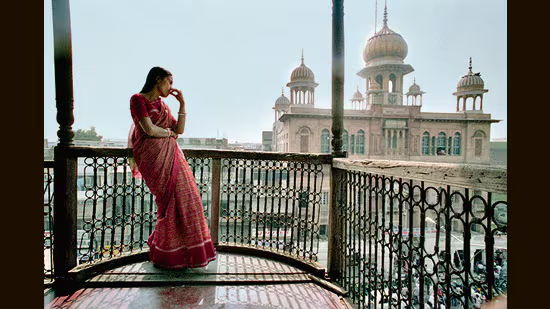
Nayantara Roy’s novel is set in Kolkata, where the once-wealthy Lahiris have to reconcile with family secrets when Lila, the heiress, arrives from the US.
1,085 words~5 min read