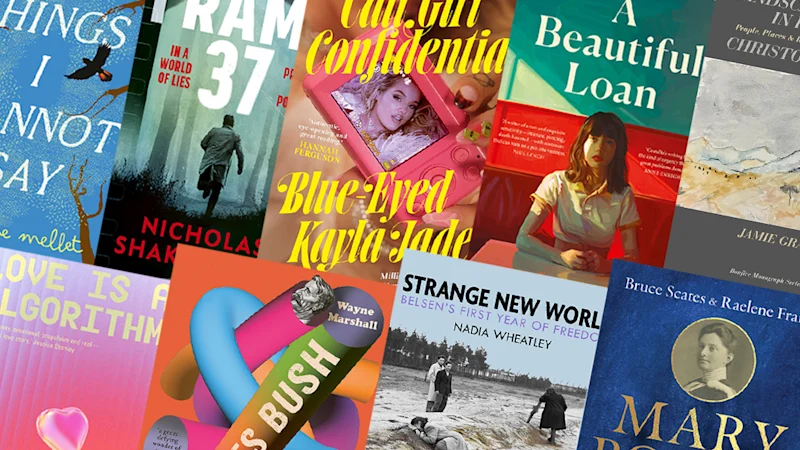
From doomed love affairs and AI dating apps to forgotten feminists, literary myth-making and female burnout, this week’s reviews roam widely. Our critics cast their eye over 10 new fiction and non-fiction releases.Fiction A Beautiful Loan, by Mary CostelloText, $35Residual mysticism seeps into the latest novel from Irish writer Mary Costello, a salve to the woundedness involved in the protagonist’s search for intimacy. A Beautiful Loan follows Anna Hughes over 25 years and two love affairs. We’re introduced to her as an introverted 19-year-old in thrall to a worldly, cultivated older man, Peter, whom she will marry. Costello builds a sense of wrongness into the relationship by subtle degrees. Crucially, it doesn’t negate Anna’s real desires, not least for the aesthetic and intellectual cosmopolitanism that Peter seems to offer. The reader’s creeping unease holds an unsettling mirror to Anna’s realisation, intuited before it can be reasoned, that Peter is prone to emotionally abusive behaviour. Anna’s second love – an Algerian Muslim, Karim – is a kind, open-hearted soul, though his sense of compassion gets shuttered when tragedy strikes. Costello has composed an emotionally intricate love story that – like Milan Kundera’s The Unbearable Lightness of Being before it – questions the authenticity of emotional life and the ways we have of knowing love, given how little we can ultimately know of another’s experience of the world. Things I Cannot Say, by Geraldine MelletHQ, $34.99At 37, Tracey Read suffers a catastrophic injury. The high-flying engineer is a woman of action, and living with quadriplegia is challenging enough without being forced to do it in an aged care facility. The Last Resort, as Tracey dubs the place with characteristic grim humour, is just that. There’s nowhere else for Tracey to go, and it isn’t long before she encounters both unexpected kindness and shocking mistreatment. As she adjusts to her life at The Last Resort, Tracey must find a way to communicate the institutional abuse occurring there to the outside world – a problem that triggers her can-do attitude and sets her on a path that may restore her sense of identity and agency. Journalist and disability advocate Geraldine Mellet tackles problems raised in more than one royal commission into institutional abuse. The book seeks to expose dark and awful truths through fiction, though it doesn’t feel like an “issues” novel thanks to Tracey – a character who cannot speak – and the plain-talking, slightly acerbic narrative voice Mellet has created for her. Henry Goes Bush, by Wayne MarshallPicador, $35It’s 1892. Young writer Henry Lawson heads for the bush he never much liked, nursing a brutal hangover. Dispatched into distant exile by J.F. Archibald, editor of The Bulletin, Lawson arrives at the town of Bourke – and there the novel departs from history, slipping into a playful interrogation of myth-making in Australian literature that delivers a multitude of Henry Lawsons and asks: can the writer escape his own legend? It’d be tempting to view Henry Goes Bush as postmodern fiction, though its anarchic spirit and freewheeling narrative invention belong as much to the likes of Joseph Furphy as they do to anything postmodern. Surreal flourishes and nods to genre emerge, with memorable set-pieces including the poetic rivalry between Lawson and Banjo Paterson, which plays out like a Western film. There’s a lot to entertain and a lot to chew over in this untamed, and ultimately moving, bush odyssey, which benefits from a kaleidoscopic sensibility, and has more than a few narrative tricks up its sleeve. Frame 37, by Nicholas ShakespeareHarvill, $35Nicholas Shakespeare has excelled in fiction and in nonfiction, as a novelist and as a literary biographer (his lives of Bruce Chatwin and Ian Fleming are particularly strong). Frame 37 is billed as a globetrotting thriller – and it is – though there’s emotional depth to the scenario. John Dyer is a former journalist living in Tasmania who receives a call from Argentina asking him to investigate the death of a mutual friend. John agrees, returning to his old stomping ground only to find himself enmeshed in a political conspiracy, and a plot to eliminate the only four witnesses to a crime committed long ago. When another witness dies in suspicious circumstances, John must find incontrovertible proof of the crime to stay alive. The hunt will take him to Michigan, where the story began decades before. Shakespeare roves from Tassie to South America and the US. Frame 37 is well-constructed crime that creates a deep sense of unease before springing into action and resolution. Still, it’s the emotional complexity of the novel, the guilt and silence and the need for atonement underlying the quest, that does a fair share of heavy lifting, lending dramatic force and impetus to the thriller as it unfolds. Love Is an Algorithm, by Laura Brooke RobsonText, $35For those interested in the intersection of love and tech, this lightly speculative romance is likely to please the lovers more than the tech nerds. Eve is a musician who relies on her gut and her emotions for inspiration. Danny is a developer and co-creator of a dating app, Pattern, though he and Eve fall in love and start dating the old-fashioned way. Pattern becomes the latest thing only when Danny tweaks it – adding an AI assistant called Bug and expanding the app’s remit from matchmaking to monitoring already existing relationships for continued compatibility, performance, and potential. The app’s take-up is massive, and soon it seems everyone except Eve is taking romantic advice from a chatbot. How that plays out is less a Black Mirror-style dystopia than you might imagine, though Laura Brooke Robson does explore rabbit-holes and fads in digital culture, from the popular obsession with attachment styles to more general questions of whether AI will foster alienation rather than human connection. Love Is an Algorithm contains sharp observations of romance among digital natives, but never quite coheres into either compelling speculative fiction or a streamlined literary parable.Non-fiction Strange New World, by Nadia WheatleyMonash University Publishing, $40On May 21, 1945, a crowd watched as the last disease-infested hut of Bergen-Belsen concentration camp (complete with a giant portrait of Hitler) was torched by the British and incinerated: a symbolic moment, the triumph of good over evil. But the reality, as Nadia Wheatley documents, was different from the symbolism. The liberation of Belsen in April 1945 (before the war finished) is an epic, tragic story by any measure. In this brilliantly orchestrated case study, Wheatley distils the tale by focusing on the first year of liberation: a 12-month period that she vividly and moving demonstrates contained multitudes. “Of the 55,000 to 60,000 who were alive at Bergen Belsen on 15 April”, she writes, “a quarter would die within the next five weeks.” Mostly, from the long-term effects of starvation and disease. Woven into the study is the story Wheatley’s father – a colonel in the British Army and medical superintendent at one of Belsen’s hospitals for survivors – with whom she had a difficult relationship. In this way, the historical is invested with the personal. She also dramatically, but coolly, captures the massive upheaval of war’s end, the shockwaves of which we are still registering today. Mary Booth, by Bruce Scates and Raelene Frances The Miegunyah Press, $50The lives of pioneering women such as Mary Gilmore are well documented, not so Mary Booth. In the first comprehensive biography, Scates and Frances retrieve the “forgotten feminist” and set the record straight. But the authors also acknowledge that Booth is a difficult figure to categorise, that she was a “creature of paradox”. On the one hand, she was a progressive, staunch vanguard feminist and one of the first women in Australia to practise medicine. On the other, a political conservative and a devoted Empire supporter. These paradoxes are manifest in the way she “feminised” Anzac – founding Anzac Fellowship of Women – as well as being an ardent supporter of conscription. And, while unmarried and childless, “she would style herself as the mother of Anzac”. The authors trace her youth, home schooling by her father and her practising of medicine in Australia and abroad, while also delving into her private life and deep friendship with fellow medico Agnes Bennett. She may have been diminutive, but her life was large, and perhaps, no longer “forgotten”. Landscape Written in His Face, by Jamie Grant Bonfire, $23With all the changes and passing fashions of literature it’s easy for writers of stature to slip below the radar, hence the need for critical reminders such as Jamie Grant’s skilfully condensed monograph on Christopher Koch. Grant, a poet of stature himself, not only has deep knowledge of Koch’s novels but was also a friend and worked as the author’s editor. Of Koch’s best known work, The Year of Living Dangerously, Grant says it is “a novel of the highest literary standard” combined with “the narrative speed of a thriller”. In chronological order he examines Koch’s considerable oeuvre, honing in on recurring themes, characters and motifs. At one point, he notes that all the novels overlap in such a way that “… it begins to feel as if they are all part of a single, interconnected work”. Not only eminently readable, first-rate literary criticism, but one of those introductions that sends you right back to the works of the subject. Drained, by Leah RuppannerAllen & Unwin, $37When a friend of the author told her husband about her stressed state after trying to balance the needs of children, a school play and visiting grandparents, he said, “Relax” – the implication being that she was putting pressure on herself by creating unrealistic standards of behaviour. It’s a common myth that sociologist Leah Ruppanner dismantles in this study of female burnout. She contends that these unrealistic standards are socially imposed expectations of women’s roles, especially on the domestic front. In one of the many tests, which form much of her research, one group was shown a photograph of a room and told it was “John’s”, another group, given the same photograph, was told it was “Jenny’s”. When asked if it was messy, John’s group said “No”, while Jenny’s said “Yes”. Ruppanner exposes these double standards and provides exit strategies in a work that convincingly and engagingly confronts female stereotypes. Call Girl Confidential, by Kayla JadeAffirm Press, $36.99Overall, Kayla Jade ushers the reader into the call-girl’s life in all its shades, in a breezy voice. Even when describing some pretty bizarre sessions, such as riding a motorised dildo in front of a client who fancies himself as Tarzan, to make the point that a key part of the trade is the ability to enter the fantasies of her clients. Mind you, there are also times when she just tells herself to think of the money. Her memoir goes back to her native New Zealand, where she wanders into a strip club one evening after a boring night’s work and lands a job on the spot. From there she moves onto OnlyFans, making porn movies and sex work. At the same time she incorporates scenes of everyday life: her supportive partner and being a mother. There’s also the inevitable dark side of things, such as disastrous cosmetic surgery in Turkey and winding up in hospital because of her eating disorder. But this is also a defiant celebration of the life she’s chosen for herself, saying at the end, “I am my own Prince Charming.”The Booklist is a weekly newsletter for book lovers from Jason Steger. Get it delivered every Friday.
Love, burnout and literary scandal: This week’s best new books
Our reviewers cast their eye over 10 new fiction and non-fiction releases.
1,914 words~9 min read