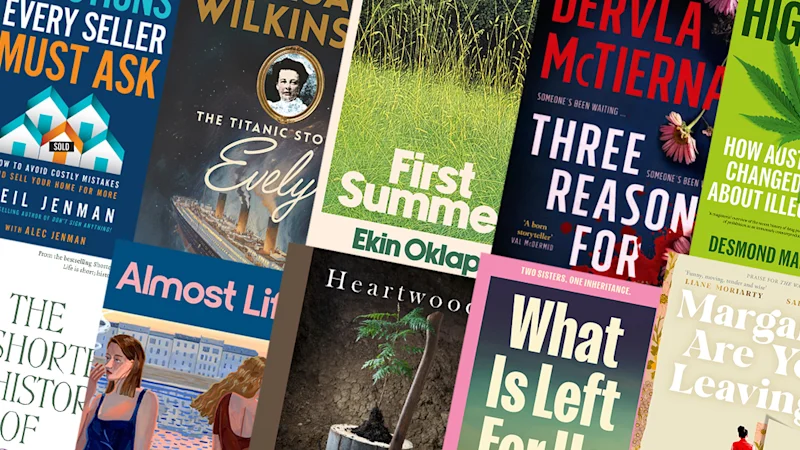
This week’s reviews range from decades-spanning queer romance and Melbourne noir to the Titanic, Scottish history and the politics of drugs and real estate. Critics Cameron Woodhead and Steven Carroll cast their eye over the latest fiction and non-fiction releases.Fiction Almost Life by Kiran Millwood HargravePicador, $35Paris, 1978. Naive 18-year-old Erica is spending the summer abroad before she begins university back in England, when she meets Laure on the steps of the Sacré-Coeur. A hard-drinking, chain-smoking PhD student at the Sorbonne, Laure is immersed in the queer demimonde of Paris. She draws Erica into it – and a whirlwind love affair which neither woman can forget – although their lives immediately diverge once summer fades. Through periods of estrangement, torrid adultery, marriage, children, and the death of friends, the bond between Erica and Laure persists through every sliding door moment, and they must decide whether to seize their chance at a future together in later life. Kiran Millwood Hargrave has created an epic and complicated love between two women – and it is a sense of intimacy, as much as passion, that smoulders for decades. Almost Life is a sweeping “will they, won’t they?” romance that traces a dramatic arc towards gay liberation in society, and an equally challenging personal quest for authenticity in the realm of the heart. A mature, fully developed queer love story fuelled by longing and compromise, suffering and the paradoxes of desire. Three Reasons for Revenge by Dervla McTiernanHarperCollins, $35Irish thriller writer Dervla McTiernan moved to Australia 14 years ago but she has never set a novel here, until now. Three Reasons for Revenge devises an elaborate revenge plot for Melbourne-based DS Judith Lee to solve. Three beautifully wrapped packages arrive at three very different addresses – one for an esteemed psychologist, another at the mansion of a socialite, and a third for a single father living in a rundown apartment. The three are seemingly unrelated, but all are victims targeted by a highly intelligent killer with intimate knowledge of their lives. Elements of hard-boiled noir shadow the narrative, from a corrupt cop to a missing person who made a sexual assault complaint before she vanished. Guilt and trauma lurk in Lee’s own past. A labyrinth of twists all branch towards menace, as the investigation slides into a dangerous game of cat and mouse. McTiernan is known for dark and unflinching crime writing, intricate plotted mysteries and a talent for psychological suspense – all qualities as evident in an Australian setting as they have been in the author’s bestselling Irish crime fiction. What Is Left for Us by Sophie Stern Penguin, $35Estranged sisters Rebecca and Hannah haven’t spoken in a decade. Rebecca has spent that time in London, as an insurance lawyer. She doesn’t much like her job, and her boyfriend just dumped her, though she didn’t much like him either. When Hannah contacts her after their grandmother’s death, Rebecca is called back to a clifftop house in Bondi, where a tense reunion with Hannah beckons and the ghosts of the past resurface. The mystery behind their estrangement involves Hannah’s husband, the successful but unlikeable Max, and parts of the book have a soapie feel, even when the plot veers into darker terrain than sibling rivalry or romantic jealousy. Its melodramatic atmosphere is enhanced by the novel’s style and construction. Wrenching emotional twists are delivered at pace in this family drama geared to normcore fans. What Is Left for Us bounces along in short, unified episodes, dispensing backstory in grabs as though written for television. That keeps the pages turning, even if the novel doesn’t always do the groundwork to make moments of emotional intensity or revelation feel earned. Margaret, Are You Leaving? by Dianne YarwoodHachette, $35Dianne Yarwood’s second novel features a close bond between middle-aged women forged in adversity, as did her broadly popular debut, The Wakes. (In that one, two women start a catering company specialising in wakes, their lives full to the brim with funerals as they process their own adverse life events.) In Sydney, 2001, Maggie and Anna work night shift together at a TV station switchboard. The two coworkers become friends when Maggie’s adoptive mother dies. Anna, who’s still grieving the loss of her own mother, can relate, although Maggie’s bereavement encounters a twist. From her brother, she learns that her birth mother may still be alive and she embarks on a quest to discover her fate. It’s a novel of losing and finding family, invested with the warmth and wit it needs to uplift and to complicate its melancholy. The premise mightn’t be as memorable as it is in The Wakes, but Yarwood is a charming writer and her latest novel does possess the same empathic attention to detail as her first, lending a depth to the solace that puts it a step ahead of more hackneyed fiction in the friendship-through-grief subgenre. First Summer by Ekin OklapSummit, $30Queer coming-of-age novel First Summer reads as YA fiction for most of its short length. Its unnamed narrator is a sheltered and socially awkward teen, who befriends her new neighbour, a fellow wallflower called Clara. They meet at the start of summer and become inseparable, and the intoxicating intimacy of adolescent friendship will awaken new desires on the cusp of adulthood. The novel does get more interesting, and emotionally nuanced, at the end, though it’s also loosened by a weak strand of fantasy based on an animated sci-fi series that both girls love. In that parallel storyline, we follow the adventures of space explorer Nadia and her companion Rosa, and frankly, they might be too overwhelmingly YA for some adult readers. Their cartoonish space odyssey feels like an unnecessary diversion. It’s certainly a strange thing to encounter in the face of realistic depictions of the first stirrings of same-sex attraction, and it sits more oddly still against the broader, wiser reflection from later life that invigorates the book’s closing section.Non-fiction The Titanic Story of Evelyn by Lisa WilkinsonHachette, $35When she was young, Evelyn Marsden, the only Australian to survive the Titanic sinking, learnt to row against the tide on the Murray River in her native South Australia. It proved to be a life-saving skill when the big ship, upon which she was a stewardess, sank. Journalist turned author Lisa Wilkinson recreates not only Evelyn’s life but she also incorporates the tales of the many players and moving parts in this deeply researched dramatisation of events. In this sense, there’s a distinct touch of the convergence of the twain here. The captain who was all too sure of himself, people from early in Evelyn’s life stepping into the story, crew and owners all convinced of the ship’s invincibility – and the iceberg, patiently waiting to prove them all wrong. But Evelyn’s tale is the glue that holds the story together, from her youthful yearning for “elsewhere” to a happy post-Titanic marriage. Wilkinson, who tells the story in the present tense, is particularly adept at putting the reader on the spot, especially in the often surreal mayhem of the evacuation. But it’s also, to an extent, a tale of the times. Wilkinson references, for example, the suffragettes, giving the notion of rowing against the tide another meaning. Thoroughly engaging. Questions Every Seller Must Ask by Neil Jenman with Alec JenmanWiley, $22.95Real estate – the national pastime – is about buying and selling. This guide, by father and son real estate advocates, concentrates on the neglected latter, the crucial part of the game where you can stand to lose thousands. They explore selling with entertaining relish, exploding all sorts of myths along the way. The common belief that the best way to sell is by auction: wrong. It’s the worst. Most properties bomb on the day. The best? Private negotiation nearly always gets the best price, without the uncertainty and pressure. The book poses 200 questions sellers should ask. Is it best to buy first, then sell, or the opposite? Neither. Buy and sell on the same day. Sounds tricky, but our guides assure us it’s easy. The Jenmans cover the waterfront, from knowing how to choose an agent you trust and when to sell (they dismiss the myth of spring, which is more likely good for buyers because there are more properties on the market), to how to set the terms of a sale (selling only if Essendon wins the AFL grand final is a perfectly legal condition). I strongly suspect this astute and often humorous guidebook could be quite a popular little publication. High Time by Desmond MandersonLa Trobe University Press, $37Through most of the 19th century, there were few laws against drug use in Australia (likewise internationally). Marcus Clarke wrote at least one short story while high on marijuana. But all that changed radically. As Desmond Manderson documents in what is both a history and an analysis, the prohibition in the late 19th and early 20th centuries did far more harm than good. The pendulum swing was, he says, generated by several factors, not the least of which was a racist targeting of the Chinese and opium. Tough laws on drugs and harsh penalties became the norm. But by the 1980s – partly spurred by AIDS – more humane and compassionate attitudes began to surface along with the catch-cry “harm minimisation”. This eventually produced such measures as injecting rooms and the use of marijuana for medicinal purposes. It’s a complex, controversial subject, and sometimes absurdly comic. One NSW parliamentarian justifies the “war on drugs” in terms of “lazy teenagers who don’t listen to their parents and don’t do the dishes”. This is an academic yet accessible cultural history. The Shortest History of Scotland by Murray PittockBlack Inc., $28Much of Scottish history is defined by a cycle of struggle, uprising, and rebellion against the English. In a remarkably concise survey, the Scottish-born Murray Pittock chronicles the Jacobite risings through to their definitive defeat at the Battle of Culloden – a turning point that cemented the union with England and, famously, led to the proscription of tartan. Pittock traces Scotland back to its pre-Roman, tribal roots – the emergence of the Picts and Scots and the Roman construction of enduring landmarks like Hadrian’s Wall. He follows the narrative through the Viking invasions (noting Danish-derived words like “ken”) and carries it all the way to the modern independence movement and Brexit. But through all this upheaval and rebellion, Scotland’s borders with England have barely changed since the 13th century. A bracing ride through history that also emphasises the importance of people knowing their history. Heartwood by Rowan ReidMelbourne Books, $25As Rowan Reid, agroforestry teacher at the University of Melbourne, says in the introduction to this updated version of his book, “We have become accustomed to defining our world, and even ourselves, within the context of opposing dualisms …“. Applied to the environment, this could mean people being labelled either as conservationists or loggers. Reid contends there is a “third wave” that requires breaking down those dualisms. He draws on the personal experience of his tree farm. There, he grows and cultivates a wide range of native and overseas trees to help enrich the land, for personal use (he built his house from trees he grew) and for commercial use (wood from his farm is used to make some of the world-famous Maton guitars). Thoughtful documentation of his life on the land and his conclusions.The Booklist is a weekly newsletter for book lovers from Jason Steger. Get it delivered every Friday.
Secrets, survivors and scams: This week’s essential reading
From decades-spanning queer romance and Melbourne noir to the Titanic and the politics of drugs, we review the latest fiction and non-fiction releases.
1,915 words~9 min read