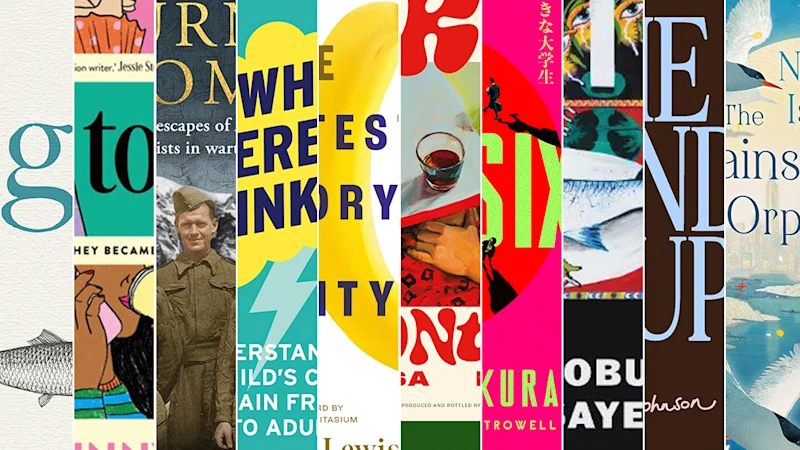
A fantasy epic, a corporate thriller, open marriage, existential philosophy and the science of reality: this week’s new releases take readers just about everywhere. Our fiction and non-fiction reviewers separate the standouts from the disappointments as they cast their eyes over buzzy debuts, Japanese bestsellers, memoirs and an enthusiastic business advice book. Photo: The Rainshadow Orphans, by Naomi Ishiguro (Atria, $35)As literary nepo babies go, Naomi Ishiguro follows in some rather imposing footsteps, though The Rainshadow Orphans stakes a claim to a different kind of storytelling than that of her father, Nobel laureate Kazuo Ishiguro. It’s the first instalment in an epic fantasy trilogy, and rides high on lush world-building that blends feudal and post-industrial Japanese cultures (while seeming to skip the dark Satanic mills phase of industrialisation). Resolute samurai exist side by side with advanced computing, and cyberpunk vibes vie with sword battles and elusive Shinto-like spirits that only some can see.Three adopted siblings, Toshiko, Jun and Mei – a martial arts prodigy, a healer and a hacker, respectively – live as refugees in the corrupt and poverty-stricken slums of Rainshadow City. When their mother figure, Reiko, is murdered by a crime gang, the Lucky Crows, they seek to avenge her death and plan to steal a dragon pearl from the Crows’ leadership. It’s an adventure destined to spark a struggle that will implicate imperial politics, with far-reaching consequences. Japanophiles will find almost every aspect of the nation’s cultural superpower represented in this immersive genre fiction, from martial arts to the kawaii (cuteness) of Studio Ghibli and even Akira-style tech-dystopia. Photo: Skin Contact, by Elisa Faison (Sceptre, $35)I’m far too tired for polyamory these days, though the public appetite for reading about it continues to grow. Elisa Faison’s Skin Contact takes a more mature approach than most contemporary genre fiction in this vein; the open marriage in it comes about through a plausible route. Shocked and still in mourning after her mother’s death, Frances has lost her usual joie de vivre, and her husband, Ben, hasn’t been able to help restore her vitality alone.Frances suggests ethical non-monogamy, and an initially reluctant Ben plays along. They formulate rules and boundaries and embark on an erotic odyssey. Their carnal exploits attract gossip and confusion from friends and family, as well as an emotional reckoning as the reasons behind the open marriage – and its ineffectiveness in achieving its stated purpose – are laid bare. Faison tackles her subject without peremptory judgments or ideological baggage, creating a contemporary romance that’s sexy and melodramatic. Yet it’s anchored by a convincing emotional landscape, with astute portrayals of psychological armour and vulnerability that keep you invested in the characters. Photo: No God but Us, by Bobuq Sayed (Ultimo Press, $35)No God but Us introduces two Afghan men who meet in Istanbul’s queer underground. Delbar has fled his immigrant community in Washington, DC, after being outed, and to avoid the aftermath, he travels to Istanbul to live with his favourite aunt. There, he falls in with a demimonde of queer activists, rebels and fringe dwellers, among whom he meets Leif and his Afghan boyfriend, Mansur. Delbar becomes besotted by Mansur, but the latter has learnt to keep his head down. Forced to flee his family and his first love, Mansur is determined to remain loyal to Leif and to do nothing that might compromise his bid for refugee status.Perth-based Bobuq Sayed is from an Afghan refugee family himself, and No God But Us is a fascinating love story. The author explores romantic and political awakening, and the book is full of subtle insights into the nuances of queer resistance and identity, within an official culture where homophobia is entrenched. A moving and eye-opening debut. Photo: Over to You, by Georgie Tunny (Allen & Unwin, $35)From broadcaster Georgie Tunny comes a novel set behind the scenes of breakfast television. Three friends – Carter, Naya, and Greta – are climbing the greasy pole, vying to become Australia’s top TV presenter. Beautiful Carter never met a spotlight she didn’t like, conscientious Naya juggles loyalties at work and home, Greta is ambitious and outspoken. All three are talented professional women, but the system seems determined to pit them against each other, and the values they hold dear, as they slog and slime their way to the top. What treacheries will they commit to achieve career success?Tunny’s novel is a bit too busy and could use pruning, but it does lay bare the problemfor ambitious women in a merciless industry where sexism and ageism are still rampant. It’s a lively, funny, sharply drawn fiction that isn’t afraid to show female rivalry alongside friendship, and the cost of integrity within a journalistic world that seems to reward grubby and unedifying conduct. Photo: The Final Six, by Akinari Asakura (Sphere, $35)Toxic competitiveness gets even more dog eat dog in The Final Six from Akinari Asakura. This Japanese bestseller is a corporate psychological thriller, focused on recruitment for a tech company, and the set-up resembles the sort of job interview process that wouldn’t be out of place in Squid Game. Six elite candidates have made it through to the final interview, and after suitably polished performances selling themselves, they get down to the nitty gritty. Each candidate receives an envelope containing career-ending dirt on another. How can they leverage the information to their advantage without attracting reprisals that will doom their own chances?Intrigues and alliances, betrayals and power plays develop in an absorbing locked-room thriller, before we’re propelled years into the future to examine the fallout. The cutthroat set-up ratchets up the tension with great skill, and although the resolution isn’t as smartly turned, there’s black satire in the glaring disparity between all those marketable personas the applicants have curated on their CVs, and the often deeply troubled individuals behind the spin.Non-fiction Photo: The Shortest History of Reality, by Geraint F. Lewis (Black Inc, $30)When T.S. Eliot wrote that “Human kind cannot bear very much reality”, he was talking of metaphysical reality; blindingly intense, like the glare off an icy puddle. While this history of reality incorporates religious constructions of the real, it’s very much the story of how science, over the centuries, has pulled apart our perception of the world and the realities we construct. Take the yellowness of a ripe banana, for example. The retina creates colours, and “our perception of the yellowness of a banana’s skin exists only in our minds”.Lewis, in admirably clear and concise writing, walks us through the discoveries of Newton (who thought that light was a particle) and Thomas Young, who concluded it was a wave. It’s a vast subject. Lewis effectively distils centuries of science, including the discovery of atoms to the splitting of them, “When the nature of reality (was) literally broken into pieces.” And, of course, there’s Einstein’s special theory of relativity and E = mc², the scientific equivalent of the opening of Beethoven’s Fifth. A compact and lucid study that takes us right up to “dark matter” and the nature of consciousness itself. Photo: Long Journey Home, by Katrina Kittel (Allen & Unwin, $35)Well after her father died in 2011, Katrina Kittel sifted through his old suitcase containing wartime photographs, papers and postcards – some from a Swiss woman called Eva. They are like pieces of a jigsaw puzzle which, along with extensive research and interviews, became the basis for this portrait of the young, wartime father she barely knew – as well as the story of his remarkable escape from a POW camp in northern Italy.Colin Booth (Kittel’s father) was captured in Africa and told the war was over for him. In fact, his war was just beginning. When Italy surrendered in 1943 and the Germans took over, many Allied POWs (including Booth) took advantage of the situation and made the extremely hazardous journey to Switzerland. They had to be constantly vigilant, as Kittel fully and convincingly documents, but were often looked after by sympathetic locals. Booth eventually ended up on a farm in Switzerland, which is where the enigmatic Eva enters the tale. A wartime escape story, but also a record of how we can know little about our parents’ younger selves. Photo: Being, by Rachel E. Menzies and Ross G. Menzies (Allen & Unwin, $35)German philosopher Martin Heidegger contended that the question of “being” is often either ignored or taken for granted. This exploration of “being” and the human experience of the world is primarily a psychological study, but it invokes philosophy and weaves in the works of existentialist writers such as Camus and Sartre.Rachel and Ross Menzies (daughter and father, both psychologists) draw heavily on their extensive case studies to explore, among other things, existential dread, mortality and the often critical inner voice we acquire in childhood. “Stephen” and “Mary”, for example, are watching a crime show on TV and having a broken conversation, when suddenly the existential chasm opens up. Stephen suddenly realises he doesn’t really know his wife of 30 years. He is left with the dreadful knowledge of the impossibility of ever knowing another being. But this is far from a pessimistic work. Above all, the authors emphasise the wonder of being alive, of taking charge of this only life we will ever have to create one of authenticity, meaning, and – yes – joy. Photo: What Were You Thinking!? by Nathan Wallis (Allen & Unwin, $37)When a teenager responds to a parent’s question with a “yep, nah, dunno” or a grunt, keep in mind it’s because their frontal cortex (which controls language and reasoning) has shut down for what neuroscience teacher Nathan Wallis calls “renovations”. His guide to the structure and development of the human brain from birth to adulthood deals, in large part, with what society calls these “awkward” years, but is also very good at filling in the big picture.It’s full of surprising facts. Wallis also confirms the astonishing brain growth that takes place in the first 1000 days. An informed, plain-speaking guided tour through the four chambers of the brain for parents, carers, or anybody interested in how we think and react to the world. Photo: From the Ground Up, by Jessica Hatzis and Bree Johnson (Affirm, $37)Capitalism is very good at reinventing itself. Take the notion of a “cult brand” in this guide to how to start one up, by two businesswomen (Hatzis and Johnson) who co-founded “branding agency” (basically, an advertising agency) Willow and Blake. They’re confident, have snappy lines, and throughout this how-to guide, drape their enterprise in quasi-artistic language, referring to themselves as “creatives” engaged in the practice of “writing”Their story involves a lot of daring, astute observation and use of seemingly chance events – such as when two women asked for used coffee grounds one morning in a cafe owned by an early co-founder, all of which created a chain reaction that led to them marketing their globally successful skincare product, Frank Body. There’s a distinct element of self-celebration and a fair share of rhapsodic language about “brand”, but their catchy phrases and sheer enthusiasm are infectious. There’s lots of practical advice for all those new wave, wannabe entrepreneurs out there who can’t wait to start up.
What’s worth reading this week (and what isn’t)
Our fiction and non-fiction reviewers separate the standouts from the disappointments.
1,860 words~8 min read