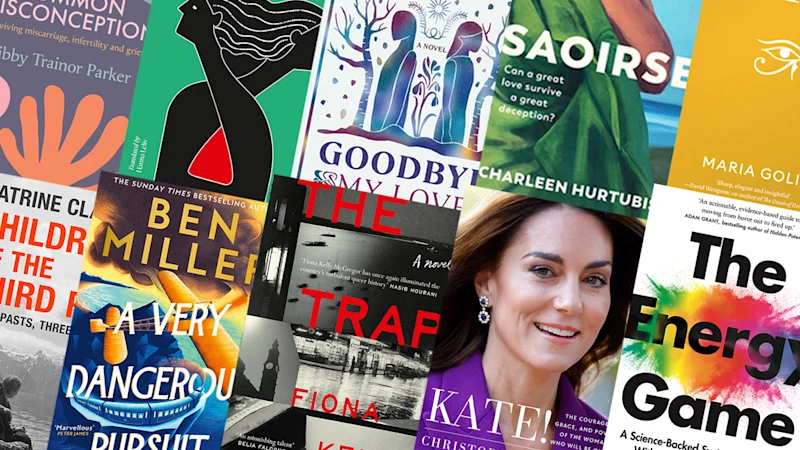
War stories, wartime Sydney, royal biographies, burnout cures and a moving book on pregnancy loss make for a varied week on the shelves. There’s also literary fiction from Ukraine and Australia, a dash of old-fashioned espionage, a brisk history of Egypt and a novel about reinvention and buried identities. Here, our reviewers cast their eyes over the latest fiction and non-fiction releases.Fiction Photo: My Women by Yuliia Iliukha (The Indigo Press, $25)This slender and intense suite of short fiction offers a polyphonic response to the Russo-Ukrainian War. Each section of My Women – almost none more than two pages long – follows an anonymous Ukrainian woman during the conflict, and their experiences take in a range of genres – literary parable, patriotic elegy, savage political satire, and ultimately a multifaceted tribute to the tenacity of Ukraine’s women, couched within a meditation on the absurdity of war. Tragic ironies abound, never sharper than when a mad Russophile takes refuge in her love of Pushkin and Lermontov, convinced devotion to the greatness of Russian literature will protect her from being targeted by Putin’s army.There are many glimpses of women as victims of war, but it is feminine resistance that draws Iliukha’s imagination and, indeed, the implacability of women as warriors. Tens of thousands of women serve in the Ukrainian military: the author makes us feel – through a soldier on patrol, staring dry-eyed at the shelled-out husk of her childhood village – their bitterness at, and resolve to defend against, the unprovoked Russian invasion of their homeland. Distilled into a kaleidoscope of perspectives, My Women is urgent, grave, sometimes unexpectedly funny antiwar fiction, stylishly translated. Photo: The Trap by Fiona Kelly McGregor (Picador, $35)Fiona Kelly McGregor’s previous novel Iris was set in Depression-era Sydney, the titular character trading rural poverty for life as a streetwise sex worker in the City of Sin. The Trap takes up the same timeline a decade later. It’s 1942 and the demimonde from Iris has been living hard, even if wartime is boomtime for the criminal underworld. With strict rationing in force and Sydney awash in American GIs, smuggling, corruption and prostitution have become rampant.At the same time, two cops – Thomas Carney and William Grigg – embark on a homophobic crusade, entrapping men in public toilets as part of a police crackdown. Their campaign against “perverts” ensnares Ray Sayles, formerly a black drag performer at a now defunct bar, and eventually (in a plot point with a real historical basis) the prominent newspaper editor Clarence McNulty. McGregor tackles a homophobic history with flair, resorting almost to hard-boiled camp for the villains, and portraying a spirited cast of misfits – some familiar from Iris – with humour and compassion. Photo: Saoirse by Charleen Hurtubise (Eriu, $35)Saoirse isn’t her real name. Nor is Sarah Walsh, the name on the passport she borrowed from a friend to make her escape. No, Saoirse was born Sarah Roy Gagneaux, in Michigan, and her childhood was bleak. Born to a dope-addicted mother and a criminal father who used her as a drug mule from a very young age, Saoirse fled her traumatic background (and the long arm of the law) by flying to Ireland in the 1990s. On the plane over, she met Paul and started a relationship that exchanged one form of abuse for another, before settling down with her soulmate, Dáithí.With an idyllic home and loving family, and on the cusp of fame as an artist, life would finally seem to be treating Saoirse kindly. But tormenting secrets gnaw at her, and the biographical nature of her art threatens to expose her double life, putting her in an invidious position. This is an uneven novel, though if the resolution feels like a letdown – and it does – that’s partly because Hurtubise handles the psychological tension of her protagonist’s dilemma so effectively in the setup. Photo: Goodbye, My Love by Yumna Kassab (Ultimo Press, $35)From the Miles Franklin-shortlisted author of The Lovers comes a searching novel about a woman haunted by a failed relationship. When Amina decides to end her marriage to Amin, her desire is in one sense easy to achieve. They’re vastly wealthy members of an Arab community, and Amina need only decamp to her favourite five-star hotel to start afresh. And yet, as Amina struggles against the views of her friends and family, she also struggles with how the marriage has shaped her identity. Even Amina’s name isn’t hers – she changed it to resemble her husband’s, at his suggestion – and while she finds formal freedom after separating, this isn’t experienced as simple liberation.Rather, Kassab strives for a complex balance of sympathy, unafraid to show how life in a gilded cage has made Amina brittle and insecure, a villain as well as a victim in her own story. The author is at pains to peel back dead layers of expectation in this swift exploration of fragility and alienation, though more than a few unresolved questions may frustrate readers who prefer more psychological context and a clearer narrative line. Photo: A Very Dangerous Pursuit by Ben Miller (HarperCollins, $35)Actor and comedian Ben Miller is also known for his children’s books and now turns, for his adult debut, to a popular brand of spy-action-adventure fiction. Miller resurrects Richard Hannay, dapper hero of John Buchan novels including The Thirty-Nine Steps, and takes us to Constantinople in 1912, where Hannay becomes unwittingly entangled in a Byzantine game of international intrigue. When our hero has a package thrust into his arms by an American running from Ottoman guards, he’s soon in a spot of bother that will take more than a stiff upper lip from which to escape.The package leads to a chase thriller seasoned with familiar tropes – a sinister German officer, a Mata Hari-like femme fatale – and a luxurious itinerary that runs to both the Orient Express and the Titanic, as Hannay embarks on a quest, with the future of Europe at stake. Miller’s A Very Dangerous Pursuit is retro espionage adventure that takes rather infectious delight in revisiting the drollery, danger, and derring-do of Buchan’s original novels.Non-fiction Photo: Children of the Third Reich by Catrine Clay (Weidenfeld & Nicolson, $35)On May 3, 1945, two days after Hitler poisoned himself (not shot himself), liberating GIs entered the Bavarian village of Steinhoring. There they made the bizarre discovery of a large home filled with abandoned babies. It was one of the many Lebensborn homes, established by Himmler and scattered across Germany, where “Aryan women” were inseminated by SS officers to make master race babies for Hitler.Renate, one of the three case studies in this grotesquely fascinating story, was born there and spent the war at the home until her mother came for her. In this respect, she was fortunate because the majority of babies were fostered out and never discovered who they were. Mind you, when she finally uncovered the truth about her SS father, it was deeply disturbing. The two other case studies, Joe (who grew up in a Displaced Persons camp in Germany) and Dan (who grew up in Israel, after his Jewish parents got out of Germany in 1933) complete the tale of this little-explored aspect of World War II. In many ways a cautionary tale for our times about what happens, as ex-BBC journalist Catrine Clay puts it, when power falls into the wrong hands. Photo: Kate! by Christopher Andersen (Gallery Books, $37)When Kate Middleton was a teenager at school, her classmates maintained that she had a life-size colour portrait of Prince William hanging over her bed. Middleton denied it, saying it was just a jeans poster. Nonetheless, Andersen – who specialises in writing about the rich and tragically famous – suggests that Kate had her eyes on William from an early age and describes her marriage as a “classic Cinderella story”.True, or just pandering to stereotype? For that stereotype of the girl from modest, even humble roots marrying her Prince Charming is integral to Kate’s fairytale-come-true story. But is it a fairy tale, anyway? Woven into her story is the ever-present paparazzi, the pressure of constant public scrutiny, comparisons to William’s mother, Diana, as well as weird conspiracy stories about her cancer treatment, especially. There are times when Andersen dramatises key moments in her life to varying degrees of success, but in a light, engaging way he creates a rounded portrait of the woman he calls an “inspiration”. One for royal watchers. Photo: The Energy Game by Dr Amantha Imber (Penguin, $37)No, this is not about climate change and the global energy crisis, but a condition that, according to one major US survey, afflicts a staggering 82 per cent of white-collar workers to varying degrees – burnout. And Amantha Imber, a psychologist who runs her own company which experimented successfully with the four-day week, is talking from experience in this guide to overcoming what she calls “chronic depletion”. In 2024, in the rain shadow of COVID, she became so physically and emotionally exhausted she began fantasising about being hospitalised. Nothing serious. Just enough to give her a week off work. Her handbook, full of charts, graphs and strategies, is the direct result of having driven herself into burnout and committing all the sins she details.It’s divided into four parts, each addressing different aspects of the condition, such as recognising all the warning signs and thinking that you’re tough enough to “push through”. Among her tips, and it gives you some idea about the style of the book, is her advice to be on the lookout for what she calls “energy vampires”, like intense exercising. No need for wellness retreats, a simple “staycation” can help. Welcome to the modern workplace and how to address the common, not “normal” burnout factor. Photo: The Shortest History of Egypt by Maria Golia (Black Inc. $28)The story of Egypt, as Maria Golia observes in this distilled history of the country, is as much about the “marvellous”, the “atmospherics”, the mass commodification (Ramses II had an afterlife as an aristocratic cigarette brand in the 1930s) and the legends that have inspired artists for centuries, as it is the facts. Golia, an American who is a long-term resident of Cairo, starts her story in 7000 BCE and finishes with the Arab Spring of 2011.The five parts of the book are divided into key themes in Egyptian history – especially the contradictions, such as the spiritual longings and the material objects employed in pursuit of the spiritual. Pivotal to it all is geography, in particular the Nile, for it replenished the desert and gave the ancients (those who could afford it) mobility. A long, complex epic confidently told in writing that is both literary and engaging. Photo: A Common Misconception by Libby Trainor Parker (Echo, $35)Comedian Libby Trainor Parker may bring a light touch to a grim topic, but when she documents her personal experience of pregnancy loss, there’s nothing comic about it. It’s real, disturbing and extremely sad. She has had 11 miscarriages – a problematic term she explores in this deeply personal guide to surviving the experience.Globally, there are 23 million cases a year. But, she says, it’s a taboo topic that spoils the party of the happy family and leaves women feeling there’s something wrong with them. Her book is an attempt to ease their sense of loneliness. She urges her readers, in a comic style, to think of her as the best friend who comes over with cheese and wine and holds your hand through the trauma of loss.What else is happening in the book world?This novel has plenty of sex - but it’s far more than a racy read.Can’t get published by the Big Five? Win a major prize instead!Here are five thrilling and chilling new novels to keep you up at night.Our critic shares 10 of the best audiobooks of 2026 (so far).
Skip or binge? Our reviewers deliver their verdicts on 10 new books
From war stories to wartime Sydney, a royal biography and burnout cures – there’s something for everyone this week.
1,977 words~9 min read