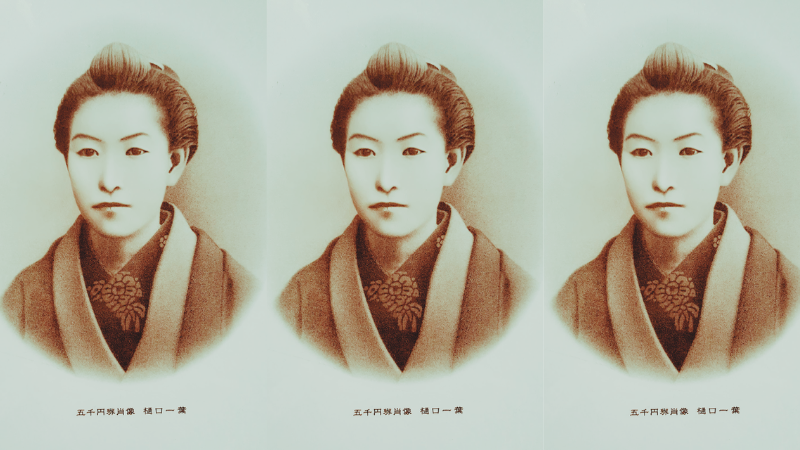
In February 1894, Higuchi Ichiyō was desperate. Aged only twenty-one and poverty-stricken, she visited a celebrated fortune-teller, hoping that he might change her luck. “I was born in the year of the monkey, on the twenty-fifth day of the third lunar month,” she told him.Article continues after advertisement
This is the sixth year since I lost my father, and I find myself tossed upon the raging waves of adversity in this floating world—yesterday to the east, tomorrow to the west. Whereas once I dwelt above the clouds, amid the moonlight, passing my days in refined pursuit of leisure, I find myself now living in squalor, with an ageing mother to support and a younger sister who knows nothing of the world. Until last year, my life seemed like that of any other girl.
Her tale was no exaggeration. She was, in those days, struggling to eke out a living, running a stationery shop with her mother and younger sister in an area known as Ryūsen-ji, a down-at-heel neighborhood situated behind Tokyo’s red-light district, the Yoshiwara—a precipitous fall from the life she had formerly known.
Born to a humble family in the twilight years of the shogunate, Higuchi Natsuko (as she was born) was the fourth child and second daughter of a man with scholarly inclinations, who as a farmer had come to the capital to seek both fortune and rank. Through astute political maneuvering and financial positioning, her father, Noriyoshi, managed to have himself adopted into a samurai family in 1867, only for the class to be abolished by the sweeping reforms of the Meiji Restoration, which began in 1868. Enough money remained, however, to send his favorite daughter in 1886 to the Haginoya, a prestigious private school, where she studied classical poetry alongside the daughters of aristocrats and noblemen. Yet the times were changing, and, under the new Meiji administration, the status and wealth of former samurai decreased; unable to keep pace with the rapidly developing economic environment, the girl’s father made a series of imprudent investments, which, by the time of his death from tuberculosis in 1889, hastened by his grief over the death of his eldest son two years previously, ended up ruining the Higuchi family and lumbering his beloved daughter with the burden of financial responsibility. And so, hounded by creditors and distressed by mounting debts, the remaining family had to leave their formerly genteel surroundings for the gritty, unsentimental shadows of the Yoshiwara.