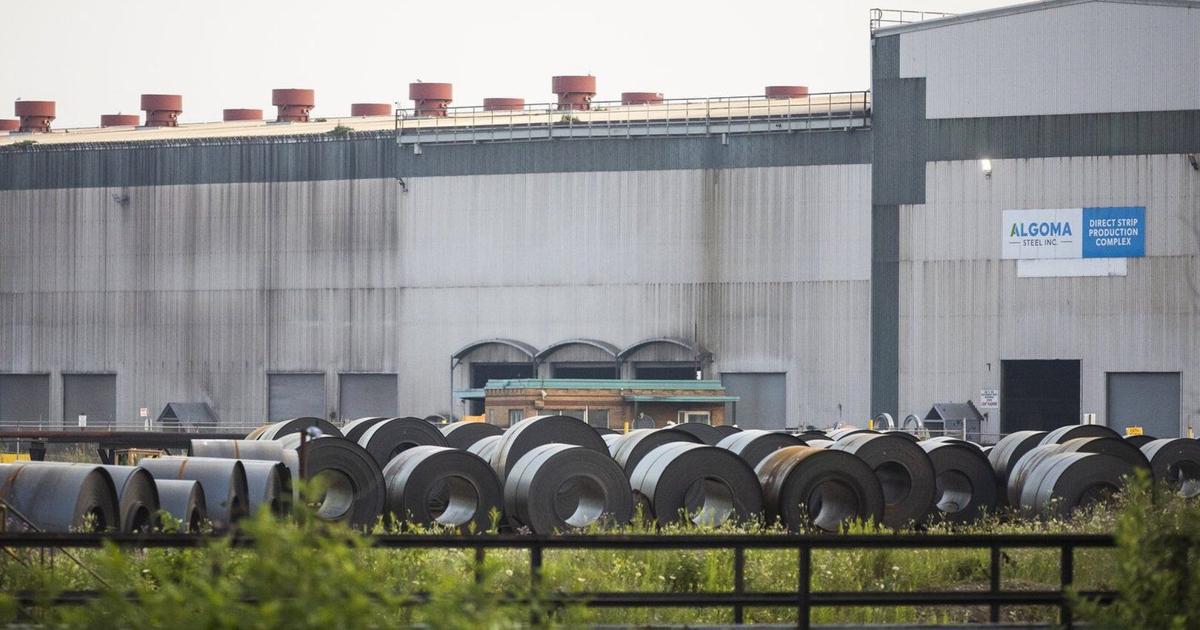
Skip to Content News Archives Economy Energy Oil & Gas Renewables Electric Vehicles Mining Commodities Agriculture Real Estate Mortgages Mortgage Rates Finance Banking Insurance Fintech Cryptocurrency Work Wealth Smart Money Wealth Management Investor Personal Finance Family Finance Retirement Taxes High Net Worth FP Comment Executive Women Puzzmo Newsletters Financial Times Business Essentials More Innovation Information Technology FP500 Podcasts Small Business Lives Told Tails Told Shopping Financial Post Store Obituaries Place a Notice Advertising Advertising With Us Advertising Solutions Postmedia Ad Manager Sponsorship Requests Classifieds Place a Classifieds ad Working Profile Settings My Subscriptions Saved Articles My Offers Newsletters Customer Service FAQ News Economy Energy Mining Real Estate Finance Work Wealth Investor FP Comment Executive Women Puzzmo Newsletters Financial Times Business Essentials HomeCommoditiesAlgoma slashes carbon emissions, but pays more in environmental feesThe company has said its transition away from coal to a low-carbon steel lies at the core of its new strategic direction You can save this article by registering for free here. Or sign-in if you have an account.After Algoma completed the switch to the electric arc furnace in Sault Ste. Marie, Ontario switched its benchmark to one based on electric production standards rather than historical emissions. Photo by Wikimedia CommonsSault Ste. Marie, Ont.-based Algoma Steel Inc. paid more in carbon taxes in the first quarter this year even though its carbon emissions plunged as a result of switching off a coal-fired blast furnace.Subscribe now to read the latest news in your city and across Canada.Exclusive articles from Barbara Shecter, Joe O'Connor, Gabriel Friedman, and others.Daily content from Financial Times, the world's leading global business publication.Unlimited online access to read articles from Financial Post, National Post and 15 news sites across Canada with one account.National Post ePaper, an electronic replica of the print edition to view on any device, share and comment on.Daily puzzles, including the New York Times Crossword.Subscribe now to read the latest news in your city and across Canada.Exclusive articles from Barbara Shecter, Joe O'Connor, Gabriel Friedman and others.Daily content from Financial Times, the world's leading global business publication.Unlimited online access to read articles from Financial Post, National Post and 15 news sites across Canada with one account.National Post ePaper, an electronic replica of the print edition to view on any device, share and comment on.Daily puzzles, including the New York Times Crossword.Create an account or sign in to continue with your reading experience.Access articles from across Canada with one account.Share your thoughts and join the conversation in the comments.Enjoy additional articles per month.Get email updates from your favourite authors.Create an account or sign in to continue with your reading experience.Access articles from across Canada with one accountShare your thoughts and join the conversation in the commentsEnjoy additional articles per monthGet email updates from your favourite authorsSign In or Create an AccountorIn the first three months of the year, Algoma reported paying $6 million in carbon taxes to Ontario, a 71 per cent increase from the $3.5 million it paid during the same period last year.The higher carbon tax payments came after it invested $987 million to stop using coal-powered blast furnaces. It switched last year to making steel entirely with electric arc furnaces in a move expected to cut its annual carbon emissions by as much as 70 per cent.Nonetheless, Algoma’s carbon tax payments increased this year because of Ontario’s carbon pricing system, according to the Clean Prosperity Institute, a non-profit that advocates for market-based solutions to climate change.“There are some inherent flaws within the system in Ontario,” Chloe McEhlone, a research manager at the institute, said. “Algoma Steel has made these large investments and they are not generating any sort of carbon credits from that investment.”Algoma reported paying $8 million in carbon tax in the fourth quarter of 2025, down 11 per cent from the same quarter a year earlier, but it paid $31.4 million in all of 2025, up from $31 million in 2024, even though it ramped up its electric arc furnace.McEhlone said the rising carbon tax payments may not be the biggest problem because Algoma has said it intends to recoup some of the money through a carbon tax rebate program that allows companies to recover money invested to reduce emissions.The problem, she said, is that a company that drastically reduces its emissions, such as Algoma, should be generating carbon credits that it can sell to other industrial carbon emitters. That would create a financial incentive for companies to reduce their carbon emissions.That’s not happening for Algoma despite its massive investment, partly because Ontario uses an intensity-based system to determine an individual company’s carbon tax. It sets an emissions benchmark based on a company’s carbon emissions per unit of production, rather than its total carbon emissions.If a company emits less than the provincial benchmark, it generates carbon credits that can be used by the company in the future or sold to other companies.But it receives a carbon tax bill if it emits more than the provincial benchmark.In the case of Algoma, after it completed the switch to the electric arc furnace, Ontario switched its benchmark for the company to one based on electric production standards rather than its historical emissions, McEhlone said.The Clean Prosperity Institute described it as “moving the goal posts” because Algoma is being held to a higher standard.For companies that invest to lower their carbon emissions, McEhlone said carbon credits provide a new source of “revenue” so they can recoup some of that money.Creating a credit market requires striking a balance because if the benchmark is too low, a company such as Algoma that drastically reduces its emissions could generate so many credits that it would overwhelm the system.The Clean Prosperity Institute has said it could make sense for Ontario to link its carbon credit market to markets in other jurisdictions, including other provinces or foreign jurisdictions such as California.That would create a larger market with more potential buyers of credits, but it would also mean some industrial emitters may buy credits from foreign sellers, resulting in a net transfer of money out of the province.Neither Algoma nor Ontario’s Ministry of Environment, Conservation and Parks responded to requests for comment.Algoma has faced heavy financial pressure as a result of United States tariffs. Last year, it accepted $500 million in federal and provincial support to refine its strategy and help find new markets to offset declining sales in the U.S., which the company said accounted for more than half its revenue base at one point.The company reported a $159-million net loss in its first quarter and it laid off 1,000 employees, or about 40 per cent of its workforce, last year. It is also conducting due diligence on whether it makes sense to construct Canada’s first steel mill capable of producing structural beams, which some analysts believe may cost around $600 million.Although the $6 million in carbon taxes represents a small amount for Algoma in light of the larger impacts of U.S. tariffs, the Clean Prosperity Network said the company’s emissions reductions have been large and could be generating revenue for the company under the old benchmark.Algoma has said its transition away from coal to a low-carbon steel lies at the core of its new strategic direction.“This is a defining moment for this company, not a conclusion, but a transformation,” Algoma chief executive Rajat Marwah said earlier this month during the company’s first-quarter earnings call. “Algoma is now a fully electric arc furnace operation and everything we are building from here rests on that foundation.” Get the latest from Gabriel Friedman straight to your inbox Join the Conversation This website uses cookies to personalize your content (including ads), and allows us to analyze our traffic. Read more about cookies here. By continuing to use our site, you agree to our Terms of Use and Privacy Policy.
Algoma slashes carbon emissions, but pays more in environmental fees
Algoma Steel invested $987 million to switch off of coal to electricity. Ontario charged it more in carbon taxes anyway. Find out more here
1,296 words~6 min read