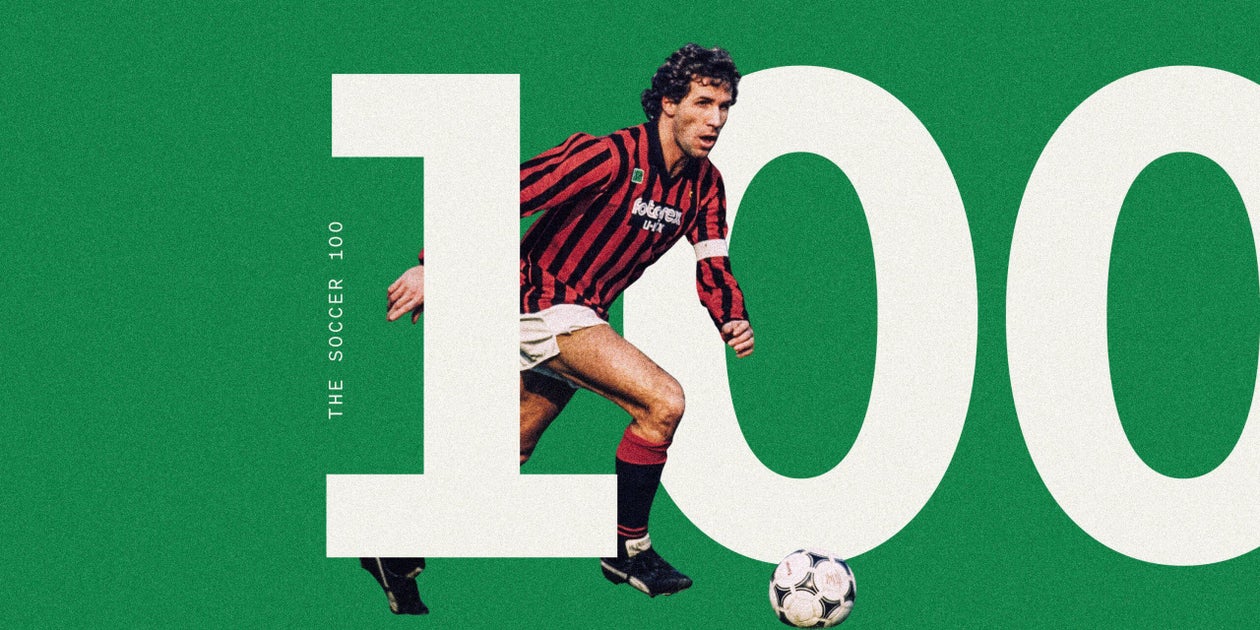
As part of our buildup to the 2026 FIFA men’s World Cup in the United States, Canada and Mexico, we are publishing excerpted chapters from The Soccer 100, The Athletic’s definitive book on the 100 greatest players of all time, courtesy of HarperCollins Publishers.The 10 players we will feature are the highest-ranked World Cup winners of our 100. Today, it is an Italian great who ranked 19th in our century and has a champions’ medal from the 1982 tournament despite never actually making it onto the pitch during it.Franco Baresi stood in the Amazon Theatre in Manaus. The salmon-pink opera house with a dome the colour of Brazil’s flag was built in 1896, when that city in the middle of the jungle became one of the richest on the planet during the rubber boom.Baresi has received many invites since his retirement to promote football in some of the world’s most obscure places. But this was a vacation. He wanted to see the opera house in Manaus for himself out of the mutual respect that exists between him and the German director Werner Herzog, who shot the opening scenes of his 1982 film Fitzcarraldo there.Baresi had been struck, and surprised, by a tribute Herzog once paid him. “There has never been a player who understood space so well,” he said at an event at a film festival in Pennabilli, near Rimini, in 2021. “He saw the game better than any player from any country, from any era.”When Herzog surveyed the Amazon, he wished to convey to the audience the same vision and deep understanding of what lay in front of him, just as Baresi did for football from the back of the great AC Milan sides of the 1980s and 1990s. Both grew up on farms in the middle of nowhere, the horizon outstretched before them. Both became regista — “directors,” as deep-lying playmakers are known in Italy — one behind a movie camera, the other behind a football as a centre-back in arguably the best club side of all time.While in Manaus, Baresi met a member of the Karapãna tribe. Her passion for archery had taken her far. Graciela Santos had become the first indigenous woman to represent Brazil in the sport. Baresi visited her village and related on a small level. He never forgot where he came from.Milan’s Franco Baresi holds off the challenge of Inter’s Gianpiero Marini in 1979 (Image Photo Agency/Getty Images)The Baresi family were raised in a horseshoe-shaped farmhouse in the countryside outside Travagliato, near Brescia in northern Italy. They were one of six families on the property and lived in an apartment next to the stalls housing a herd of cows. Young Franco milked them, took them out to pasture, and offered a hand when he could.It was an isolating early life. Hard, too. When Baresi played football in the farmyard with his older siblings, Angelo and Beppe, they did so barefoot, so as not to ruin their only pairs of shoes. The ball itself was heavy and made of thick leather, an example of traditional craftsmanship. Baresi looked after it as well as he did when he turned professional. It was the only one on the farm and as the ball became scuffed and worn-out, he took some dried pork rind — the stuff used for bar snacks — and buffed it up to preserve it longer.There was no television on the premises, only a radio that the Baresis huddled around to listen to the football. It was the 1960s; when, over the course of the decade, Milan and neighbours Inter reached five European Cup finals. Little did Franco and Beppe know at the time how significantly those clubs would figure in their destiny.Their lives changed, unbeknown to them, when a priest in Travagliato, Don Piero, decided to start a parish football club with the support of a local businessman, Mario Verzeletti: Unione Sportiva Oratorio, or USO. In no time at all, the team began to attract scouts from the sides the Baresis used to listen to on the radio.Giovanni Lorini, a midfielder, became the first of the Travagliato boys to pass a trial with Milan. He went on to make his Serie A debut with them and even won the Coppa Italia in 1977. Lorini was a year younger than Baresi’s eldest brother, Angelo, for whom USO perhaps came a little too late. Angelo was four years Franco’s senior and by the time recruiters began standing on the sidelines of USO games, he was already considered too old to be moulded by one of their academies.That wasn’t the case, however, with Beppe, who had caught the attention of Inter. He was the first of the band of brothers to make it and acted as a North Star for Franco. Continuing to play with him was the ambition. Instead, Franco ended up playing against Beppe, with the Baresis captains of both Milan sides in the Derby della Madonnina.Contrary to urban legend, Franco never tried out for Inter. The Nerazzurri did not even let it come to that. They did not think he was physically ready, even if the same scout who recommended Beppe, a certain Doctor Garoia, had promised: “Franchino, you’ll come with me to Inter.”
The Soccer 100: Franco Baresi — AC Milan’s visionary capitano
In the second of our 10 excerpts from The Soccer 100, we look back at the career of the greatest centre-back ever to play the game
2,272 words~10 min read