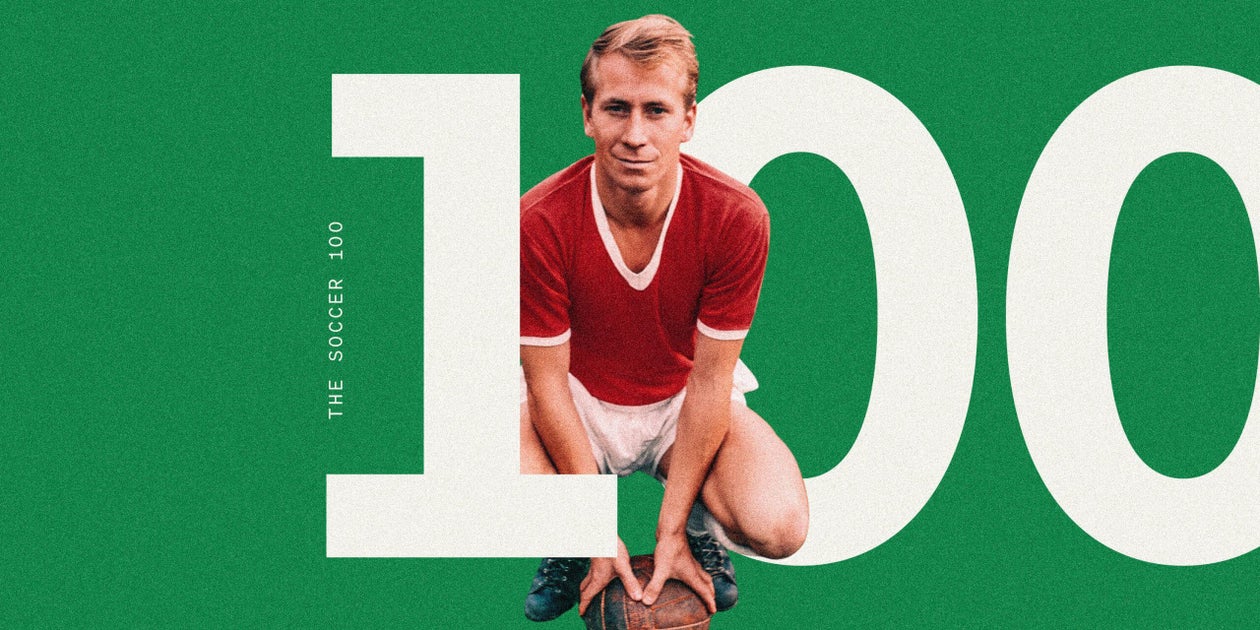
As part of our buildup to the 2026 FIFA men’s World Cup in the United States, Canada and Mexico, we are publishing excerpted chapters from The Soccer 100, The Athletic’s definitive book on the 100 greatest players of all time, courtesy of HarperCollins Publishers.The 10 players we will feature are the highest-ranked World Cup winners of our 100, starting today with the man ranked 20th in our full list, and the greatest ever to wear the England shirt.In the moments before tragedy struck, as the plane hurtled down the runway, Bobby Charlton felt a deep sense of unease. Then came a loud crash. The last thing he remembered was ducking his head to try to protect himself from whatever was going to happen next.The next thing he knew, he was lying on the airfield, still strapped to his seat, which had been catapulted out of the fuselage and across the runway. He turned his head to one side and saw a team-mate, one of his closest friends, looking lifeless. All around him was a scene of chaos, death, and devastation that would haunt him for the rest of his life.He spent the next hours drifting in and out of consciousness: recalling the bitter chill of the air in Munich, the ice and slush on the ground, the smell of the smoke and the burning wreckage; the sound of distressed voices shouting instructions in German and English; the comforting arms of team-mate Harry Gregg, cradling him and then leading him to safety; the blaring sirens of an ambulance, ferrying him and others to hospital; the horrifying suggestion that many lives had been lost.It felt like a nightmare. Make it stop, make it stop.Charlton woke up in a hospital bed. All was quiet now, but the nightmare had been real. A young German man in the next bed was sitting up and reading a newspaper. In broken English, he told Charlton, “I am sorry.”Panicked, Charlton asked who had died. The man read out a list of names: Roger Byrne, David Pegg, Eddie Colman, Tommy Taylor, Billy Whelan, Mark Jones, Geoff Bent — players Charlton had been honoured to perform alongside in a brilliant Manchester United team. Young men he had been honoured to call friends.An eighth team-mate and close friend, the formidably gifted Duncan Edwards, died from his injuries 15 days later. Two other team-mates, Johnny Berry and Jackie Blanchflower, were so badly injured that they never played again. The team’s manager, Matt Busby, suffered multiple injuries and was left fighting for his life before eventually returning and leading United to further glories in one of the most compelling of all sporting tales.The tragic events of February 6, 1958, and their harrowing aftermath would never leave Charlton. He could never come to terms with the injustice that had allowed him to escape with an injury to his head while 23 of the others aboard British European Airways flight 609, which had stopped at Munich to refuel on the way back from a European Cup quarter-final second leg away to Red Star Belgrade (known as Crvena Zvezda today), had lost their lives.“Sometimes it engulfs me with a terrible regret and sadness,” he wrote in Sir Bobby Charlton: My Manchester United Years, “and guilt that I walked away and found so much.”A rescue worker stands next to the debris of the plane that crashed in Munich (Intercontinentale/AFP via Getty Images)Decades later, Charlton would reflect that the Munich air disaster changed him profoundly.Every triumph and every accolade that followed in an extraordinary football career — winning another two league titles, an FA Cup and finally the European Cup with United, 106 appearances and 49 goals for England, winning the World Cup, being crowned European Footballer of the Year — was accompanied by feelings of regret.The survivor’s guilt. “Why me?”The only way he could even begin to rationalise it was by making a silent pledge to shoulder that burden, to play on in his team-mates’ memory, to carry that torch and to ensure that the “Busby Babes” were never forgotten.He was only 20 years old at the time, only 16 months and 32 games into a first-team career that would span almost two decades and see him become a byword not just for sporting longevity but for excellence, integrity, and fair play. When Charlton died in October 2023, at the age of 86, he was widely acclaimed as the greatest English footballer of them all.Charlton didn’t set out to be a standard-bearer. Even before Munich, he was a quiet, shy, self-effacing youngster. He was nothing like his friend Edwards, who, although only a year older, was so sure of himself, both on and off the pitch. Charlton was also the complete opposite of his brother Jack, who was only two years older but had a boisterous, gregarious, uncompromising manner in keeping with the way he played at centre-half for Leeds United and England.Bobby was an introvert who came to life on a football pitch. The venerable British football writer Geoffrey Green described him as a player whose talents had an “elemental quality”. “Jinking, changing feet and direction, turning gracefully on the ball or accelerating through a gap surrendered by a confused enemy,” Green wrote in The Times in November 1969. “He can be gone like the wind.”Bobby Charlton talks to a journalist at his hospital bedside as he recovers following the Munich air disaster (Keystone/Hulton Archive/Getty Images)It is an illuminating description because, watching the highlight reels of Charlton’s playing days, of his most famous goals for United and England, you could be forgiven for imagining him otherwise.Careers in that era are too easily distilled to a few brief clips of grainy black-and-white footage — in Charlton’s case, to a handful of goals, generally struck with sledgehammer force with either foot, calling to mind a particular type of British comic-book hero.Those who played alongside or against Charlton always recalled his talent in very different terms, citing, like Green, his vision, his intelligence, his poise, and a body-swerve that would leave opponents bamboozled, whether he was playing at centre-forward, on the left wing, or in an advanced midfield role in which he excelled in his later career in particular.Jimmy Murphy, United’s assistant manager from 1946 to 1971, called him a player “with the grace of a ballet dancer yet with dynamite in his boots. With the ball at his feet, has there ever been a more graceful mover, able to drift either to the left or right of an opponent with consummate ease?”The numbers are immediately striking.Charlton made 758 appearances for United, scoring 249 goals. Both were records that stood for decades until they were broken by Ryan Giggs and Wayne Rooney, respectively. He remained the England team’s top goalscorer until September 2015, with Rooney again the record breaker (though he has in turn now been overtaken by Harry Kane).But neither the numbers nor the footage can begin to reflect the essence of Charlton’s story as the player who, having witnessed and suffered the most appalling tragedy, had such an integral role in restoring United to preeminence in England, leading them to glory in Europe and inspiring his national team to what remains their only World Cup success.Bobby Charlton raises the Jules Rimet trophy in 1966 (Hulton Archive/Getty Images)On his return from Munich, heartbroken, Charlton sought comfort at his family home in Ashington, the coal-mining town in the northeast of England where he had spent his early years.It has sometimes been claimed that he planned to stay there for good, unable to contemplate a return to Manchester after losing so many of his close friends. “Pals you go to the dance hall with, lads you would have round for dinner at Christmas,” he told reporters in 2008, reflecting ahead of the 50th anniversary of the tragedy.But Charlton’s return to United’s colours was never in doubt, so heightened was his sense of purpose. He did not play again as soon as goalkeeper Gregg and defender Bill Foulkes, who remarkably lined up for an FA Cup tie against Sheffield Wednesday at Old Trafford just 13 days after the tragedy, but he was back within weeks, forced, like Gregg and Foulkes, to live with a post-traumatic burden with no access in those austere post-war days to even the most basic counselling or therapy.A patched-up United team swept to that season’s FA Cup final on a wave of emotion, only to lose to Bolton Wanderers. With Charlton scoring 29 league goals, they almost won the league title the following season, finishing runners-up to Wolverhampton Wanderers, but a period in the doldrums followed as the rebuilding mission faltered. United finished 15th in 1961–62 and 19th a year later, only three points above relegated Manchester City.But FA Cup success in 1963 proved the catalyst to greater glories, along with the acquisition of Denis Law from Torino of Italy and the emergence of the precocious George Best, whose talents on the wing enabled Charlton to return to a central role. United were champions of England again in 1964–65 and 1966–67, which brought the opportunity to compete for the European Cup once more.Charlton’s status as one of the game’s greats was confirmed at the 1966 World Cup. He and England had fallen short of expectations at the same tournament in Chile four years earlier, but on home soil they were inspired under the quietly forceful management of Alf Ramsey. Charlton thrived in an advanced midfield role, scoring with one of those blockbuster shots against Mexico in the group stage and twice in the semi-final against Portugal as he edged his shootout with the great Eusébio.He would describe the final against West Germany as one of his quieter matches; he and Franz Beckenbauer effectively marked each other out of the game, with three-goal Geoff Hurst the hero on the day as England ran out 4-2 winners. But there is a beautiful image of Charlton letting out a rare smile at the final whistle. His brother Jack later recalled him breathlessly saying their lives would never be the same again. Jack laughed and asked what was left for them to win.Bobby and Jack Charlton relaxing ahead of the World Cup final (Terry Fincher/Express/Getty Images)But Bobby still had a personal odyssey to fulfil.He was desperate to win the European Cup — not just for himself or the team-mates he had lost along the way, but for Busby, who had been weighed down by a deep sense of guilt, having defied the English football authorities by leading United into European competition in the first place.Busby was a football romantic. So too, less demonstrably, was Charlton, who had become the on-pitch embodiment of the manager’s vision. Both men were fiercely competitive but they shared a feeling that football was something to be enjoyed — if not always for the players, then certainly for the spectators. Charlton always liked to quote Busby’s line about United having a duty to entertain the factory workers who would show up at Old Trafford on a Saturday afternoon to cheer them on from the terraces at the end of a long, hard week.The Busby ideal reached its apotheosis on May 29, 1968, the night that Charlton, as captain, finally got his hands on the European Cup as United thrashed Benfica 4-1 after extra time at Wembley.When I interviewed Charlton more than four decades later, he played down his involvement, going into great detail about the goals by Best and Brian Kidd that night but glossing over the two he scored himself. “I got the last one,” he said, not thinking to mention that he also scored the first. “I just kind of… helped it on its way.”Talk about modesty. It was a terrific goal, the third in a seven-minute blitz during extra time. Charlton darted toward the near post and produced an instinctive first-time finish to whip Kidd’s low cutback beyond goalkeeper José Henrique and inside the far post. Only Charlton could describe a goal like that as “helping it on its way”.Bobby Charlton holds aloft the European Cup in 1968 (Hulton-Deutsch Collection/CORBIS/Corbis via Getty Images)Amid jubilation at the final whistle, Charlton sought out Busby and embraced him. “Everybody was pleased for the Old Man,” he told me. “It was the end of a story.”A great victory celebration had been arranged in the ballroom at the Russell Hotel in central London. But Charlton didn’t make it. Having got back to the hotel, he broke down, fainting three times as he tried to find the energy to head downstairs to join the party. He was certain it was nothing more than dehydration, but several of his team-mates felt it was something more: a sense of emotional overload as the immediate euphoria wore off and he found himself consumed with thoughts of lost friends and of everything that he, Foulkes, and Busby had been through since that awful day in Munich a decade earlier.“My life, truly, has been a miracle granted to me,” Charlton wrote in the prologue to his book. “But in Munich in 1958, I learnt that even miracles come at a price.”Excerpted from The Soccer 100 by Oliver Kay & James Horncastle with The Athletic Soccer Staff, published by William Morrow. Copyright © 2025 by The Athletic Media Company. Reprinted courtesy of HarperCollins Publishers.
The Soccer 100: Bobby Charlton — How England’s greatest player was changed by the Munich air disaster
In the first of our 10 excerpts from The Soccer 100, we revisit Charlton's journey from Munich to World Cup and European Cup triumphs
2,209 words~10 min read