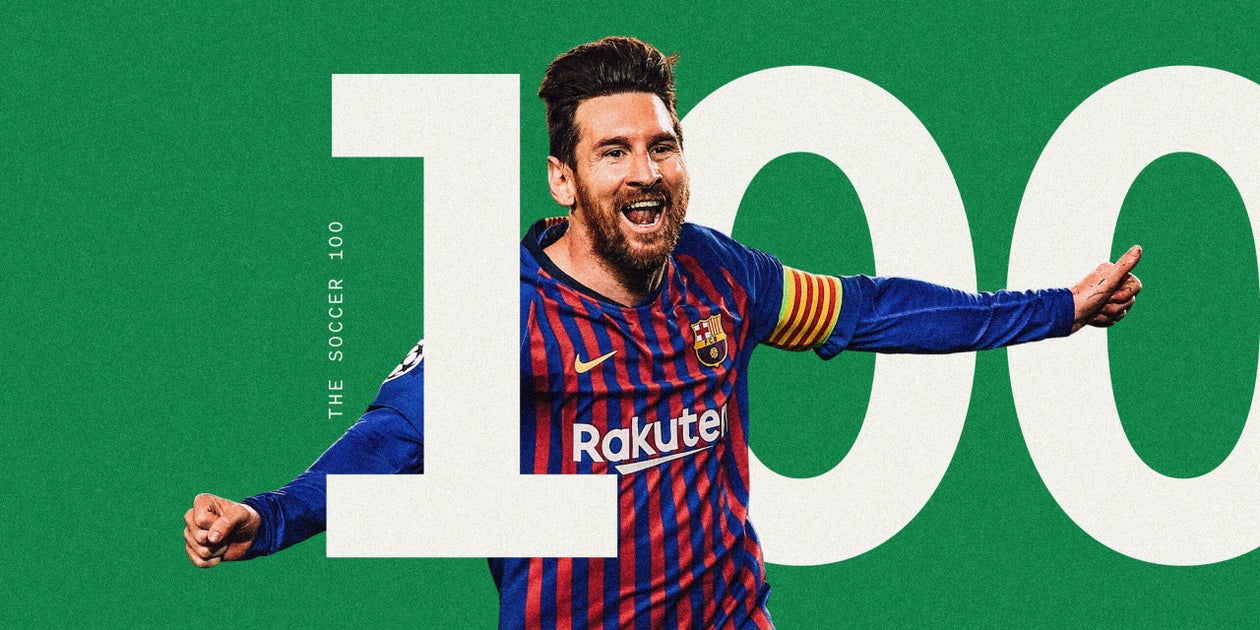
As part of our buildup to the 2026 FIFA men’s World Cup in the United States, Canada and Mexico, we are publishing excerpted chapters from The Soccer 100, The Athletic’s definitive book on the 100 greatest players of all time, courtesy of HarperCollins Publishers.The 10 players we will feature are the highest ranked World Cup winners of our 100. Today, in our final extract, we look at a player who lifted football’s most coveted trophy late in his career — but it was worth the wait.The pantheon of sporting greats is dominated by larger-than-life athletes and larger-than-life personalities, towering figures who looked like they were born to dominate and transcend the sporting landscape: Muhammad Ali, Michael Jordan, Michael Phelps, Tom Brady, Usain Bolt.In that context, it feels all the more remarkable to say that the greatest living footballer — in our collective view, the greatest of all time — is someone who needed growth-hormone treatment to reach a height of 5’7″, an introvert who regards fame and celebrity as the downside of his genius.Lionel Messi doesn’t look like a megastar. At one stage, he barely looked like a footballer.Of all the footballers whose arrival in the big time is heralded in such excited terms — the next Pelé, the next Maradona, the next Cruyff — he looked the most unlikely. Emerging from Barcelona’s academy as a 17-year-old, there was a profound teenage awkwardness about him, as if he had been on a stadium tour with a group of schoolmates, taken a wrong turn, and found himself on the touchline ready to come on as a substitute.Seriously? Him?Then you saw him with the ball at his feet and he took your breath away. The waif with the lank hair and the blank stare played football like you would not believe.Lionel Messi kisses the World Cup after winning the trophy with Argentina in 2022 (Julian Finney/Getty Images)You don’t forget your first time. I had already watched him on television as he established himself in the Barcelona team over the course of the 2005–06 season, but my first time watching him in the flesh came when Messi, still 18, emerged off the bench for Argentina in a group game against Serbia and Montenegro at the 2006 World Cup in Germany.It is a day that sticks in the mind for a variety of reasons: an outstanding 6–0 Argentina victory, a sublime goal that saw Esteban Cambiasso provide the finishing touch to a sweeping 25-pass move, the theatrics of a delirious Diego Maradona in the stands threatening to steal the show.But then came Messi’s cameo — and the sense of quasi-religious fervor that swept the crowd in Gelsenkirchen as he appeared on the touchline. He hadn’t played a competitive match for three months due to a hamstring injury, but that only increased the air of anticipation.It was like we were preparing for the second coming. The sight of Maradona watching from high in the VIP area, clasping his hands together like a proud father and struggling to hold back the tears, only heightened that feeling. Nearby, Messi’s image adorned a huge banner with his legend, Este es mi sueño (This is my dream).Lionel Messi and Diego Maradona, Argentina greats (Juan Mabromata/AFP via Getty Images)In the press box, there was just a little cynicism. What number “next Maradona” was this? There had been Ariel Ortega, Pablo Aimar, Juan Román Riquelme, Marcelo Gallardo, Andrés D’Alessandro, and Javier Saviola, to name but six. Great talents all of them, and some had achieved great things, but none had come close to Maradona’s level. And this kid was going to be different, was he? Seriously? Him?Within two minutes, Messi had scampered down the left wing to set up Hernán Crespo for Argentina’s fourth goal. He scored the sixth himself, threading the ball between the goalkeeper’s legs. But even more than those contributions, it was his adhesive touch and the way he carried the ball. The speed with which he drifted between opponents and into space was something else. Every movement was perfect.I remember writing in the London Times in early 2010, flying home from Barcelona the morning after watching him score four times in an astounding performance against Arsenal in the Champions League, that what Messi was doing at the age of 22 was of a level not seen since Maradona’s heyday in the 1980s. I followed that with a note of caution, pointing out that even Maradona had not been able to sustain such standards throughout his career and that other true greats, such as Marco van Basten and the Brazilian forward Ronaldo, had been thwarted by injury at what proved to be the peak of their powers.We should enjoy Messi’s brilliance for as long as it lasts, I wrote, adding that “experience warns us that this could be as good as it gets.”Hmmm. Experience tells me I shouldn’t have worried.Lionel Messi celebrates scoring against Arsenal in the Champions League of in 2010 (Josep Lago/AFP via Getty Images)Where do you start when it comes to detailing what makes Messi so special?If he was just a goalscorer, the record books at the International Federation of Football History and Statistics tell us he is the second greatest of all time behind Cristiano Ronaldo. But goals have never even been the main feature of Messi’s game, which has instead been defined by his vision, his passing, his dribbling, his creativity.By the time he made his 1,000th career appearance, which he marked with a goal for Argentina against Australia at the 2022 World Cup, he had scored 789 goals and registered 348 assists. At the time of writing, he has won 12 league titles—10 with Barcelona and two with Paris Saint-Germain (plus a Supporters’ Shield with Inter Miami), as well as four Champions League titles (all with Barcelona), the Copa América twice, the World Cup once, and the Ballon d’Or award eight times, finishing as runner-up on another five occasions. The numbers are outrageous, but again, the trophy collection and the goal tally cannot begin to do justice to his talent.Every great athlete has a moment that defines his or her excellence in the public consciousness.In football, Pelé is best recalled for the goals he scored in the 1958 and 1970 World Cup finals; Maradona for the astonishing solo goals he scored against England and Belgium en route to World Cup glory in 1986; Van Basten for that stunning volley against the Soviet Union in the European Championship final in 1988; Zinédine Zidane for his volley for Real Madrid against Bayer Leverkusen in the 2002 Champions League final; Cristiano Ronaldo — though
The Soccer 100: Lionel Messi — The greatest of all time
In the final excerpt from The Soccer 100, we look at the Argentinian who thrived at Barcelona before realising a dream with his country
3,601 words~16 min read