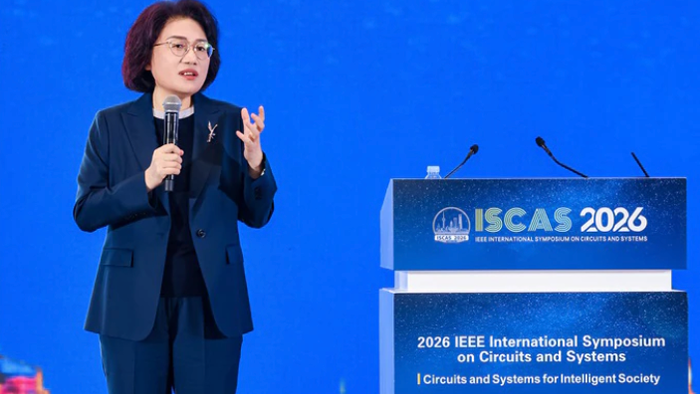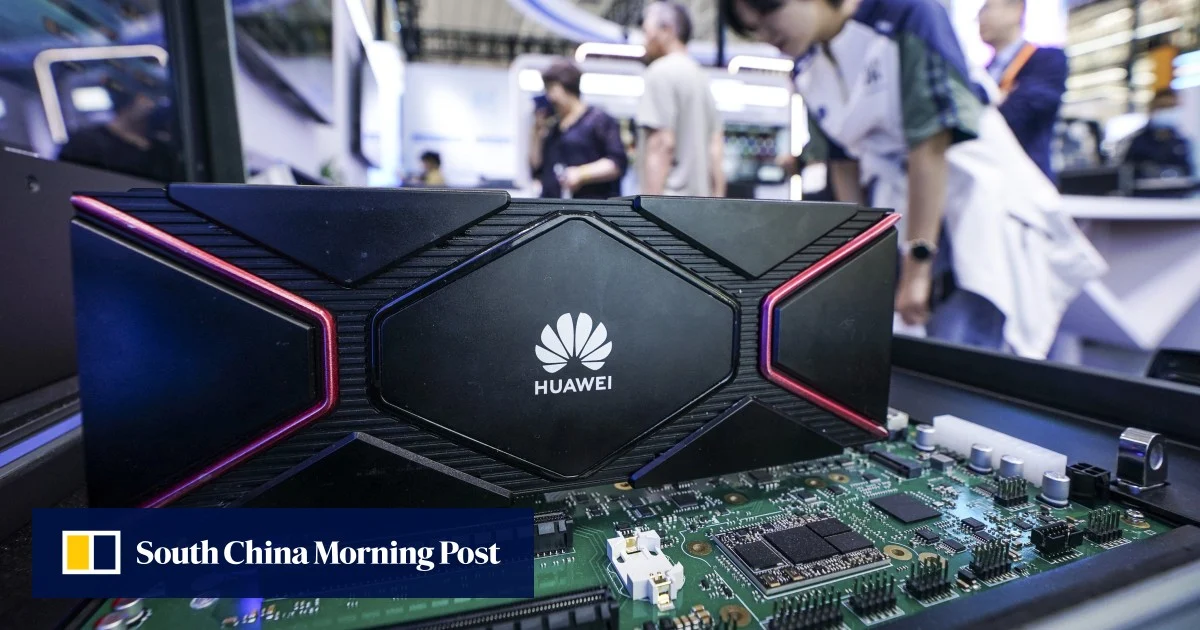
Skip to Content News Archives Economy Energy Oil & Gas Renewables Electric Vehicles Mining Commodities Agriculture Real Estate Mortgages Mortgage Rates Finance Banking Insurance Fintech Cryptocurrency Work Wealth Smart Money Wealth Management Investor Personal Finance Family Finance Retirement Taxes High Net Worth FP Comment Executive Women Puzzmo Newsletters Financial Times Business Essentials More Innovation Information Technology FP500 Podcasts Small Business Lives Told Tails Told Shopping Financial Post Store Obituaries Place a Notice Advertising Advertising With Us Advertising Solutions Postmedia Ad Manager Sponsorship Requests Classifieds Place a Classifieds ad Working Profile Settings My Subscriptions Saved Articles My Offers Newsletters Customer Service FAQ News Economy Energy Mining Real Estate Finance Work Wealth Investor FP Comment Executive Women Puzzmo Newsletters Financial Times Business Essentials HomeInformation TechnologyNewsHuawei touts chip breakthrough to shorten gap with TSMCLast year, Huawei announced a three-year roadmap to roll out a series of AI chips to fill in the vacuum left by NvidiaAuthor of the article:Last updated 1 hour ago You can save this article by registering for free here. Or sign-in if you have an account.While Huawei has continued to improve its technologies, it is unclear whether it will indeed be able to reach the cutting edge of chipmaking by experimenting with a non-mainstream path. Photo by STR/AFP via Getty ImagesHuawei Technologies Co. said it has come up with a new pathway to shorten its gap with industry leader Taiwan Semiconductor Manufacturing Co., potentially achieving a breakthrough in making advanced semiconductors without cutting-edge equipment.Subscribe now to read the latest news in your city and across Canada.Exclusive articles from Barbara Shecter, Joe O'Connor, Gabriel Friedman, and others.Daily content from Financial Times, the world's leading global business publication.Unlimited online access to read articles from Financial Post, National Post and 15 news sites across Canada with one account.National Post ePaper, an electronic replica of the print edition to view on any device, share and comment on.Daily puzzles, including the New York Times Crossword.Subscribe now to read the latest news in your city and across Canada.Exclusive articles from Barbara Shecter, Joe O'Connor, Gabriel Friedman and others.Daily content from Financial Times, the world's leading global business publication.Unlimited online access to read articles from Financial Post, National Post and 15 news sites across Canada with one account.National Post ePaper, an electronic replica of the print edition to view on any device, share and comment on.Daily puzzles, including the New York Times Crossword.Create an account or sign in to continue with your reading experience.Access articles from across Canada with one account.Share your thoughts and join the conversation in the comments.Enjoy additional articles per month.Get email updates from your favourite authors.Create an account or sign in to continue with your reading experience.Access articles from across Canada with one accountShare your thoughts and join the conversation in the commentsEnjoy additional articles per monthGet email updates from your favourite authorsSign In or Create an AccountorRight now there is about a five-year gap between what TSMC is capable of and what Huawei together with its manufacturing partner Semiconductor Manufacturing International Corp. can produce. Huawei will start making 1.4 nanometre chips by 2031 with its own “LogicFolding” technology, Huawei’s semiconductor chief He Tingbo said in a rare public appearance during a chip conference on Monday, while TSMC has said that it will begin mass production of the same product in 2028.The executive said that her team has found a way for “sustainable evolution.” She told reporters after her speech on Monday that Huawei can advance its chipmaking prowess significantly without the use of Dutch supplier ASML Holding NV’s extreme ultraviolet lithography machines, widely considered as essential for production of cutting-edge semiconductors that China doesn’t have access to.Breaking business news, incisive views, must-reads and market signals. Weekdays by 9 a.m.By signing up you consent to receive the above newsletter from Postmedia Network Inc.A welcome email is on its way. If you don't see it, please check your junk folder.The next issue of Posthaste will soon be in your inbox.We encountered an issue signing you up. Please try againHe added that the Kirin mobile chips to be launched this fall will be the first to adopt the LogicFolding architecture, which helps boost performance of a chip by increasing the number of transistors it carries and optimizing data transmission speed.“This year we have prepared a surprise for the whole industry. Not saturation, not continuation, but a big leap ahead,” she said.The Star 50 Index in Shanghai, which includes several major Chinese chip firms, rose to a record after He’s announcement on Monday. Shares of SMIC rose more than 18 per cent while foundry peer Hua Hong Semiconductor Ltd. surged by the daily limit of 20 per cent.If Huawei can manage to make 1.4 nanometre semiconductors in large quantities, it means it’s defying the industry consensus that ASML’s EUV lithography machines are necessary to mass-produce chips that are 5nm or more advanced. Such semiconductors are used to power the most sophisticated AI technologies.The nanometer measure is used to indicate the size of transistors on a chip. The smaller a transistor becomes, the more can be fitted on a chip, which in turn will become more powerful. ASML’s EUV machines are seen as essential in shrinking transistors, and they are used widely by leading global chipmakers including TSMC, Samsung Electronics Co. and Intel Corp. for mass production.Huawei’s He added that the LogicFolding architecture is based on Huawei’s own Tau Scaling Law, a principle the Chinese company is adopting to rival Moore’s Law, the guideline for the global chip industry for decades. Moore’s Law, named after Intel co-founder Gordon Moore, is an extrapolation that the numbers of transistors in a chip will roughly double about every two years, though many in the industry including He say the cadence has been slowing down in recent years.He said that Huawei’s scaling efforts based on Moore’s Law plateaued six years ago after United States export controls hit. Her team then proposed a new “time scaling” method to replace the global industry’s gold standard. Huawei’s new principle appears to focus on boosting data transmission speed by transistors to compensate for a lack of state-of-the-art equipment to shrink those components significantly further.“We saw time scaling can deliver strong benefits across devices, circuits, chips and systems,” He said, adding that Huawei has designed and made 381 chips over the past six years based on the Tau Scaling Law. Huawei in a separate statement said that the company is dubbing its new principle “Her’s Law,” in a nod to its chip chief.The Tau Scaling Law is a summary of some current trends in the semiconductor industry, but it appears to be the first attempt by a company to formulate these ideas into a coherent theory, according to Kitty Fok, managing director of research firm IDC China.“It may also provide a new reference point for China’s semiconductor industry in overcoming process-node constraints,” Fok said.The Shenzhen firm has previously filed for patents that show it is trying so-called self-aligned quadruple patterning, or SAQP, that may allow it to produce advanced chips without ASML’s EUV machines. Quadruple patterning is a technique for etching lines on silicon wafers multiple times to increase transistor density — and therefore performance.While Huawei has continued to improve its technologies over the past few years, it is unclear whether it will indeed be able to reach the cutting edge of chipmaking by experimenting with a non-mainstream path.Huawei has been at the vanguard of Beijing’s semiconductor self-sufficiency drive following a years-long U.S.-led, multinational campaign to tighten exports of advanced chips and gear that have somewhat curbed China’s AI progress.In September, Huawei announced a three-year roadmap to roll out a series of AI chips to fill in the vacuum left by Nvidia Corp., whose most advanced semiconductors are banned for China.—With assistance from Kelly Li. Join the Conversation This website uses cookies to personalize your content (including ads), and allows us to analyze our traffic. Read more about cookies here. By continuing to use our site, you agree to our Terms of Use and Privacy Policy.
Huawei touts chip breakthrough to shorten gap with TSMC
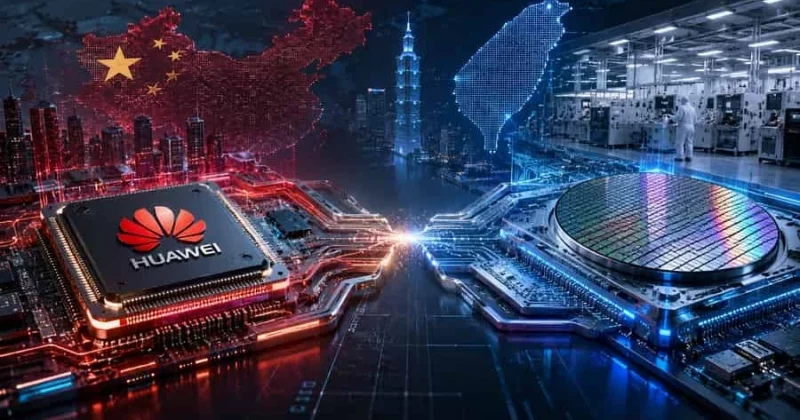
Huawei Technologies Co. has come up with a pathway to shorten its gap with industry leader Taiwan Semiconductor Manufacturing Co. Read here
1,331 words~6 min read