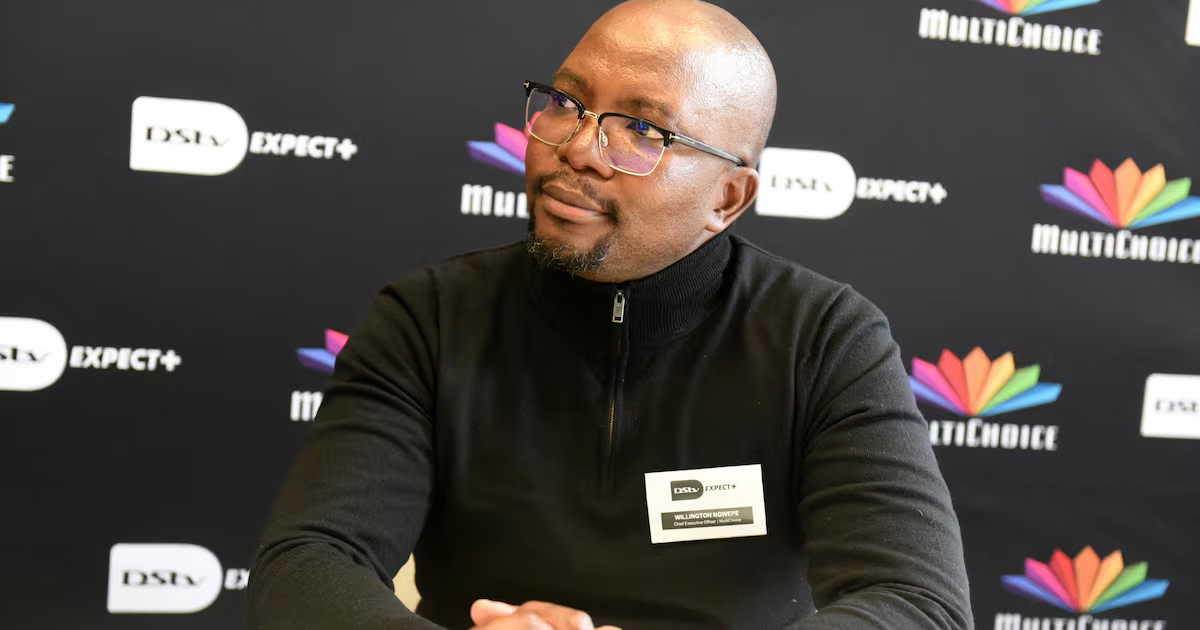
For years former MultiChoice CEO and chair Nolo Letele used to repeat the phrase “I wish we had competition so people could know how good we are”.I’m often reminded of it whenever the broadcaster is in the news, and especially when people complain about what is objectively one of the world’s best broadcast television offerings.I’ve travelled enough in the past 20 years to see what pay-television looks like in the rest of the world, especially the US, UK and Europe. What we have been getting from MultiChoice is impressive, especially the sport. Like Discovery, MultiChoice is a home-grown success story many South Africans love to hate. You see the same weird grumbles about both of them even as they provide truly world-class services. What MultiChoice does with satellite broadcast is technically complex, vastly expensive and highly efficient.Before streaming became our default form of entertainment (if you’re lucky enough to live in a well-resourced urban area and can afford the cost of the connectivity), the only way to get the high-quality DStv service was via satellite. It takes a lot of technical know-how to bounce a signal up and back down and hit that little white dish on the wall. Only severe weather tended to interfere with that.The storms DStv hasn’t weathered have been the rapid arrival of American streaming services and the evolution of its own packages, which have always pushed customers to the pricier premium bouquet. That is still the home to all the premium sport (especially the Springboks and international rugby, F1, golf and tennis) and all the other channels, but is now R800 a month. If you still want it all, this is where you get it.There are now five packages, at R100, R300, R400, R500 and R800, offering a combination of channels, including R400 sports and R500 “movies & series” options. Most noteworthy is the much-asked-for sports package for R400, which includes the UK’s Premier League, UEFA, our PSL, cricket and local rugby.“I don’t think you can find all of those sports for $25,” says Byron du Plessis, CEO of MultiChoice PayTV South Africa division. He’s right. That is a soccer lover’s ideal bouquet. (If nothing else, DStv has taught the country what the word bouquet means.)MultiChoice is calling this its biggest change in 15 years. It’s probably that long overdue. At this week’s launch several MultiChoice executives conceded the broadcaster could have done it sooner. I know it has been discussing this internally for over a decade, based on my own conversations with people involved. This week a former contractor told me about a similar new package strategy when he did some work for the Randburg-based giant 10 years ago.The ridiculous gamble taken on the now-shuttered Showmax to revamp its backend (R4.9bn spent for the year ending March 2025, dragging MultiChoice’s profit down 49% to R4bn) was a decidedly poor strategic decision. It was a needlessly desperate Hail Mary that backfired. That kind of rusty monopolist thinking appears to have been swept away with the Canal+ takeover. This week’s announcement saw its executives openly admit they waited too long for this restructuring.Splitting the once-imperious premium package into sports, movies and series themes is a good move. Not everyone loves sports nor wants to watch the soapies, so they can now choose their flavour. It has worked for other broadcasters around the world, but their streaming services (be it Netflix, Prime, Disney+ or Apple TV) generally include only the TV shows and movies. None offer live news, and there’s only a smidgen of sport ― beyond glossy sports documentaries, good as they are. Who knew watching rugby player Ellis Genge eating a wrap while driving one-handedly around London could be so watchable?Meanwhile, DStv’s Stream app works well. I often use it to watch the news or rugby. When I chanced upon Tom Hanks’ amazing World War 2 series on the History channel I used the app, rather than the decoder, to find and watch it. I “record” rugby games on my phone’s app and watch them later on my TV at home. That app now comes pre-installed on Samsung TVs, just like the big-name streamers.The once-imperious decoder is long-in-the-tooth now and its interface is clunky and slow compared with the slickness of its own app alone. But you have to remember that people in bandwidth-rich urban areas with disposable income have fewer challenges than a farm, lodge or mine when it comes to getting quality entertainment.South Africans often fail to appreciate the world-class service they get because, as Letele so often lamented, there was never anything else to measure it against. Now, with international streamers there is a benchmark, albeit limited because it doesn’t carry the two costliest services, news and sport.There is also no underestimating the contribution MultiChoice has made to the local film and TV industry, having created numerous shows and careers. Being a counterbalance to the SABC has also been important, not least because it is a better payer than the state broadcaster.MultiChoice has built up a vast library of content, that ghastly catchall word we now all use for what was once called scriptwriting or directing. That’s what you’re paying for when you take the movies & series or premium packages, as much as BBC Earth and Springboks rugby.A lack of decent leadership at the SABC means its vast troves of its own historical shows haven’t been used as well. But the lack of strategy and vision at the SABC is for another column.This week, if not a humbled MultiChoice we saw a less arrogant one. Like all monopolists, it has tried to hang on to its dominance for too long. And, like many monopolists, only when significant competition (and, in this case, new owners) arrived did it change its strategy.As Apple’s Steve Jobs so famously said: “If you don’t cannibalise yourself, someone else will.”• Shapshak is editor-in-chief of Stuff.co.za.
TOBY SHAPSHAK | DStv’s new packages have been a long time coming
With competition from streamers MultiChoice has unbundled its premium package ― mostly
978 words~4 min read