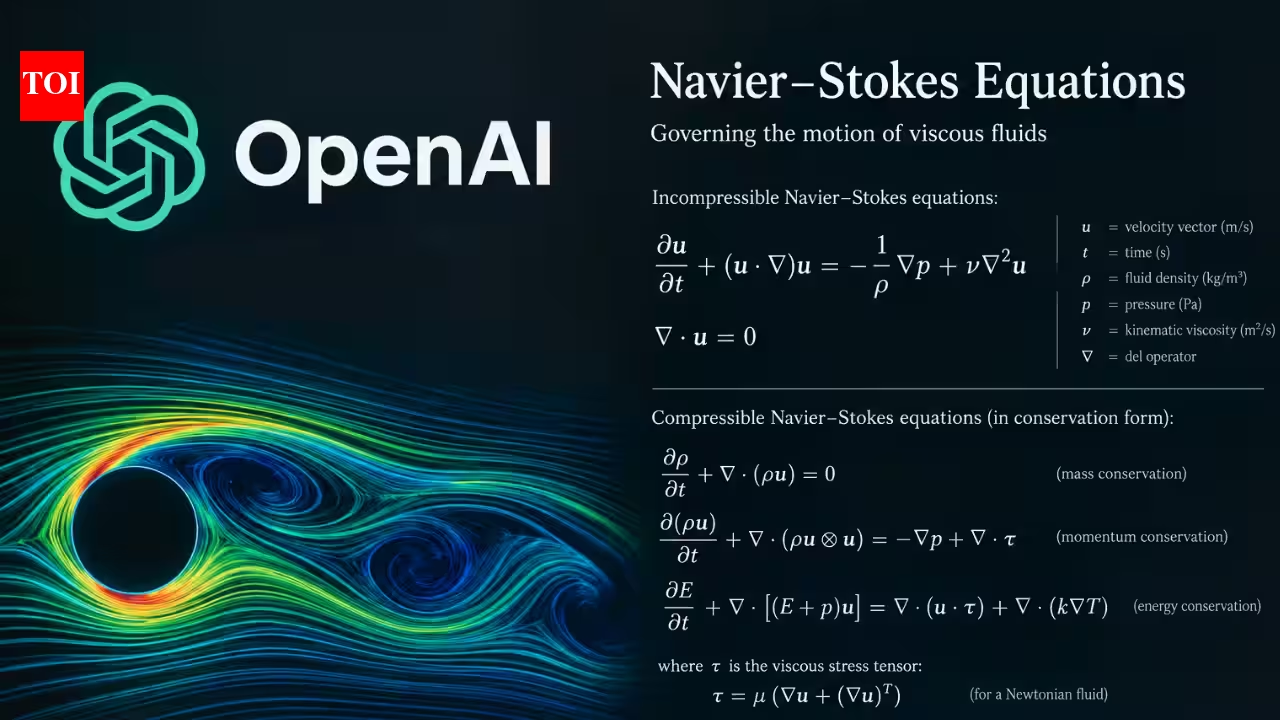
OpenAI today announced an internal AI system solved the Navier–Stokes existence and smoothness problem, one of the seven notoriously challenging Millennium Prize Problems in mathematics that has remained unsolved since its introduction 26 years ago, using a coordinated system that involved roughly 10,000 concurrent AI agents.The problem, named for 19th-century mathematicians Claude-Louis Navier and George Gabriel Stokes, asks a basic but extremely difficult question about equations used to describe how fluids such as air and water move: can a fluid that starts out behaving smoothly eventually develop a mathematical breakdown?OpenAI says its system produced a new proof showing that, under certain conditions, a smoothly moving three-dimensional fluid can reach a point where its calculated speed grows without limit in a finite amount of time. In practical terms, that would mean the equations themselves eventually stop providing a physically meaningful description of the fluid. But OpenAI's announcement also comes with a dispute over how the work was produced and who should receive credit. An NYU mathematician involved in closely related AI-assisted research released a statement on Mastodon last night, prior to OpenAI's announcement, questioning whether the company's model could have been trained on or otherwise benefited from research he and a collaborator from Anthropic had conducted in part using Codex, OpenAI's coding and work-focused AI harness and application. OpenAI initially told VentureBeat that neither its researchers nor AI systems searched user data to solve the problem. In a subsequent public statement, however, the company added an important qualification: while it says no specific user data was accessed to produce the solution, it “cannot rule out” that de-identified data derived from the researchers' use of OpenAI products helped improve its modelsAsked directly by VentureBeat during a video press briefing earlier today whether OpenAI or its agents had accessed Codex results from the outside researchers, OpenAI Chief Research Officer Mark Chen replied: " No people or AI systems searched through user data to solve this problem or any specific problem that we were trying. And I'm a little bit disappointed by the allegations of the huge breach of user trust. We we did not do that." Yet later today on X, OpenAI posted a statement reading in part: "We (the researchers and the agents) did not see any of their work through any means until they released it publicly — in particular, no specific user data was accessed in order to solve this problem.
OpenAI solves longstanding math problem with 10,000-agent swarm — but can't rule out benefitting from a researcher's private Codex data
As companies entrust AI systems with increasingly valuable intellectual property, the policies governing model training, retention and access become part of the technical architecture, not simply language in a privacy statement.
3,171 words~14 min read