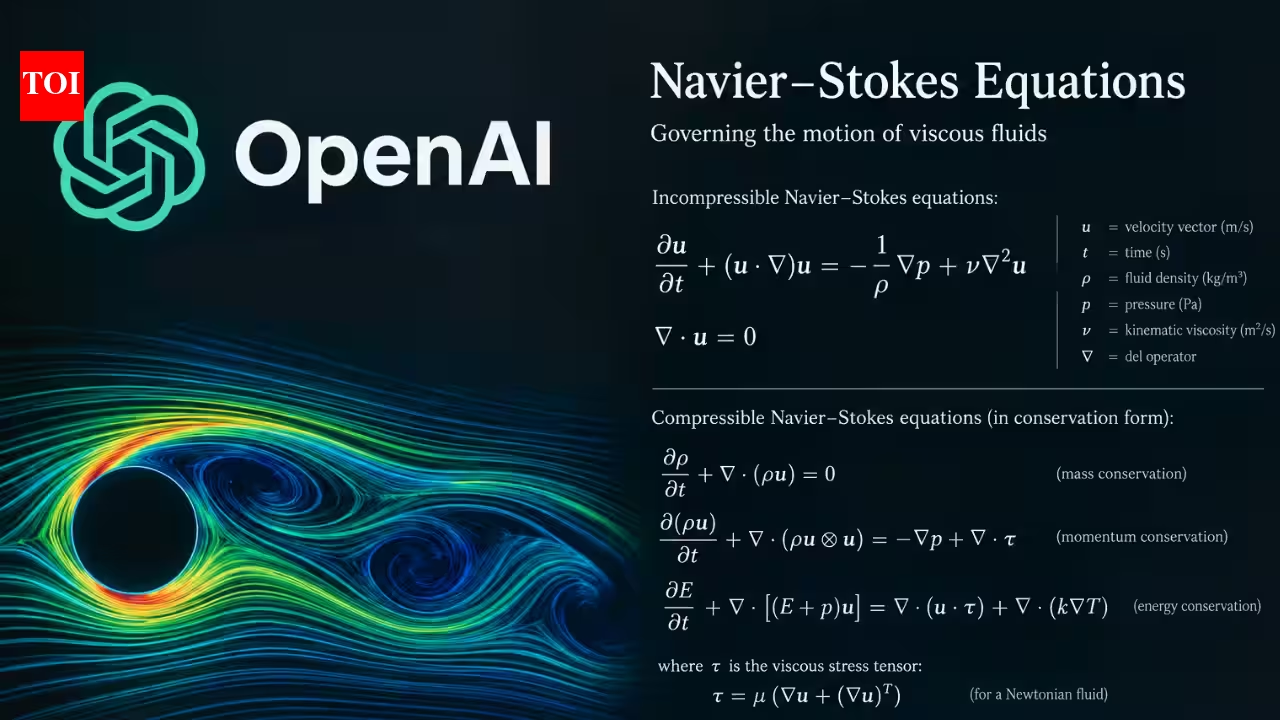
Nature reported that the proof shows the equations, the most commonly used physical model of fluids, can break down: an initially smooth three-dimensional fluid develops a singularity in finite time, with part of it accelerating without bound.
OpenAI said the result establishes statements C and D of the official problem formulation, and released a written proof and a Lean formalization for outside researchers to check.
The effort began Sept. 1, after OpenAI researchers heard rumors that two Millennium problems had fallen elsewhere.
Roughly 100 agents spent about 50 hours disproving regularity for the simpler Euler equations, then some 10,000 agents worked 88 hours on the full Navier-Stokes system, with a further 17 hours for a second model to verify the result in Lean.
The agents exchanged almost five million messages across the project, and executives told reporters the computing bill ran into the millions of dollars.