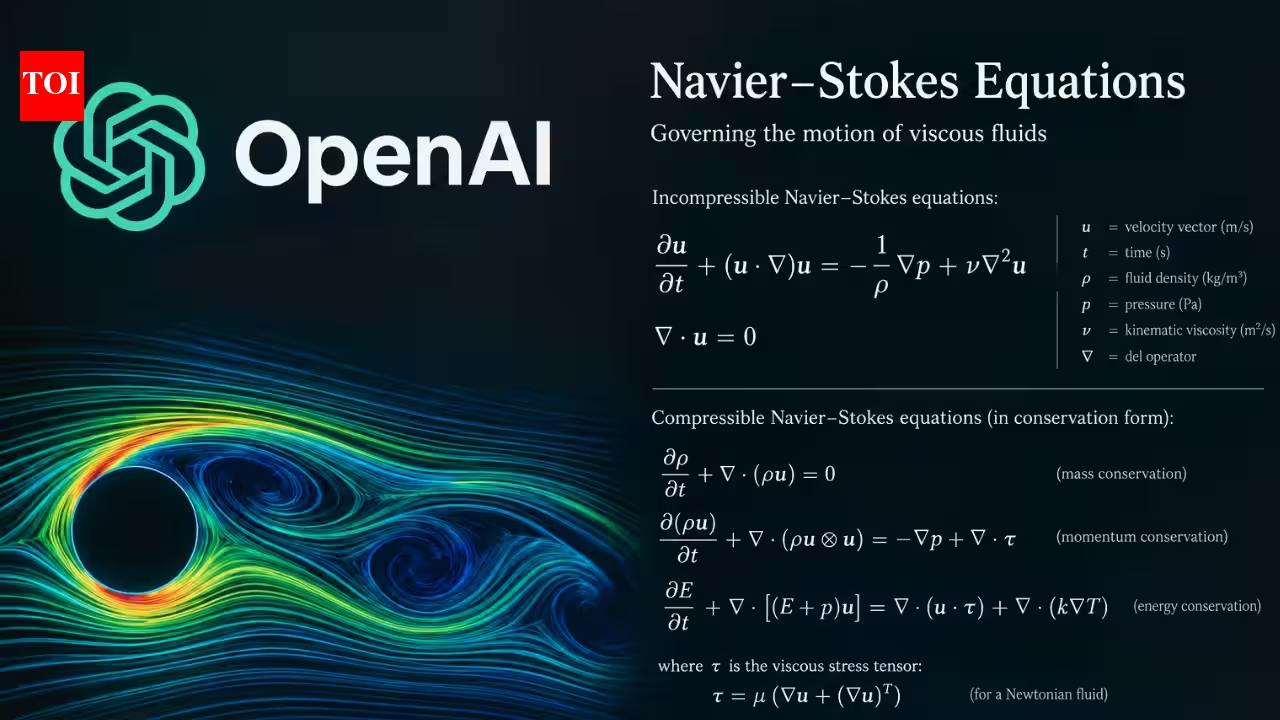
On September 8, 2026, OpenAI published a paper claiming that an internal, unreleased AI system had made progress on one of the seven Millennium Prize Problems: the Navier–Stokes existence and smoothness problem. The announcement got a lot of attention fast, partly because of the result itself, and partly because of how it was produced — a coordinated swarm of roughly 10,000 AI agents working in parallel.
As developers, we've all seen "AI solves impossible problem" headlines before, and most of them fall apart under scrutiny. This one is more interesting than most, but it also comes with real caveats that are worth understanding before you repeat the claim anywhere. Here's a breakdown of what was actually done, how the multi-agent workflow worked, and why the story isn't as clean as the headline suggests.
The problem
The Navier–Stokes equations describe how fluids move — they're used in weather forecasting, aircraft design, and blood flow modeling, among other things. They work great in practice. What's never been settled mathematically is whether, under the right conditions, a smooth three-dimensional fluid flow could spontaneously "blow up" — meaning some property like velocity shoots to infinity in a finite amount of time, breaking the model.