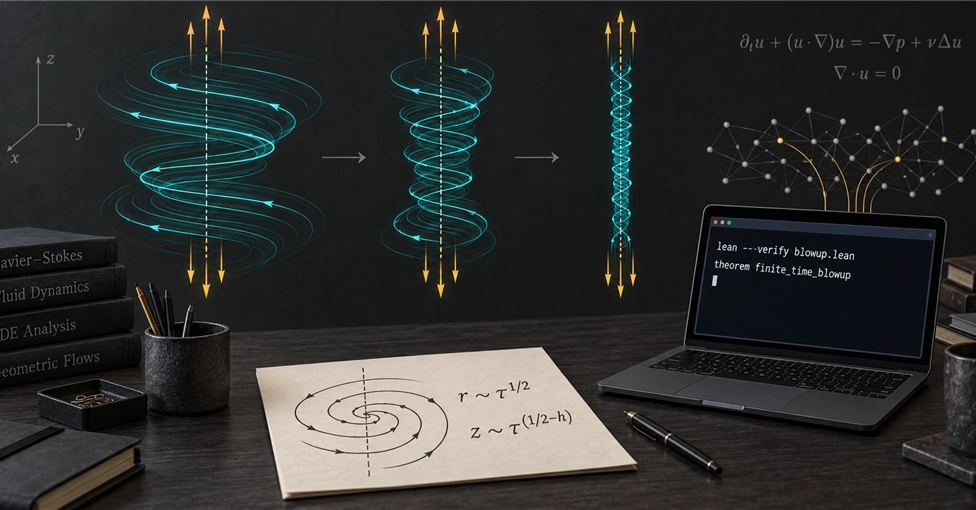
On 8 September OpenAI published a proof that the three-dimensional incompressible Navier–Stokes equations can develop a singularity in finite time: a smooth fluid, starting from rest under a smooth external force, whose speed grows without bound while its total energy stays finite. The proof comes as a 166-page paper and a Lean formalization. That is the negative resolution of the Navier–Stokes Millennium Prize problem as Clay wrote it, ninety years after Leray.
The coverage has been about the million dollars and about who got there first. Both of those are better questions than the coverage makes them, and neither is the most interesting thing here. Five things, none of which fits in a headline: which model did it, what exactly "breaks" and for whom, why the solution is one you can draw on a napkin, what happens to the theorems that had been waiting on this answer, and who the prize would belong to if anyone claimed it.
It wasn't Astra
The proof did not come from GPT-6 Astra, the model OpenAI released five days earlier. It came from an internal model that has been training since 28 August and that OpenAI describes as "significantly more capable than GPT-6 Astra", with "unprecedented performance in our benchmarks, including mathematics". Training is still ongoing. OpenAI does not call it a mathematics model; the jump it reports is across its benchmarks, with mathematics among them. Astra's only role in the story was the last step: it produced the Lean formalization and verification in 17 hours.