New CPU and GPU designs chase lower latency and richer games within a 1 W power budget
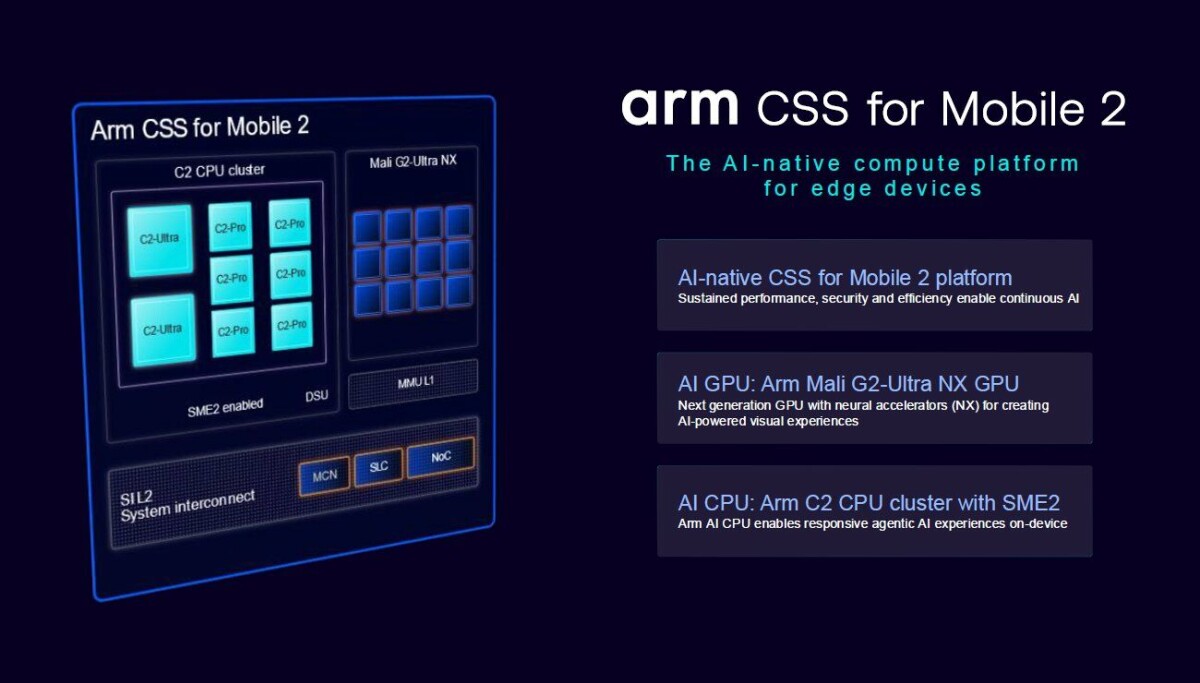
Arm's latest smartphone platform is optimized for running AI agents on mobile devices and introduces neural graphics that it claims can deliver desktop-class gaming within a smartphone's power constraints.Announced at the Arm Everywhere China event in Shanghai today, Compute Subsystem (CSS) for Mobile 2 succeeds last year's Lumex CSS and reflects Arm's embrace of AI as a strategy for future growth.Arm sees itself as central to this shift, arguing that AI workloads currently run largely in the cloud but will increasingly move to devices at the network edge.
"When every interaction has to travel to a datacenter and back, there's implications for latency, connectivity, the cost of delivering those services at enormous scale, so this is where we're seeing it becoming more distributed, and I think few doubt now that basically everything you can push to the edge you will," says Arm's EVP of Edge AI, Chris Bergey.
AI has evolved from background capabilities such as speech recognition and image processing into tools people actively engage with, including generative assistants, Bergey claims. Agentic AI goes further by interpreting objectives, coordinating applications and models, and executing sequences of actions."So you have repeated inference, application logic, system orchestration, multiple workloads operating concurrently, and so that means you don't just need more CPU performance. You need multiple high-performance CPUs working in parallel to keep all those different workloads running," Bergey explains.