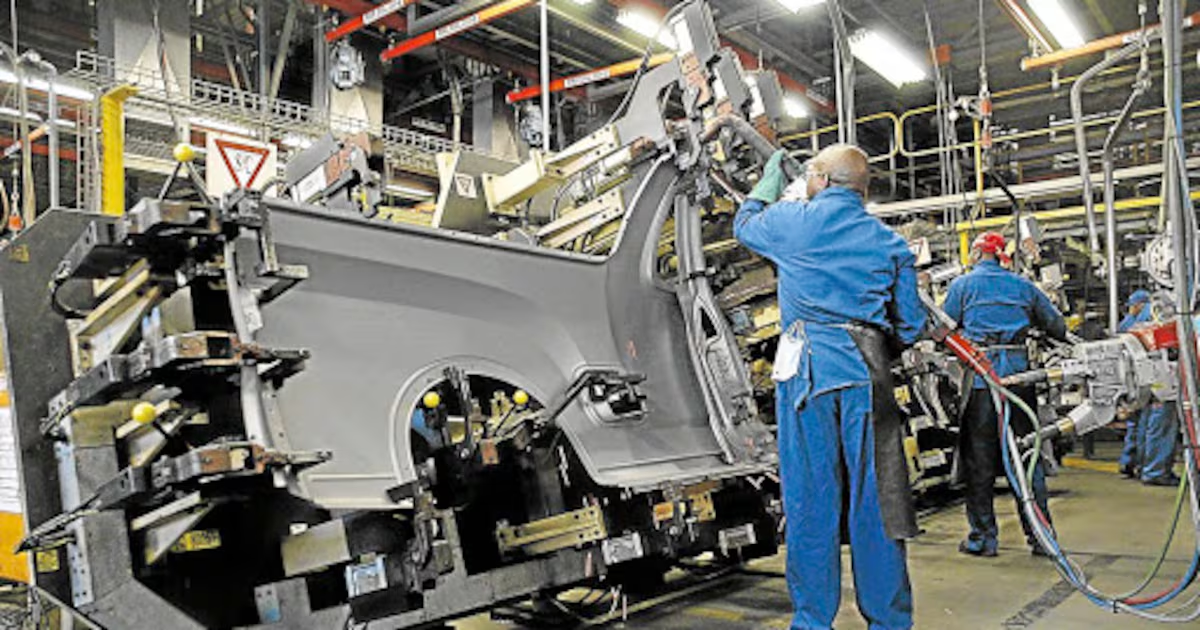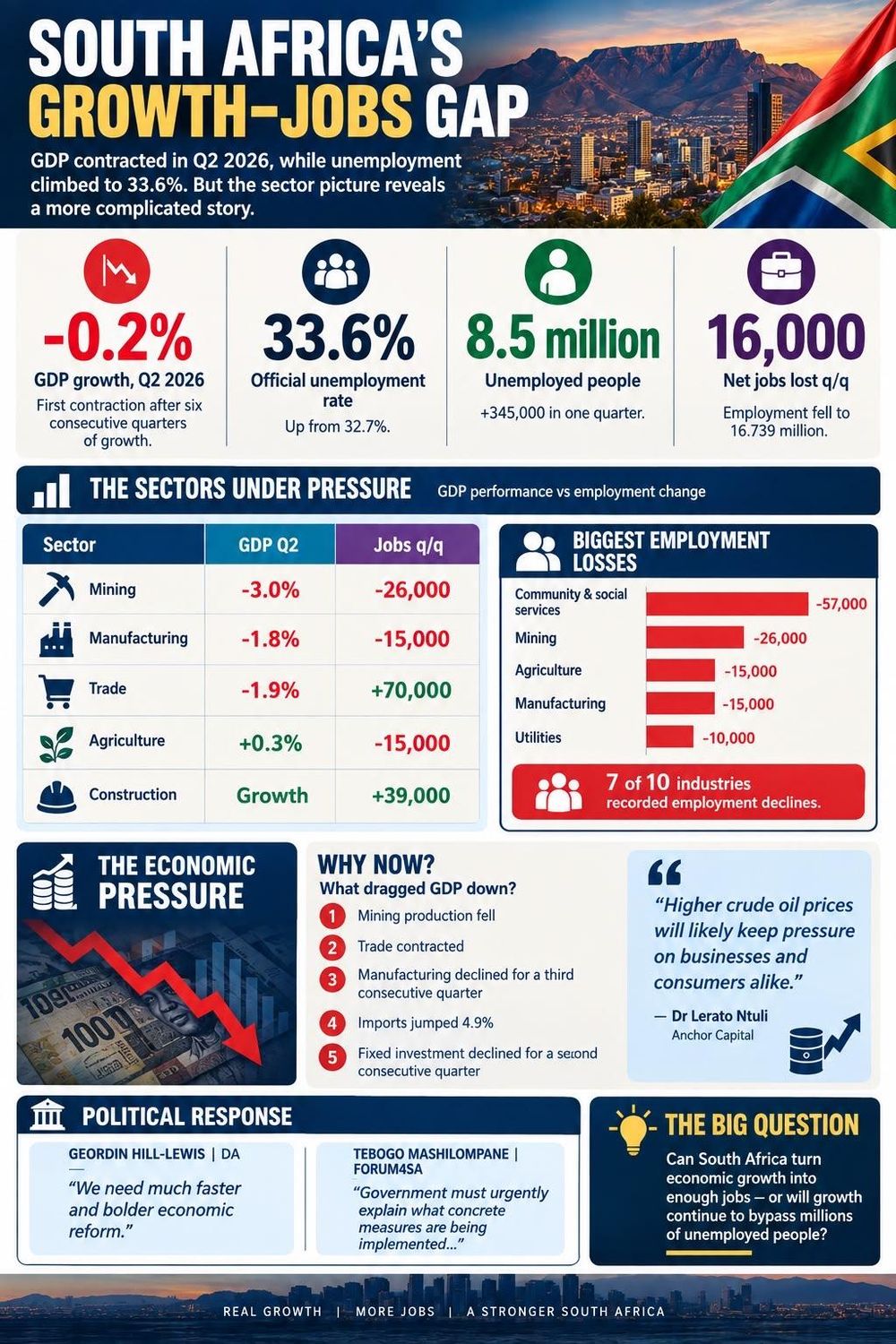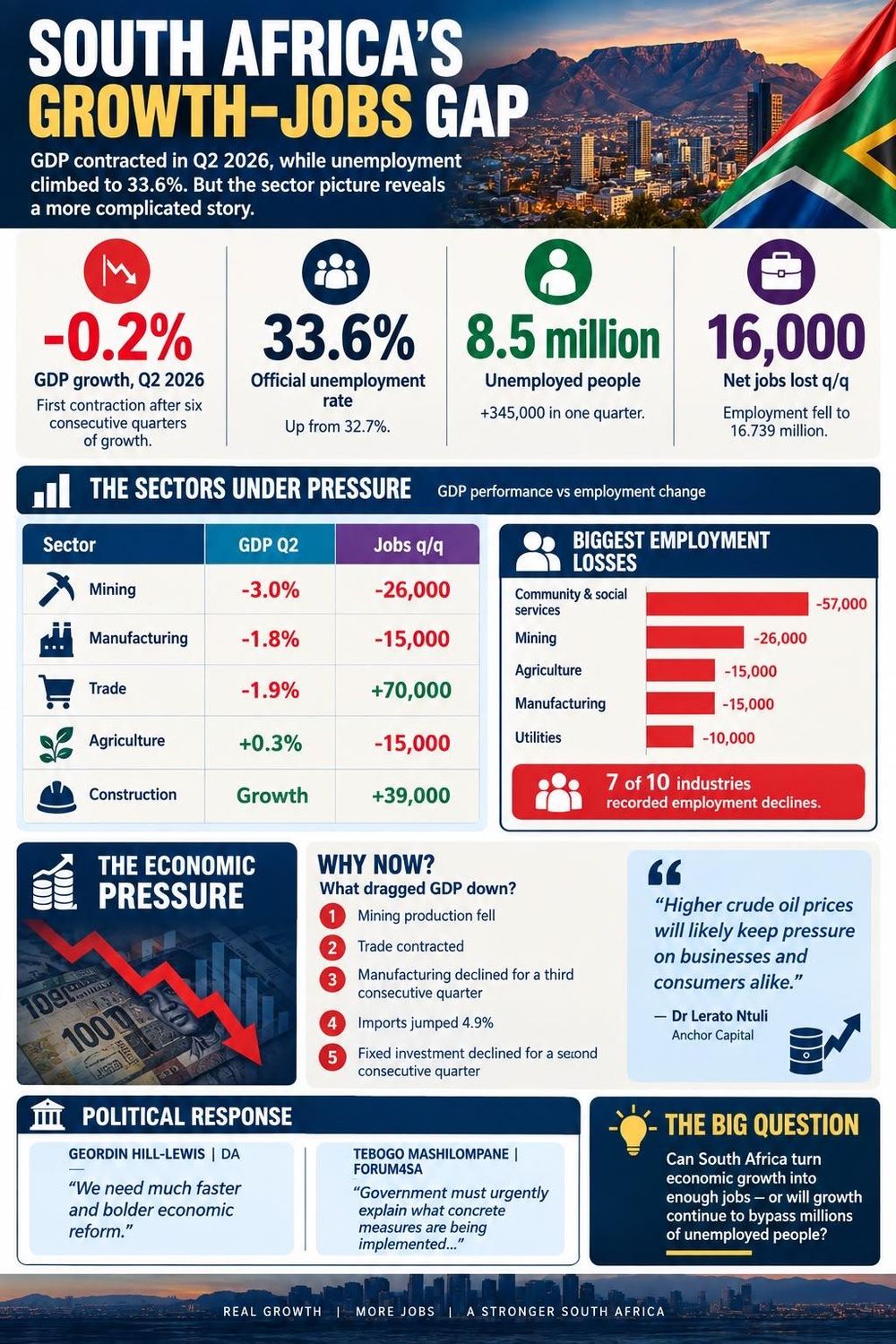
Stats SA’s second-quarter GDP growth data on Tuesday will be the highlight of a fairly data-heavy week, offering a summary of how weak demand and rising costs linked to oil market turbulence have affected the domestic economy.Economists are expecting output to have remained stagnant or to have shrunk slightly in the second quarter after expanding by just 0.5% in the first three months of the year, when it was held back largely by a weak manufacturing performance.“Growth likely moderated materially in 2Q26, as the negative effects of the external shock reverberated across the domestic economy,” FNB said in its weekly economic report, citing a cumulative increase in domestic fuel prices of R7.76 a litre for petrol and R9.39 for diesel during the second quarter.“Goods-producing sectors were particularly weak, with manufacturing, mining and electricity production all recording quarterly declines on a seasonally adjusted basis. Given their importance to the economy, these sectors are likely to have weighed on overall GDP growth,” it added, forecasting GDP growth of around 0% quarter on quarter or even marginally lower.Investec economist Lara Hodes also predicted flat growth with a chance of a mild contraction, while Nedbank analysts Busisiwe Nkonki and Isaac Matshego expected a 0.2% contraction.“High-frequency indicators point to weakness in mining, manufacturing, electricity, gas and water, and domestic trade. In contrast, agriculture and parts of the services sector likely continued to support overall economic activity,” Nkonki and Matshego said.“Household consumption expenditure is expected to have expanded by only around 0.1%, as higher fuel prices and broader inflationary pressures constrained consumer spending. Fixed investment is also likely to weigh on growth.”Read: Locked out: why townships struggle to do businessTwo big sources of uncertainty for the GDP number will be the agriculture and services sectors, Absa economists Miyelani Maluleke and Sello Sekele said. In the case of the former they cited the inherent volatility of gross value added estimates which measure the total economic value generated by farming, forestry, and fishing after subtracting the cost of intermediate inputs like seeds, fertiliser and fuel.They noted that in services, major sectors such as finance and personal services, which account for about 36% of GDP, have no high-frequency data, “making it difficult to track intra-quarter momentum”.On Tuesday deputy finance minister David Masondo will deliver the keynote speech at Bain’s Financial Crime and Sanctions Risk Forum. As the financial industry undergoes a huge transition — including continued regulation changes, rising costs and expectations, and enhanced AI capabilities — the event will provide an opportunity to identify lasting, practical solutions, organisers said.On Thursday, the South African Reserve Bank will publish the current account of the balance of payments for the period ending June. The surplus on the account — which records the flow of money in and out of the country through imports and exports, investment earnings and foreign aid — widened to 2.4% of GDP in the first quarter from 0.6% in the final three months of 2025, its highest level in nearly five years. Nedbank expects it to swing to a deficit of 1.2% in the second quarter, largely reflecting a narrower trade surplus as imports increased faster than exports.Stats SA will publish July production and sales data for the mining and manufacturing sectors, indicating whether the woes that dogged both industries in the first half of the year extended into the second.Manufacturing production fell 1.7% year on year in June after a 4.4% contraction in May, while mining output contracted further by 2.7% following a 5.1% slip as the output of coal, iron ore and platinum group metals fell sharply.“July mining and manufacturing production … will provide some of the first hard activity data for the new quarter and help assess whether conditions began to stabilise after a weak Q2,” said Katrien Smuts, an analyst at the Bureau for Economic Research (BER).On Thursday to Friday, Trade Conference International will host another forum on financial crime. The 11th edition of the annual Anti-money-laundering and Financial Crime Southern Africa conference will bring together regulators, financial institutions, compliance professionals, risk practitioners, law enforcement agencies, technology providers and industry experts to discuss the latest developments shaping the fight against the scourge.Also on Thursday, FNB and the BER will publish their building confidence index for the third quarter. The index declined in the second quarter as weaker activity, rising input costs, and softer demand and ongoing contraction in building investment weighed on sentiment and profitability across the construction sector.Business Day
ECONOMIC WEEK AHEAD | GDP contraction on the cards as fuel costs bite
Economists expect economy to have been stagnant or shrunk slightly in second quarter
737 words~3 min read